What Is That in the Sky? Field Guide
Start with what the light did, not what it seemed to be.
- Fixed or moving? Compare the light with a roofline or nearby star for at least 30 seconds.
- Time the event. A one-second streak, six-minute pass, and ten-minute spiral point to very different causes.
- Record context. Exact time, location, direction, and original images make identification far more reliable.
- Most reports resolve. Official investigations close 94-97% of cases to known astronomical or artificial causes.
Most lights in the sky can be sorted with a small set of measurable observations: brightness, angular size and speed, position, color, timing, and whether the light changes when it reaches Earth’s shadow. This is the same discrimination framework aerospace investigators use—the first job is classification, not guessing a name.
What should you check first?
Anchor the object against something stable. A roof edge, utility pole, or known star reveals real motion and reduces the autokinetic illusion, in which a fixed point of light against a featureless dark background appears to dart, hover, or drift even though it never moved. This single perceptual quirk is behind a large share of “maneuvering light” reports.
- Brightness (apparent magnitude): the scale runs backward and logarithmic—each step is about 2.512× brighter. The full Moon is −12.6, Venus can reach −4.9, Sirius peaks at −1.46. Anything flaring past −8 rules out ordinary aviation.
- Angular size and speed: without depth perception, degrees-per-second is the only usable measure of speed. A meteor crosses the sky in a fraction of a second; the ISS takes about six minutes; a fixed star or planet takes none at all.
- Position and direction: altitude above the horizon, compass direction, and path relative to background stars. Satellites travel west-to-east or pole-to-pole—a steady east-to-west light is almost never a satellite.
- Color, pattern, and periodicity: steady white favors reflected sunlight; discrete red/green/white strobes favor aircraft; rhythmic flashing favors tumbling debris catching the sun.
- Scintillation, sound, and shadow behavior: point sources (stars) twinkle hard; extended disks (planets) barely do. Delayed engine noise favors aircraft; sound arriving with the flash favors an electrophonic fireball. A smooth fade to orange, then nothing, is the signature of a satellite crossing into Earth’s shadow.
How do the common categories compare?
| What you see | Likely category | Best clue |
|---|---|---|
| Fixed, chaotic color flashes | Bright star | Twinkle strengthens near the horizon |
| Fixed, very bright, mostly steady | Planet | Usually lies near the zodiac |
| Smooth white point for 3–15 minutes | Satellite | May fade orange into shadow |
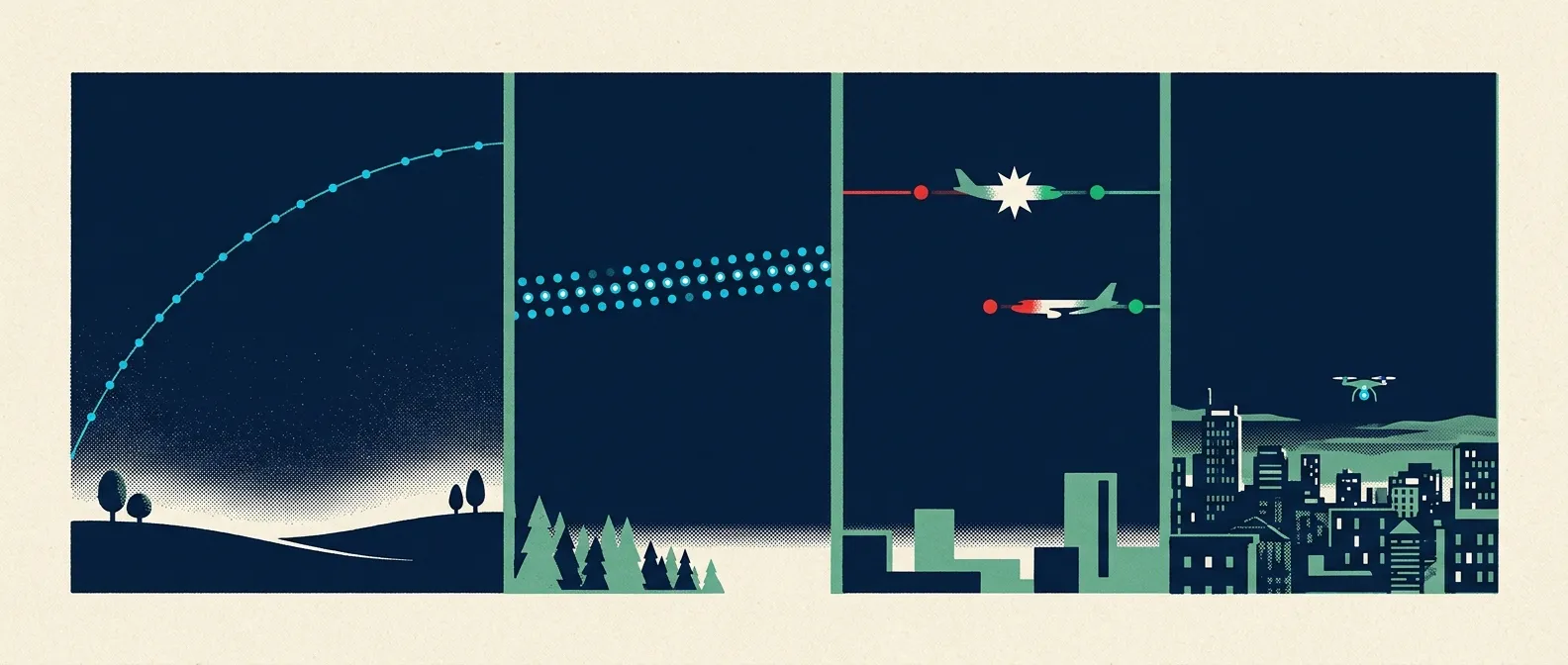
| Straight line of evenly spaced points | Starlink train | Only in the weeks after a launch, before spreading out |
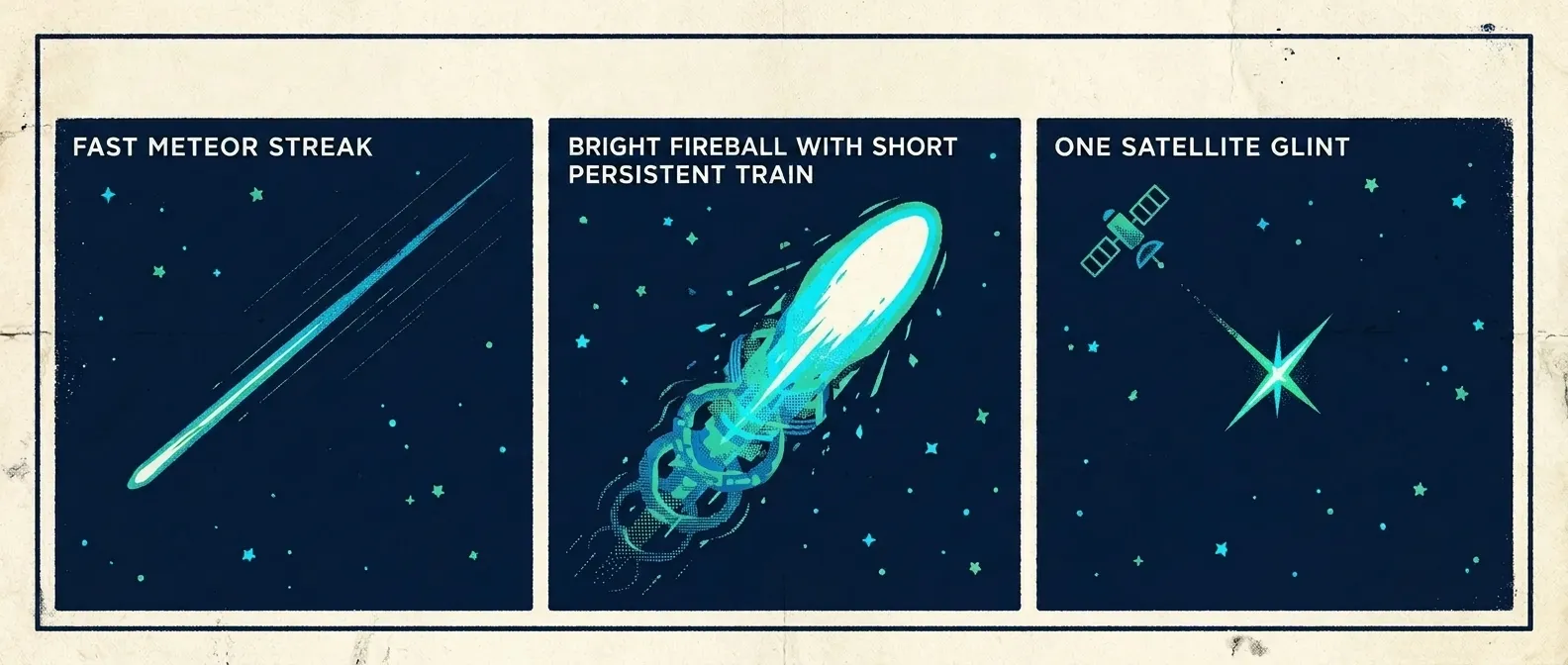
| Sudden flare to about magnitude −8 | Satellite glint | Brief, silent, over in 5–20 seconds |
| Regular red, green, or white flashes | Aircraft or drone | Rhythmic navigation lights, engine noise arrives late |
| Fast streak under three seconds | Meteor | Very high apparent speed |
| Slow fragmented procession | Re-entry | Parallel pieces over 20–90+ seconds |
| Large plume or spiral at twilight | Rocket event | Sunlit exhaust high above darkness |
| Broad transparent glow, stars visible through it | Atmospheric light | Aurora, airglow, or light pillar |
Fixed lights: is it a star or a planet?
The single most common source of “UFO” reports is not a craft at all—it’s Venus. Before dashcams and phone cameras were everywhere, Venus alone accounted for roughly half of recorded UFO sightings. Hanging low near the horizon during twilight, with no bright neighboring stars for scale, its light passes through the thickest air, flashes with prismatic color, and falls prey to the autokinetic illusion.
Stars are effectively point sources, so turbulent air makes them scintillate hard; a planet’s tiny disk spans several atmospheric cells whose fluctuations partly cancel, so it glows more steadily. That makes twinkle a useful clue, not an absolute rule—Sirius can flash red, green, and blue low on the horizon, and Venus can shimmer too. The full method, plus a table of which planet is visible when, is in the star-versus-planet guide.
Moving lights: satellite, plane, or drone?
Low Earth orbit now holds over 14,500 active satellites, the large majority of them Starlink. A single satellite crosses the sky as a smooth, silent, unblinking point—the ISS is the brightest example, reaching magnitude −5.9 and taking about six minutes end to end. Freshly launched Starlink batches instead appear as a straight, evenly spaced “train” of lights before they climb to operating altitude and spread apart. Geostationary satellites add brief seasonal “glints” near the equinoxes; the retired Iridium constellation once produced flares up to magnitude −8, dozens of times brighter than Venus.
Aircraft and drones look different up close: FAA-mandated strobe colors (red port, green starboard, white tail) blink on a strict rhythm, and engine noise always arrives after the light, never with it. The full comparison, including how a satellite fades to orange at the shadow line, is in the satellite-vs-plane-vs-drone guide.
Rocket launches, spirals, and re-entries
A launch or upper-stage maneuver near dawn or dusk can produce a “space jellyfish”—a glowing bulbous cloud from sunlit exhaust expanding in the near-vacuum of the upper atmosphere—or a slow, precise spiral, when a spinning stage vents leftover propellant that freezes into an illuminated vortex lasting up to ten or twelve minutes. Both have shown up repeatedly over the western US and Europe after Falcon 9 missions.
Natural meteor
- 11–72 km/s
- Usually under three seconds
- Single streak or terminal burst
Artificial re-entry
- About 7–8 km/s
- Often 20–90+ seconds
- Slow parallel fragmentation train
A controlled re-entry is steered into a remote ocean target and looks brief and localized; an uncontrolled one drifts in for months, then breaks up along a long, shallow, horizontal path. The full breakdown of plumes, spirals, and re-entry types is in the rocket launch and re-entry guide.
Meteors, fireballs, and satellite flares
Duration is the fastest filter for a brief flash. Ordinary meteors burn up in well under three seconds at 11 to 72 km/s. A fireball is any meteor brighter than magnitude −4 (brighter than Venus); a bolide tops −14 and can end in an explosive airburst. The rarest and strangest confirmed effect is electrophonic sound—hissing or crackling heard at the exact instant of the flash, not minutes later, produced when VLF radio waves from an intensely bright fireball vibrate objects near the observer.
A satellite glint, by contrast, is a brief brightening from an otherwise stationary or slow-moving point, over in 5-20 seconds. The full duration table and how to rule out a flare is in the meteor-vs-fireball-vs-flare guide.
Glowing clouds and atmospheric sky glows
Not everything overhead is a point of light. Auroras emit strict spectral lines—557.7 nm green, 630.0 nm red—dictated by atomic physics, while the rarer STEVE phenomenon is a continuous-spectrum purple ribbon produced by hot plasma, not particle bombardment, and can appear far from the poles. Airglow, zodiacal light, noctilucent clouds, and light pillars formed by ice crystals reflecting ground lighting round out the diffuse, non-point-source category that stars remain visible through.
Each of these has a distinct color signature and season. The full identification guide is in glowing clouds and sky glows explained.
Could it just be a constellation?
A stable group of stars can look like a formation of hovering, silent craft to someone unfamiliar with the pattern, especially when the autokinetic illusion makes the whole group seem to shift together. Learning a handful of anchor stars and asterisms removes this category almost entirely. The recognition method is in why that “UFO” might be a constellation.
What can a phone photo actually prove?
A photo can preserve background stars for plate solving, but computational photography also invents misleading shapes. Night-mode stacking segments a blinking aircraft into a solid dashed cylinder; lens reflections mirror a bright source across the optical center; rolling shutters turn fast motion into curved streaks; JPEG compression builds blocky edges around bright points; out-of-focus bokeh takes the shape of the lens aperture (a hexagonal aperture produces a hexagonal “craft”). Keep the original file, and take a second frame from a different position if you can.
When EXIF metadata survives, it can date- and location-stamp an image outright; when it’s stripped (as most social platforms do), astrometric plate solving against visible stars is the strongest remaining forensic tool. The full artifact catalog is in camera artifacts vs. a real anomaly.
What do official investigations actually find?
The pattern holds across every rigorous dataset. The US Air Force’s Project Blue Book (1952-1969) resolved 11,917 of 12,618 cases—about 94%—to known astronomical, atmospheric, or aircraft causes, leaving 5.5% unidentified. France’s GEIPAN currently splits reports into four tiers: roughly 28% perfectly identified, 39% probably identified, 30% unresolved for lack of data, and only about 3% genuinely unexplained after full analysis. The Pentagon’s modern AARO office resolved 370 cases in its FY2025 report, with 238 of those newly attributed to satellite flares once better 3D modeling came online.
The consistent takeaway: better data and better modeling keep shrinking the unexplained fraction, not growing it. The full breakdown by agency and year is in what official UFO investigations actually found.
Reference data: NASA’s ISS reference, AARO’s FY2025 report, CNES GEIPAN statistics, and the US Air Force’s Project Blue Book fact sheet.
For the light above you right now, open Astro and point your phone at the sky.
Open the live sky