Sky Photo Artifacts vs Real Anomalies
A smartphone night photo is a product of computational stacking, AI segmentation, and optical geometry—not an unvarnished slice of time.
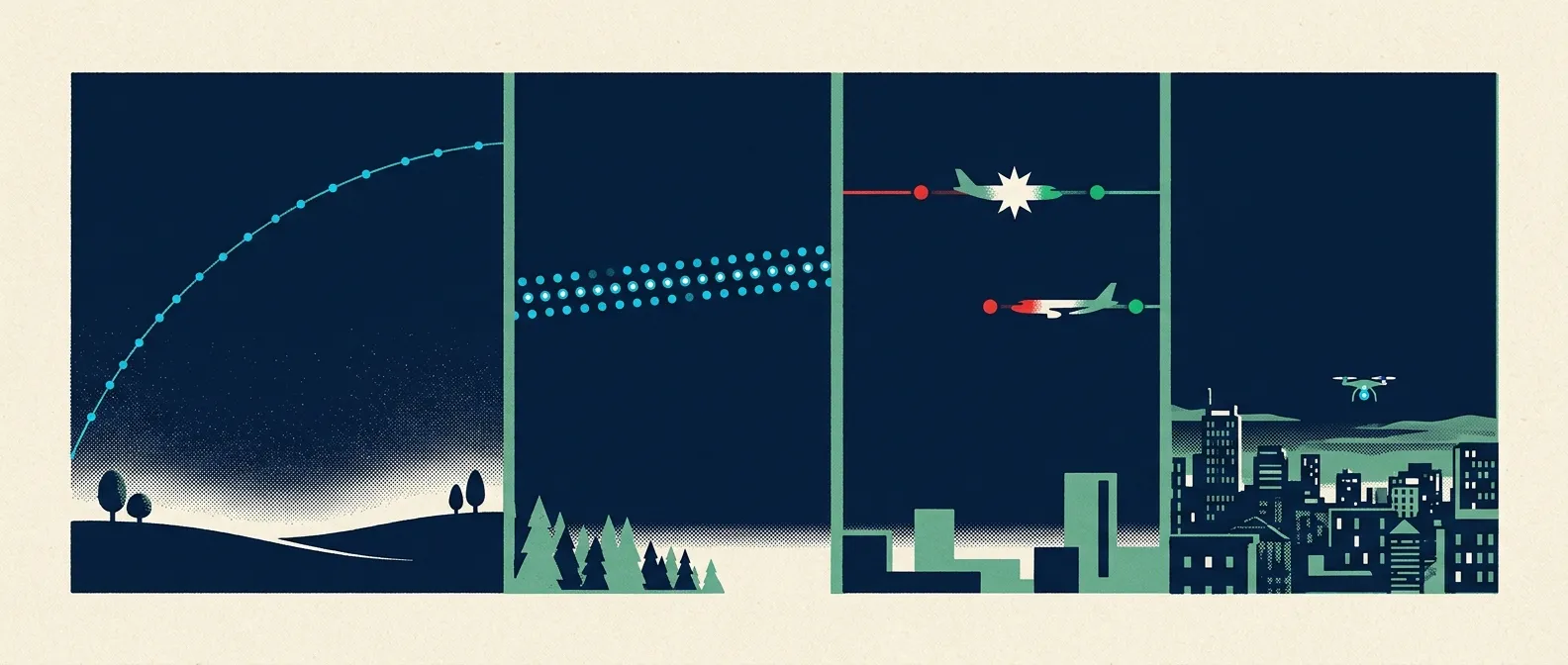
- Lens flares exhibit mirror symmetry. Internal ghost reflections (like the iPhone green dot) sit directly opposite bright light sources pivoted around the frame center.
- Rolling shutters segment flashing lights. Line-by-line CMOS readout (5–25 ms) splits blinking aircraft strobes into series of floating dashed lines.
- Hot pixels stay fixed in sensor coordinates. A single-pixel dot that remains in the exact same pixel position across multiple frames is a sensor thermal defect, not a moving object.
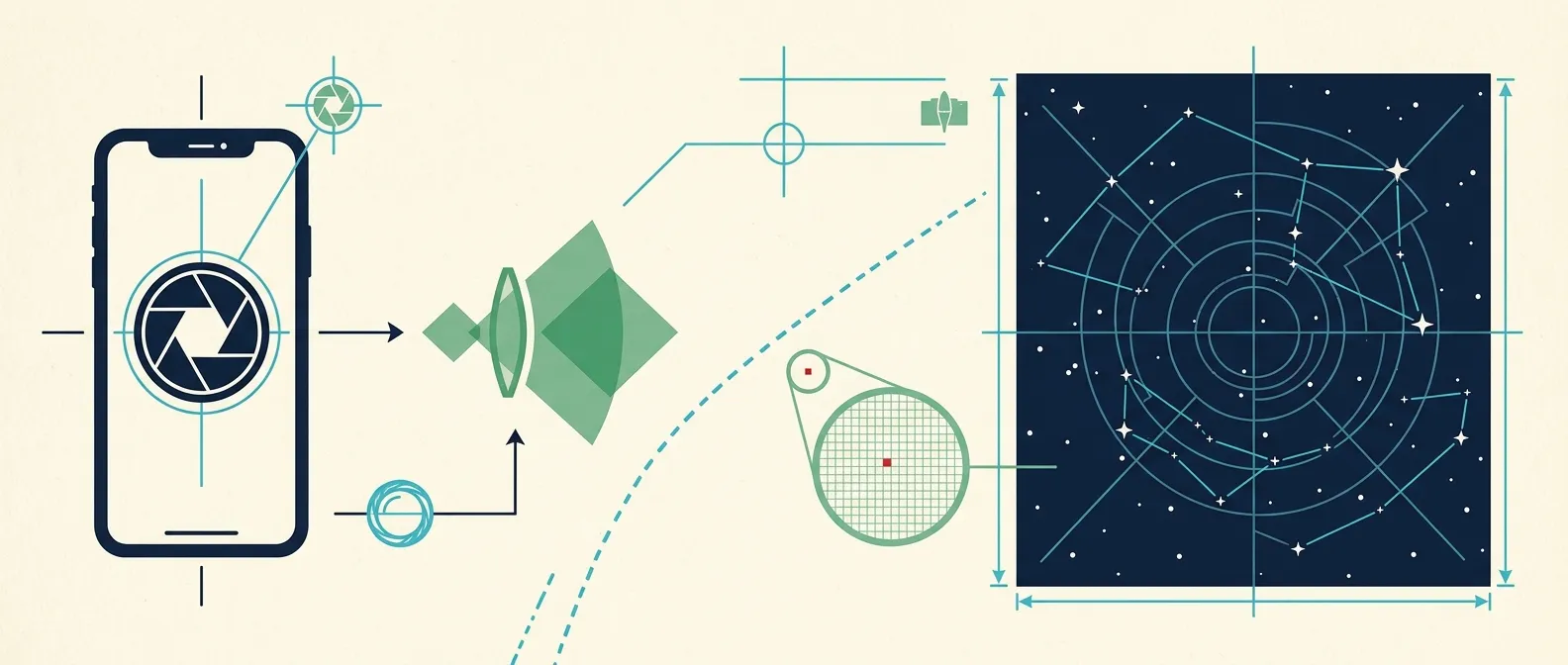
- Plate solving locks camera geometry. Algorithmic star-field matching against catalogs (Gaia, USNO-B) confirms exact camera pointing direction and field of view.
When you take a night-mode photo with a smartphone, you are initiating an aggressive computational pipeline. Algorithms stack multiple exposures, align frames, denoise dark areas, sharpen edges, and apply AI sky optimization before saving the file.
While this process reveals faint stars and auroras, it also creates ghosts, halos, dashed lines, and geometric block noise that observers mistake for anomalous craft. For real moving sky objects, consult our moving lights guide. To analyze a photographic anomaly, use this field guide to computational pipelines, lens physics, sensor defects, and astrometric plate solving.
The smartphone night-imaging pipeline
Modern smartphone cameras overcome small physical sensors through multi-frame burst integration and AI segmentation:
- Exposure Stacking & Integration: Night Mode captures a rapid sequence of sub-exposures (e.g. Pixel astrophotography combines 15 × 16s = 4 minutes; iPhone Night Mode 10s handheld up to 30s on a tripod). Alignment algorithms using motion vectors ensure stars remain sharp, but moving transients (satellites or planes) can be rendered as disjointed, segmented lines.
- Sharpening Halos: On-device tone mapping over-corrects boundaries between dark objects (like tree branches) and night sky, producing glowing white/cyan outlines often mistaken for atmospheric plasma.
- Denoising & “Star Eater” Filters: Spatial noise-reduction algorithms mistake faint pinpoint stars for sensor noise, systematically erasing faint celestial bodies or blurring star clusters.
- Semantic AI Segmentation: Scene optimizers slice photos into sky and foreground layers, applying generative enhancement. Samsung “Space Zoom” tests proved AI neural nets overlay high-resolution crater textures when detecting a white lunar disc, demonstrating computational AI can fabricate textures not present in the optical path.
Optical aberrations: lens flares, smudges, and dew
Before light reaches the sensor, it passes through the multi-element lens array:
Lens Flare Symmetry
- Light reflects internally between lens surfaces
- Pivots around exact optical center of the frame
- Ghost lies at mirror-opposite coordinates from source
- e.g., streetlight in bottom-left → green dot in top-right
Smudges & Anamorphic Streaks
- Directional fingerprint grease acts as a diffraction grating
- Stretches point sources into long streaks
- Streak is perpendicular to smudge direction
- All lights in frame share the exact same flare angle
Additionally, environmental dew on cold glass causes point sources to bloom into featureless glowing “orbs,” while multi-lens anamorphic attachments squeeze point lights into broad horizontal streaks across the frame.
Sensor-level anomalies: hot pixels, amp glow, and cosmic rays
High ISO gain and extended exposures push CMOS photodiodes to their thermal and electronic limits:
| Sensor Artifact | Physical Cause | Visual Appearance & Diagnostic |
|---|---|---|
| Stuck / Hot Pixel | Manufacturing defect / thermal dark current saturation | Single-pixel white or RGB dot in the exact same pixel coordinates across all photos |
| Amp Glow | Heat/NIR radiation from sensor readout circuitry | Magenta or purple gradient glowing inward from frame edges/corners |
| Cosmic Ray Hit | High-energy muon depositing 0.2–1 MeV charge in silicon | Sharp bright dot or tiny track appearing in a single frame with zero continuity |
| Banding Noise | Column amplifier transistor voltage variance | Structured horizontal/vertical grid visible when shadow levels are boosted |
| Color Clipping | Bayer matrix channel saturation (Sirius green clips first) | Overexposed bright white stars render as glowing cyan or magenta dots |
Temporal artifacts: rolling shutter and “flying rods”
Consumer sensors read data line-by-line (rolling shutter) rather than simultaneously (global shutter), taking 5 to 25 milliseconds per frame readout.
When an FAA-mandated aircraft strobe (flashing 40–100 times/minute) is captured by a rolling shutter or Night Mode exposure stack, the blinking light is sampled on separate scan lines, producing a series of floating, segmented dashed lines across the sky.
Similarly, the infamous “flying rod” (or skyfish) anomaly was debunked as a simple rolling shutter artifact: an ordinary insect flying near the lens during a 1/30s exposure has its body recorded as a continuous motion blur while its rapid wingbeats form undulating sine-wave fins along the sides.
Data compression degradation and JPEG block noise
JPEG/HEIC compression uses Discrete Cosine Transform (DCT) quantization to divide images into 8×8 pixel blocks (Minimum Coding Units). Discarding high-frequency data around high-contrast light points creates “mosquito noise” halos.
When an image is downloaded, cropped, and re-uploaded across social platforms, it undergoes generational loss. The 8×8 DCT compression grid compounds, compressing its own artifacts. Aggressively brightening dark areas of a low-quality viral JPEG reveals rigid, blocky “hull structures” that are actually 8×8 JPEG macroblocking artifacts, not a physical spacecraft.
To detect digital forgery, analysts use Error Level Analysis (ELA) to highlight differential compression errors. Modern camera systems are transitioning to C2PA cryptographic provenance, embedding digital signatures at capture time to irrevocably verify hardware origin and edit history.
Forensic analysis: Plate solving and EXIF metadata
While EXIF metadata provides basic camera settings (ISO, exposure time, aperture, GPS), it can be edited or corrupted by system clock drift.
The gold standard for night-sky image verification is astrometric plate solving (using engines like Astrometry.net). Plate solving extracts the star field from an image, generates geometric hashes of star clusters, and matches them against catalogs like Gaia or USNO-B. This locks the exact pointing direction (Right Ascension and Declination) and camera field of view, allowing analysts to cross-reference known planets, satellites, and flight tracks.
Minimum Useful Capture Protocol
- Capture multiple frames / burst: Establishes whether a dot is fixed on the sensor (hot pixel) or moving across stars.
- Retain original RAW file: Bypasses computational JPEG compression and preserves uncompressed sensor data.
- Record context: Note exact UTC timestamp, GPS location, and compass heading.
- Shoot a second frame from a new position: Moving sideways a few feet immediately rules out window reflections and internal lens flares.
To understand how faint atmospheric colors recorded by camera sensors compare with human eye limits, consult our glowing clouds and sky glows guide. For historical reporting data, see our analysis of official UFO investigation data.
For the light above you right now, open Astro and point your phone at the sky.
Open the live sky