Glowing Clouds and Sky Glows Explained
Shape, direction, opacity, and solar/geomagnetic angle reveal which layer of the atmosphere is glowing.
- Stars show through natural sky emissions. Background stars remain sharply visible through auroras and airglow, whereas light pollution reflects off opaque tropospheric clouds.
- Atomic oxygen dictates auroral colors. Green light (557.7 nm) originates at 100–150 km, while red light (630.0 nm) emits at 200–300 km via a delayed 110-second forbidden transition.
- STEVE is a thermal plasma river. A 25-km-wide stream of 3,000 °C plasma flowing at 6 km/s at 450 km altitude creates a distinct mauve subauroral ribbon.
- Ice crystal geometry creates pillars and halos. Flat horizontal ice crystals reflect ground lamps into vertical light pillars, while 22° halos form via refraction through hexagonal prisms.
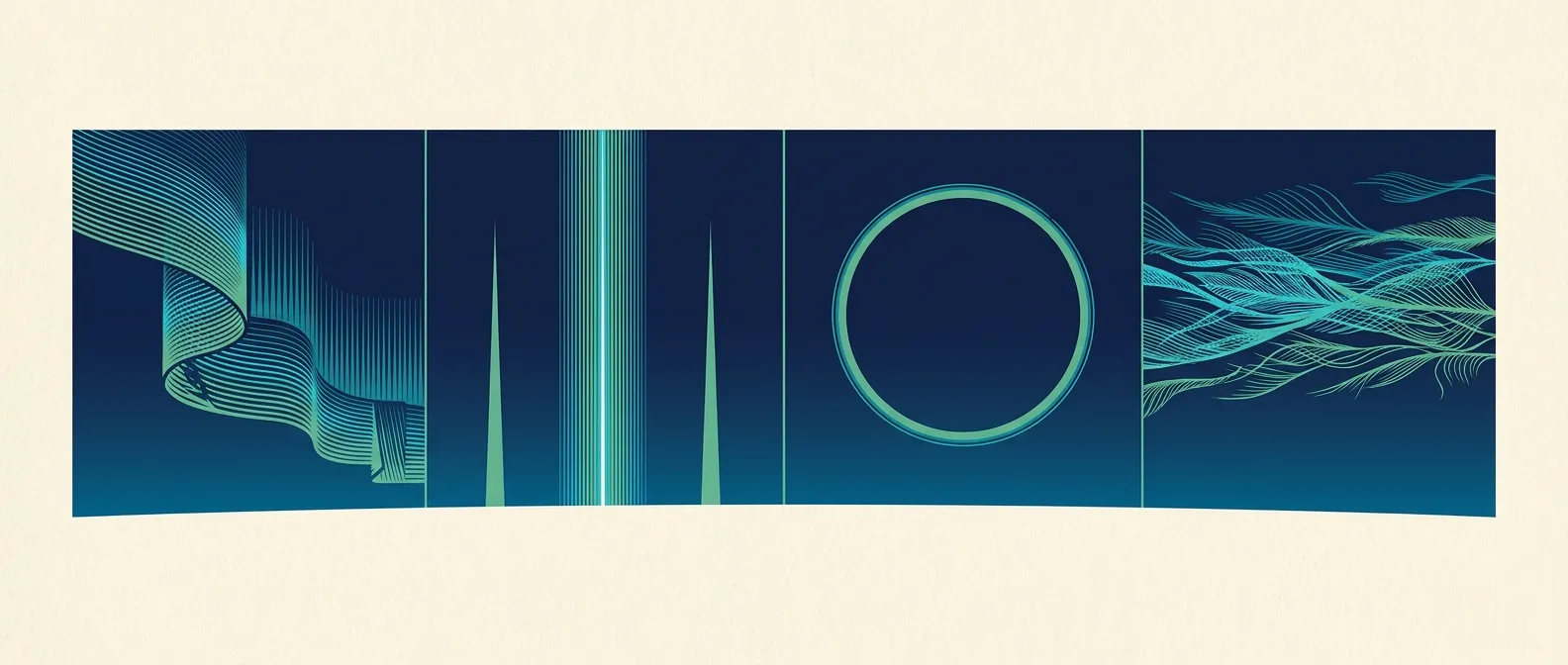
A diffuse glow across the night sky can range from high-altitude geomagnetic auroras and subauroral plasma streams to tropospheric light pillars and urban light domes.
Before analyzing diffuse glows, check your observation against our master sky field guide. If you saw a translucent fan or spiral after sunset, consult our rocket launch and re-entry guide. To classify sky-wide glows, halos, and atmospheric optics, use this breakdown of emission wavelengths, structural altitudes, and human night-vision biology.
Atmospheric stratification of sky glows
Diffuse luminous phenomena occur across specific atmospheric layers, from low-altitude tropospheric ice optics up to upper-thermospheric plasma streams.
| Atmospheric Layer | Altitude Range | Associated Luminous Phenomena |
|---|---|---|
| Troposphere | 0 to 15 km | Urban light domes, light pillars, halos, ordinary clouds |
| Stratosphere | 15 to 50 km | Polar Stratospheric Clouds (PSCs / Nacreous clouds at 15–25 km) |
| Mesosphere | 50 to 85 km | Noctilucent Clouds (76–85 km), Mesospheric Bores (50–85 km) |
| Lower Thermosphere | 85 to 200 km | Nitrogen Blue Aurora (<100 km), Dune Aurora (~100 km), Oxygen Green Aurora (100–150 km) |
| Upper Thermosphere | 200 to 500 km | Oxygen Red Aurora (200–300 km), STEVE (~450 km) |
Physics and spectra of the Northern and Southern Lights
Auroras occur when solar wind particles are funneled along Earth’s magnetic field lines, colliding with thermospheric gases and exciting atoms to higher energy levels. Specific colors correspond to exact quantum transitions and altitudes:
- Atomic Oxygen Green (557.7 nm): Occurs between 100 and 150 km. Produced by a “forbidden transition” from a metastable state with a 0.74-second lifetime.
- Atomic Oxygen Red (630.0 nm): Occurs between 200 and 300 km. Results from a forbidden transition with a 110-second lifetime. At lower altitudes (<200 km), higher atmospheric density causes “collisional quenching,” preventing the red photon emission.
- Molecular Nitrogen Blue & Purple (391.4 nm / 427.8 nm): Formed below 100 km during intense geomagnetic storms (Kp ≥ 5) as energetic solar particles penetrate deep into dense molecular nitrogen.
Why Low-Latitude Auroras Look Red to the Eye
During major geomagnetic storms, observers at mid-to-low latitudes often see the high-altitude red oxygen crown (200–300 km) peeking over the northern horizon, while the lower-altitude green base remains hidden behind Earth’s physical curvature.
Aurora vs. urban light domes, airglow, and wildfire glow
To separate true auroral emissions from tropospheric light pollution and atmospheric scattering, apply these diagnostic criteria:
| Phenomenon | Position / Alignment | Temporal Shift | Star Opacity Test | Camera Spectrum |
|---|---|---|---|---|
| Aurora | Geomagnetic North (or South) | Shifts in seconds to minutes | Transparent (stars shine brightly through) | Vivid 557.7 nm green or 630.0 nm red |
| Urban Light Dome | Anchored over city geography | Completely static | Opaque / translucent (obscures stars) | Broad-spectrum orange/yellow or white |
| Airglow | Sky-wide / zenith ripples | Very slow wave-like drift | Transparent (stars shine brightly) | Faint green and red bands |
| Zodiacal Light | Tilted along the ecliptic | Shifts slowly with Earth rotation | Transparent (stars shine brightly) | Faint, colorless white/grey cone |
| Wildfire Glow | Anchored over fire lines | Static with local flickering | Opaque (smoke blocks starlight) | Low-horizon deep orange/red |
STEVE, Dune Auroras, and Isolated Proton Arcs
High-sensitivity digital photography has enabled citizen scientists to discover novel subauroral atmospheric phenomena:
- STEVE (Strong Thermal Emission Velocity Enhancement): A narrow mauve/purple ribbon discovered by Alberta Aurora Chasers in 2016 and published in 2018 (MacDonald et al.). Caused by Subauroral Ion Drift (SAID)—a 25-km-wide river of 3,000 °C plasma flowing at 6 km/s at 450 km altitude. The accompanying green “picket fence” columns are produced by local electron precipitation.
- Dune Aurora: Discovered by Finnish citizen scientists (Palmroth et al. 2020), manifesting as regularly spaced green ripples at ~100 km altitude. Created by mesospheric bores (gravity waves in atmospheric temperature inversion ducting layers) modulating atomic oxygen density.
- Isolated Proton Arcs (IPAs): Formed when ring-current protons are scattered by EMIC waves, generating faint Hydrogen-beta (486.1 nm) and Hydrogen-alpha (656.3 nm) emissions at 110–140 km altitude.
Natural faint diffuse sources: Airglow, Zodiacal Light, and Gegenschein
Even in dark skies without auroras, natural phenomena establish a baseline surface brightness measured in magnitudes per square arcsecond (mag/arcsec²):
- Airglow (~21.9 mag/arcsec²): Accounts for ~65% of natural dark sky brightness, driven by upper-atmospheric chemiluminescence of oxygen (557.7 nm & 630.0 nm) and sodium (589.0 nm).
- Zodiacal Light (~23.5 mag/arcsec²): Sunlight scattering off interplanetary dust along the ecliptic plane, visible in Bortle Class 1–4 dark skies as a broad twilight cone.
- The Gegenschein (~21.0–21.2 mag/arcsec²): An elliptical patch of light directly opposite the Sun (antisolar point) created by backscattering off interplanetary dust.
- Integrated Starlight (~24.8 to 29.0 mag/arcsec²): The combined light from all unresolved main-sequence stars and red giants in the Milky Way galaxy.
Extreme clouds, ice-crystal optics, and light pillars
Atmospheric optics in the troposphere and mesosphere create striking geometric shapes:
- Noctilucent Clouds (NLCs / Polar Mesospheric Clouds): Reside in the mesosphere at 76 to 85 km altitude. Visible during summer at 50°–65° latitudes when water vapor (increasingly supplied by rocket launch exhaust) condenses onto meteoritic dust at −120 °C, catching sunlight long after dark on the ground.
- 22-Degree Halo: Formed by refraction through randomly oriented hexagonal ice column crystals (minimum deviation angle 22°).
- Parhelia (Sun Dogs): Bright spots 22°+ to the left and right of the Sun, formed by horizontally floating hexagonal plate crystals.
- Circumzenithal Arc (CZA): An upside-down rainbow circling the zenith, forming only when the Sun is lower than 32.2°.
- Circumhorizontal Arc (CHA): A bright horizontal color band requiring the Sun to be higher than 58°.
- Light Pillars: Reflection off the flat surfaces of horizontally oriented ice crystals, creating 5°–20° vertical beams above streetlamps in freezing air.
Human vision limits and the 60-second smartphone test
At night, human vision shifts from color-sensitive cone cells (photopic) to rod cells (scotopic vision, peaking at 507 nm). Because rods cannot perceive color and are insensitive to deep red 630.0 nm emissions (the Purkinje shift), low-latitude auroras often look like pale grey haze to the naked eye.
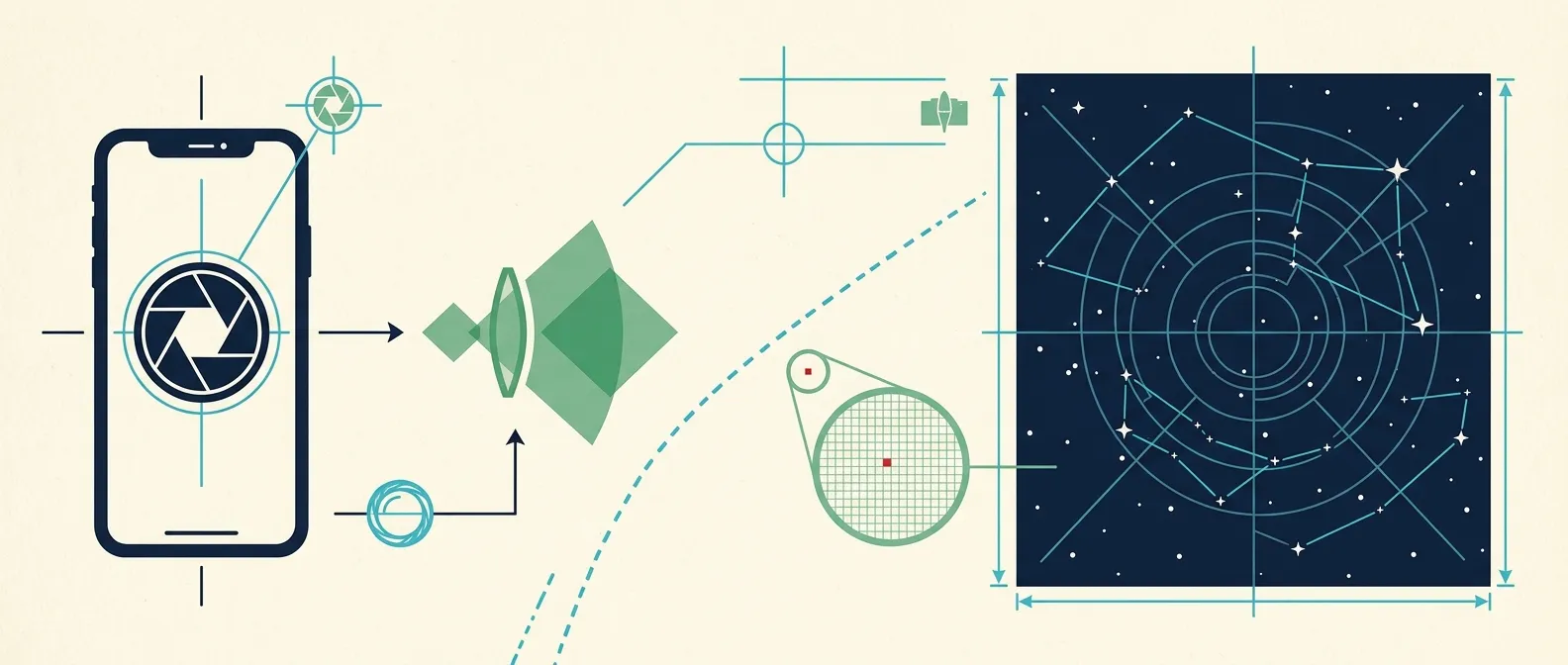
A smartphone camera collects photons over a 3-to-10-second exposure, bypassing human eye limits to reveal true green and pink/red emissions.
The 60-Second Smartphone Diagnostic Checklist
- Face Geomagnetic North: Ensure camera faces geomagnetic north (or south in southern hemisphere).
- Use Night Mode: Take a 3-to-10-second night-mode photo while keeping the camera completely still.
- Test Star Opacity: Verify if background stars remain sharply visible through the glow.
- Analyze Spectrum: Look for distinct 557.7 nm green or 630.0 nm pink/red hues. If the glow is broad-spectrum yellow/orange and hides background stars, it is city light pollution.
To understand how camera white balance and sensor noise affect night photos, see our camera photo forensics guide. For historical reporting context, inspect our analysis of official UFO investigation data.
For the light above you right now, open Astro and point your phone at the sky.
Open the live sky