Rocket Launches, Spirals, and Re-Entries
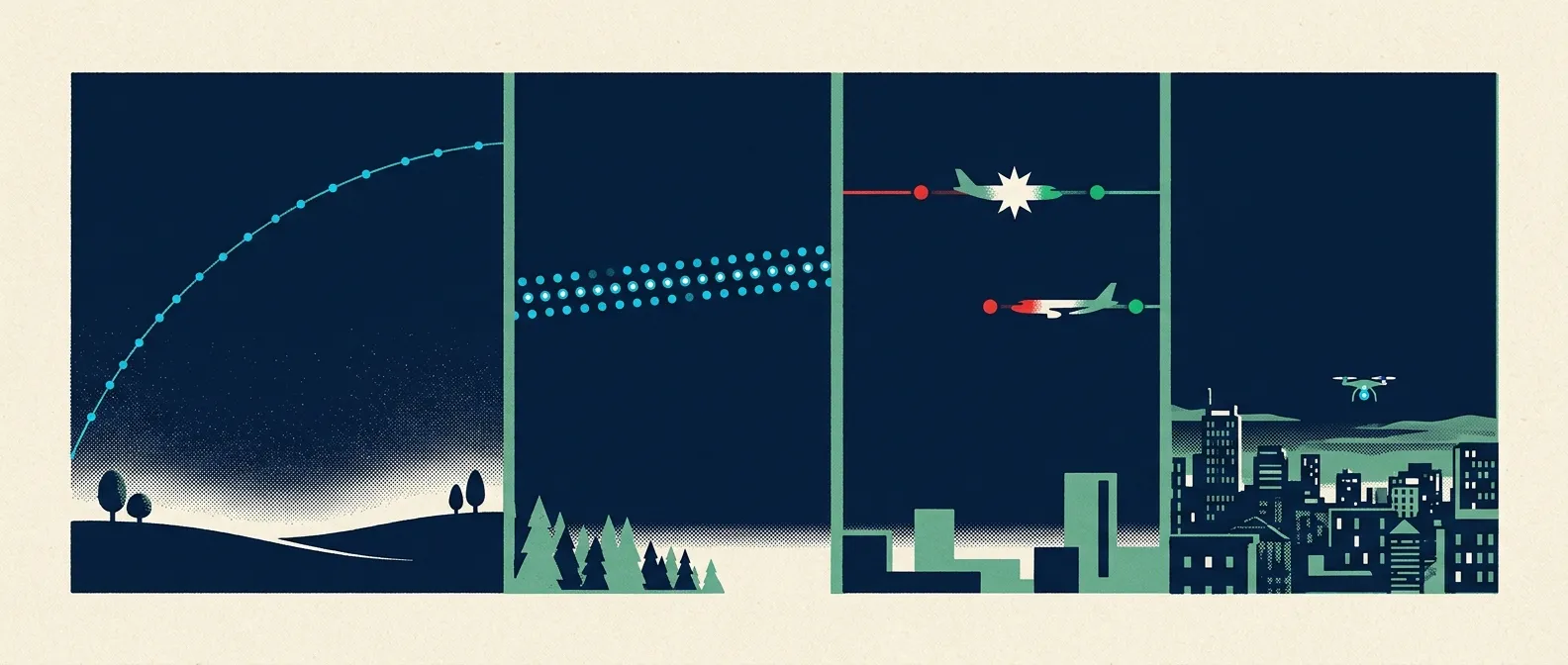
Large geometry, twilight timing, and long durations are the signatures of propulsion hardware above the atmosphere.
- Twilight plumes scatter high-altitude sunlight. Exhaust gases expand in near-vacuum (>50 km) and freeze into ice crystals, remaining sunlit while ground observers are dark.
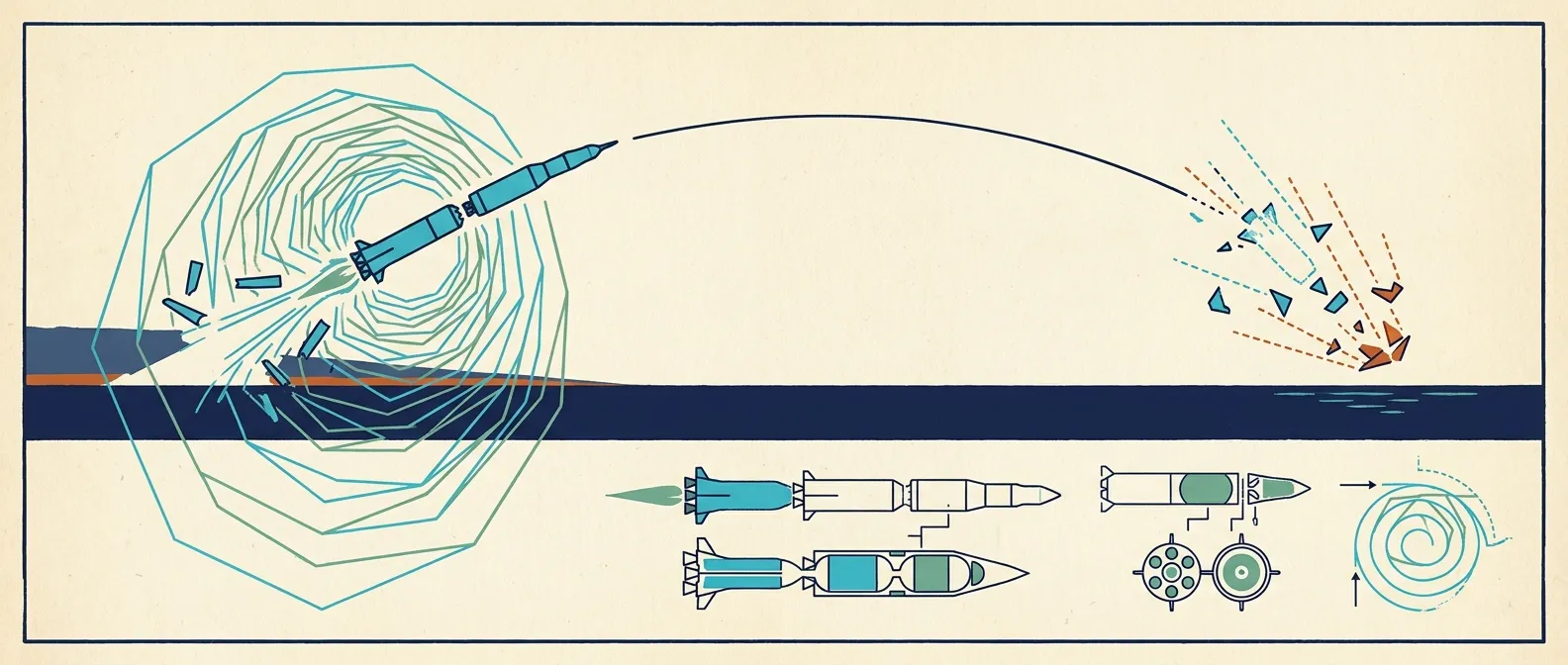
- Spinning upper stages create expanding spirals. Propellant vented from a rolling stage sweeps frozen gas into a pinwheel pattern that lasts 5–12 minutes.
- Re-entries move slowly in parallel trains. Artificial debris enters at ~7–8 km/s, taking 20–90+ seconds to fragment at 75–85 km altitude into white/red glowing tracks.
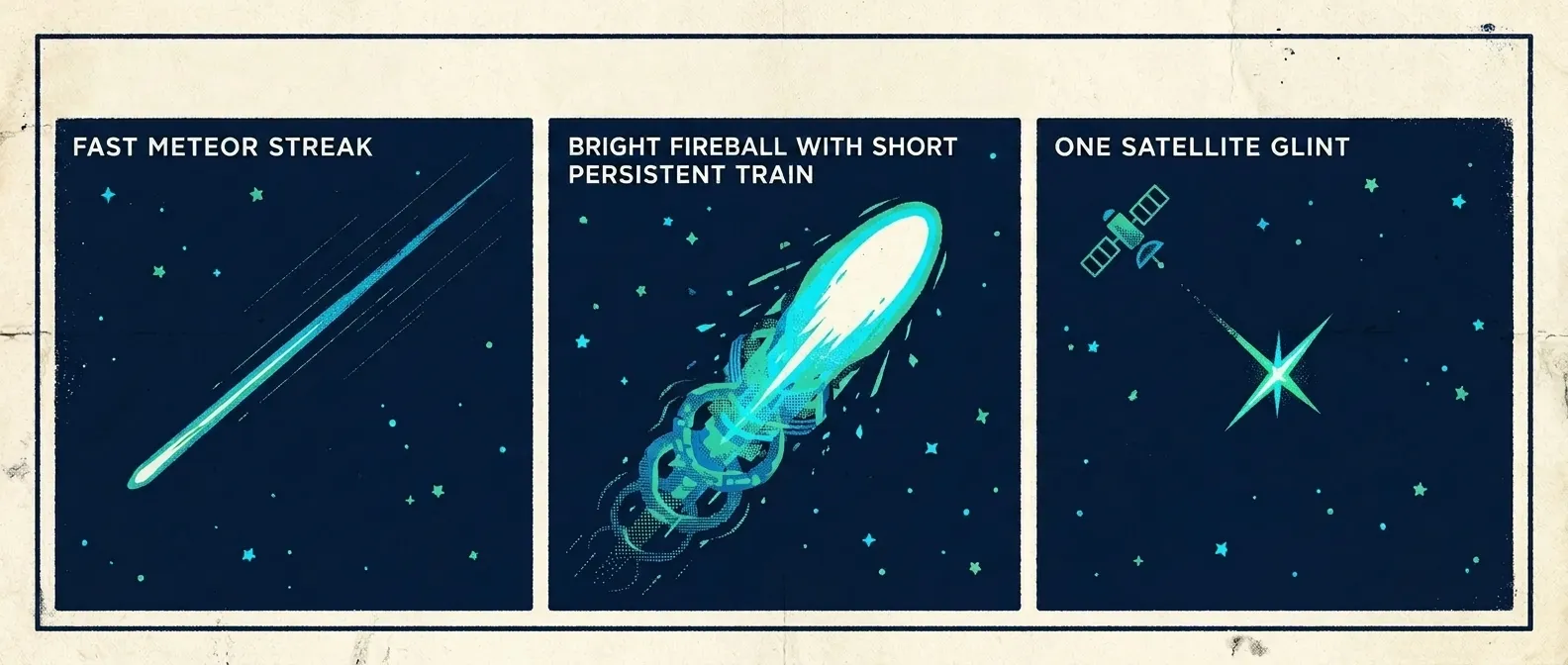
- Meteors streak rapidly in under 3 seconds. Natural meteoroids enter at 11.2–72.8 km/s, producing brief, high-speed flashes often exhibiting neon green or blue hues.
Some of the most startling sights in the night sky—glowing blue spirals, translucent jellyfish-like clouds, and slow trains of burning fragments—are produced by rocket launches, upper-stage fuel dumps, and atmospheric re-entries.
Because these events occur high above the troposphere, they behave differently from low-altitude aircraft or natural meteors. For intact satellites crossing the sky, check our moving lights guide. To classify launches, spirals, and re-entries, use this breakdown of fluid dynamics, entry velocities, and historical case studies.
Physics of the twilight launch plume (space jellyfish)
The spectacle known as the “space jellyfish” or “twilight effect” occurs when a rocket ascends through the mesosphere (above 50 km) into near-vacuum.
At sea level, atmospheric pressure compresses engine exhaust into a tight column. Above 50 km, ambient air pressure drops toward zero, causing under-expanded exhaust gases (water vapor and carbon dioxide from kerosene, methane, or hydrogen engines) to expand violently into a massive, bell-shaped cloud hundreds of kilometers wide. In the freezing upper air, this water vapor instantly freezes into fine ice crystals.
The display requires strict twilight geometry: the launch occurs roughly 30 to 60 minutes before sunrise or after sunset. Ground observers are in Earth’s shadow, but the rocket above 100 km is illuminated by direct sunlight. Sunlight scatters off the ice crystals (Rayleigh and Mie scattering), turning the exhaust into an iridescent, glowing cloud visible up to 836 kilometers (520 miles) from the launch site.
Famous Case Studies: SpaceX Spirals, Bulava Missiles, and Trident Tests
Because high-altitude plumes and fuel dumps cover vast geographical regions, they frequently prompt widespread public alarm and UFO reports.
- December 2017 Southern California Falcon 9: Launched from Vandenberg Space Force Base at 5:27 PM PST into evening twilight. The expanding plume created an enormous glowing jellyfish visible from Los Angeles to Phoenix, Arizona, with nitrogen cold-gas attitude thrusters pulsing visible rings.
- The “SpaceX Spirals”: When a Falcon 9 second stage completes its mission, it vents leftover propellant to passivate its tanks and prevent in-orbit explosion. If the stage is put into a stabilizing roll while venting, the gas sprays outward into an Archimedean spiral. Famous examples include Hawaii (Jan 18, 2023, GPS III SV06), New Zealand (June 19, 2022, MRV-MEV), Alaska (April 15, 2023, Transporter-7 over auroras), and Scandinavia (March 4, 2024, Transporter-10).
- Chinese & Russian Upper-Stage Spirals: A Chinese Long March 2C stage dumped hypergolic UDMH fuel over New Caledonia (June 18, 2021), forming a giant Pacific spiral. On October 26, 2017, a Russian Topol ICBM vented aluminum oxide (Al2O3) particles, creating a brilliant turquoise blue auroral orb over Siberia.
- The 2009 Norwegian Spiral Anomaly: On December 9, 2009, a failed test of a Russian submarine-launched Bulava (RSM-56) missile produced a massive, blue-and-white spiral over northern Norway lasting 3 to 12 minutes. The third-stage control nozzle jammed, sending the firing rocket into a violent cartwheel.
- Trident Missile Test (Nov 7, 2015): A US Navy Trident II missile launched off Southern California executed high-altitude stage separation in vacuum, creating a massive, expanding spherical ring visible across the American Southwest.
Mechanism Taxonomy: Expanding Shells vs. Rotating Spirals
The shape of a high-altitude gas release directly reflects the mechanical rotation of the spacecraft:
Expanding Shell / Halo
- Unspun deorbit burn or stage separation
- Symmetrical spherical orb or halo
- Gas sublimates into ice expanding in all directions
- Fades within 1 to 3 minutes as particles spread
Rotating Spiral Arm
- Propellant venting from a rolling upper stage
- Lawn-sprinkler Archimedean pinwheel pattern
- Requires vehicle angular rotation along its axis
- Maintains a clean spiral structure for 5 to 12 minutes
Re-entry vs. meteor: velocity, duration, and fragmentation
While ascending rockets produce glowing plumes, descending hardware creates artificial re-entry fireballs that look vastly different from natural meteors.
| Characteristic | Interplanetary Meteoroid | Artificial Orbital Debris Re-entry |
|---|---|---|
| Entry Velocity | 11.2 to 72.8 km/s (Mach 35–270) | ~7.0 to 8.0 km/s (orbital speed) |
| Visual Duration | Brief streak; under 3 seconds | Slow, majestic traverse; 20 to 90+ seconds |
| Fragmentation | Single streak or single terminal burst (bolide) | Tight cluster of multiple fragments on a shared parallel track |
| Observed Color | Neon green (Magnesium), blue (Iron), orange (Sodium) | Stark white, yellow, or reddish-orange (Steel & Aluminum) |
| Breakup Altitude | High atmosphere (>100 km) from shockwave | Aerodynamic fragmentation occurs between 75 and 85 km |
Velocity is the primary physical filter. Meteors strike at 11.2 to 72.8 km/s, crossing the sky in a flash. Artificial satellites enter at 7 to 8 km/s and move slowly like a high-altitude aircraft. As aerospace metals (steel, titanium, aluminum) melt at 75–85 km altitude, they break into a slow train of parallel fireballs.
For brief single-point flashes, consult our meteor and satellite flare guide.
Controlled vs. uncontrolled re-entry and Point Nemo
Space operations distinguish between controlled disposals and uncontrolled orbital decay:
- Controlled Re-entry (Point Nemo): Operators execute a deorbit burn targeting the South Pacific Ocean Uninhabited Area (SPOUA / Point Nemo, 48°52’S 123°23’W), over 2,600 km from the nearest land. Over 260 spacecraft have been intentionally crashed here since 1971, including Mir (2001) and the Compton Gamma Ray Observatory (2000). The ISS is scheduled for a controlled SPOUA disposal in 2030–2031. Mandatory casualty risk guidelines require mitigation to less than 1 in 10,000.
- Uncontrolled Re-entry Statistics: Defunct satellites without fuel undergo natural orbital decay from thermospheric drag. Annual re-entered mass grew from ~90 metric tons/year (2008–2017) to 281.7 tons in 2024 and 442.8 tons in 2025 (per ESA reports).
- Megaconstellation Attrition: LEO broadband networks experience routine satellite decay (~1.26 satellites/day for Starlink), driving increased re-entry frequency over the coming decade.
Attribution workflow, military phenomena, and global spaceports
Attributing a sky event to a specific launch or re-entry requires matching observer timing with orbital records and launch manifests.
The 60-Second Triage Sequence
- Check Speed and Duration: If the event lasted under 3 seconds, classify as a natural meteor. If it took 20 to 90+ seconds, proceed to step 2.
- Check Shape and Structure: If it is a bright point trailing an expanding plume or spiral, classify as a Rocket Launch / Fuel Dump (confirm twilight timing within 60 minutes of sunrise/sunset).
- Check Fragmentation: If it is a tight cluster of multiple slow-moving fireballs traveling in parallel, classify as an Artificial Orbital Debris Re-entry.
Attribution Workflow & Uncertainty Limits
To confirm an event, record your exact UTC timestamp, GPS location, and compass look direction. Analysts cross-reference NOTAMs (Notices to Airmen) and Space-Track TLE data. Uncontrolled re-entry predictions carry an inherent ±20% uncertainty window of remaining orbital lifetime due to unpredictable thermospheric density fluctuations caused by solar radiation and satellite tumbling.
Military Propulsion & Global Launch Spaceports
Other phenomena include sounding rocket chemical tracer releases (barium green/purple and strontium red clouds used to measure ionospheric winds), kinetic Exoatmospheric Kill Vehicles (EKVs) in missile defense (silent high-altitude collision clouds), and aircraft flare/chaff deployments.
Primary global launch corridors driving twilight sightings include Cape Canaveral Florida (59 launches/year, Atlantic corridor), Vandenberg California (30 launches/year, Pacific polar corridor), Jiuquan China (36/year), Wenchang China (14/year), Baikonur Kazakhstan (5/year), Kourou French Guiana (3/year), and Starbase Texas (Brownsville / Gulf of Mexico corridor).
For additional context on how astronomical misidentifications are handled historically, see our analysis of official UFO investigation data.
For the light above you right now, open Astro and point your phone at the sky.
Open the live sky