Meteor, Fireball, or Satellite Flare?
Entry velocity, elemental emission colors, and light curve duration distinguish natural meteors from satellite glints and aircraft.
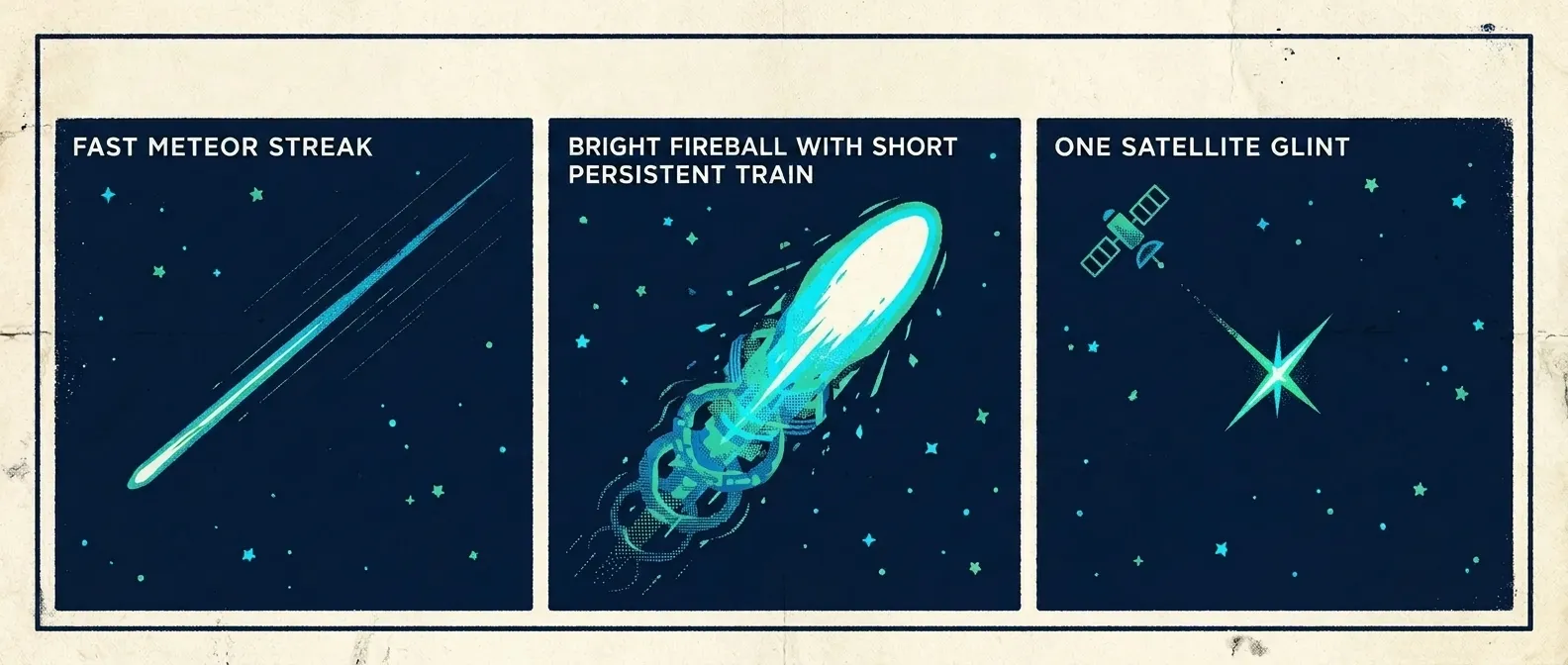
- Meteors streak rapidly in under 3 seconds. Entry speeds range from 11.2 to 72.8 km/s; a fireball is any meteor brighter than magnitude −4 (Venus).
- Elemental emission dictates color. Fast meteors excite magnesium and oxygen to glow neon green; slower meteors and re-entries glow orange/red from sodium and iron.
- Simultaneous hissing is electrophonic sound. VLF radio waves from a fireball's plasma wake vibrate nearby conductors (glasses, hair) at light speed before the sonic boom arrives.
- Satellite glints rise and fade smoothly. Specular reflections on solar panels produce symmetrical 5-to-20-second glints without streaks, wakes, or fragmentation.
A sudden, intense flash of light across the night sky usually lasts only a few seconds, leaving witnesses wondering if they saw a shooting star, a fireball explosion, a satellite solar reflection, or a military aircraft.
Before analyzing brief flashes, check your observation against our master sky field guide. For slow, fragmenting fireball trains that persist for tens of seconds, consult our rocket launch and re-entry guide. To classify brief flashes, use this breakdown of entry velocities, elemental colors, electrophonic acoustics, and satellite glint mechanics.
Meteor physics: velocity limits, ablation, and brightness scale
When a meteoroid strikes Earth’s upper atmosphere, its velocity is governed by strict orbital mechanics. The entry speed ranges between 11.2 and 72.8 kilometers per second (Mach 35 to Mach 270).
The lower limit of 11.2 km/s corresponds to Earth’s escape velocity—the speed an object acquires simply by falling into Earth’s gravity well. The upper limit of 72.8 km/s occurs when Earth (traveling at 30 km/s in orbit) collides head-on with a retrograde meteoroid traveling at parabolic heliocentric limit velocity (42.5 km/s).
At these extreme speeds, intense ram pressure compresses and heats the air into a high-temperature plasma envelope, ablating (melting and vaporizing) the rock between 80 and 120 km altitude in the mesosphere.
Formal IAU Brightness Classification
| Classification | Absolute Visual Magnitude | Observational Characteristic |
|---|---|---|
| Meteor | Any visible magnitude | Standard “shooting star” generated by a 30 μm to 1 m meteoroid |
| Fireball | −4 or brighter | Outshines the planet Venus; lasts 1 to several seconds |
| Bolide | ~ −14 or brighter | Extremely bright fireball ending in a terminal airburst with visible fragmentation |
| Superbolide | −17 or brighter | More than 100 times brighter than the full Moon (−13); multi-meter impactor |
Emission spectra: what element causes neon green, blue, and red?
The color of a meteor is produced by atomic emission lines as excited electrons in the vaporized rock and surrounding atmospheric plasma drop back to lower energy states:
- Magnesium (Mg I): Emits a brilliant neon blue-green line (~517 nm).
- Sodium (Na I): Produces a rich yellow-orange glow (~589 nm).
- Iron (Fe I): Yields a yellow or bluish emission.
- Atmospheric Oxygen & Nitrogen: Surrounding air contributes green and broad red emission bands.
Fast meteors (>30 km/s, such as the Perseids or Leonids) collide violently enough to excite high-energy magnesium and atmospheric oxygen lines, producing striking neon-green streaks. Slow meteors (<15 km/s) and artificial space debris re-entries (~8 km/s) generate cooler plasma temperatures that excite lower-energy sodium and iron, burning with yellow, orange, or reddish hues.
Persistent trains, smoke trails, and electrophonic acoustics
Bright fireballs frequently leave secondary atmospheric and acoustic effects:
Persistent Luminous Train
- Self-luminous column of ionized plasma
- Visible in darkness for seconds to several minutes
- Twisted and deformed by upper-mesospheric winds
- Left by high-speed, energetic fireballs
Daylight Smoke Trail
- Non-luminous column of condensed dust particles
- Scatters ambient sunlight in daylight or twilight
- Appears gray or white against a illuminated sky
- Drifts slowly as dust falls into the troposphere
Sonic Booms vs. Electrophonic Hissing
If a dense meteoroid penetrates below 50 km altitude at supersonic speed, it generates a bow shock that reaches the ground as a heavy sonic boom. Because sound travels at ~0.34 km/s, an airburst at 30 km altitude produces a boom that arrives approximately 90 seconds after the visual flash.
However, observers frequently report hearing a faint hissing, crackling, or popping sound at the exact same second as the light flash. This is explained by the Keay electrophonic mechanism: the turbulent plasma wake of an intense fireball (−11 to −13 magnitude) twists Earth’s magnetic field lines, emitting a pulse of Very Low Frequency (VLF) radio waves. Traveling at the speed of light, these radio waves arrive simultaneously with the flash and vibrate dielectric materials near the observer (such as hair, glasses frames, dark clothing, or pine needles), creating photoacoustic sound right next to their ears.
Satellite glints vs. meteors vs. aircraft strobes
Not every brief flash is a meteor. Flat surfaces on artificial satellites (solar arrays and synthetic aperture radar antennas) act like mirrors, casting concentrated beams of sunlight down to Earth.
While historic Iridium flares reached magnitude −8, modern Starlink direct-to-cell satellites produce extreme glints up to magnitude −5 or −6. Geostationary satellites (at 35,786 km altitude) produce stationary flashes around the vernal and autumnal equinoxes as they align with the Sun near Earth’s shadow edge.
| Diagnostic Feature | Meteors & Fireballs | Satellite Glints & Flares | Aircraft Strobes |
|---|---|---|---|
| Duration | Fraction of a second to ~3 seconds | Smooth surge and fade over 5 to 20 seconds | Continuous over minutes across the sky |
| Motion | Fast, continuous ballistic streak | Slow, steady linear path (GEO glints are fixed) | Appears fixed only when approaching head-on |
| Light Curve | Asymmetric; terminal explosion or flare | Symmetrical brightening and fading; no fragmentation | Strict mechanical rhythm (1–2 Hz) |
| Wake & Trail | Leaves persistent ionized train or dust trail | Zero wake, trail, or smoke | May leave high-altitude contrails at 35,000 ft |
Global bolide networks, NASA CNEOS, and Chelyabinsk
Global monitoring of fireball events combines citizen-science reporting with automated instrumental arrays:
- Public Reporting: The American Meteor Society (AMS) and International Meteor Organization (IMO) process ~20,000 fireball submissions annually.
- Instrumental Camera Arrays: The Global Meteor Network (GMN, 450+ CMOS cameras across 30 countries), European Fireball Network (EFN), Desert Fireball Network (DFN Australia), and FRIPON (150 automated cameras across France/EU) triangulate trajectories to calculate heliocentric orbits within 24 hours.
- NASA CNEOS Bolide Database: U.S. government satellite sensors record atmospheric detonations in kilotons (kt) of TNT equivalent (1 kt = 4.184 × 10¹² Joules). Based on power-law impact models (N = 3.7 × E−0.9), a 0.1 kt impactor strikes weekly, a 5 kt impactor strikes annually, and a 50 kt event strikes decadally.
The 2013 Chelyabinsk Superbolide
On February 15, 2013, a 19-to-20-meter asteroid (12,000 metric tons) entered the atmosphere over Russia at 19.16 km/s at a shallow 18° angle. It detonated in a superbolide airburst at 27–30 km altitude, releasing 400 to 500 kilotons of TNT equivalent energy (30 times Hiroshima). The flash reached magnitude −27.3 (brighter than the Sun), damaging 7,000 buildings and injuring 1,500 people from shattered window glass.
Meteorite falls, Doppler radar, and recovery facts
Less than 1% of fireballs yield recoverable meteorites. Once a fireball decelerates below 3–4 km/s, it enters “dark flight,” free-falling at terminal velocity (100–300 km/h) while being drifted by upper winds.
Scientists use NEXRAD Doppler weather radar to detect falling debris signatures in clear sky, pinpointing strewn fields down to tens of meters and improving recovery rates by 3.6 times. Notable radar-assisted recoveries include Neuschwanstein (2002, rare EL6 enstatite chondrite), Sutter’s Mill (2012, CM carbonaceous chondrite), and Winchcombe UK (2021, pristine CM2 carbonaceous chondrite recovered within 12 hours).
Identifying a Fresh Meteorite & Legal Facts
- Visual Markers: Thin, black/brown fusion crust; regmaglypts (thumbprint-like depressions); high density and strong magnetic attraction from iron-nickel metal.
- Temperature & Safety: Fresh meteorites are cold or warm to the touch (not hot), as ablation sheds outer heat instantly. They are non-radioactive and present zero radiation danger.
- Legal Ownership: Under U.S. property law (Goddard v. Winchell, 1892), a meteorite belongs to the owner of the land where it falls. Meteorites on public lands cannot be claimed under general mining rights.
How to file a scientifically usable fireball report
If you witness an intense fireball, file a structured report with the American Meteor Society or International Meteor Organization:
- Note the exact timestamp: Record the time to the minute immediately.
- Record your location: Save your exact street address or GPS coordinates.
- Measure start and end angles: Stand in the exact spot and use your phone compass (azimuth) and level app (elevation angle above horizon) to measure where the meteor appeared and disappeared relative to landmarks.
- Compare brightness: Gauge brightness against known objects (Venus at −4, Full Moon at −13).
- Note acoustic delay: Count the exact seconds between the visual flash and any subsequent sonic boom.
For details on how historical optical misidentifications compare with official military records, see our analysis of official UFO investigation data.
For the light above you right now, open Astro and point your phone at the sky.
Open the live sky