Mistaking Constellations for UFOs
When city light pollution erases faint connective stars, the surviving bright corners form mysterious geometric formations that observers mistake for hovering craft.
- Light pollution erases connective context. Bortle Class 8/9 urban skyglow eliminates stars fainter than magnitude +4.0, leaving isolated geometric corners that look like hovering craft.
- Internal angles stay perfectly fixed. A star pattern rotates westward at 15°/hour due to Earth's spin, but the angular distance between its stars never changes.
- The hand provides a 1° to 25° ruler. Held at arm's length, a pinky finger measures 1°, a fist 10°, and a spread hand 20°–25°.
- Asterisms are practical units. Popular patterns like the Big Dipper, Summer Triangle, and Orion's Belt are informal asterisms, not official IAU territory bounds.
Three or four bright lights hovering in a silent, perfect triangle or square can look like an engineered craft to an urban observer. In reality, these are often the surviving bright corners of a familiar constellation whose fainter connective stars have been erased by city light pollution.
To check individual fixed points, see our star-versus-planet guide. To analyze a group of fixed points, use this field guide to light pollution thresholds, cognitive illusions, star-hopping multipliers, and hand-based angular measurement.
Why city light pollution turns star patterns into “UFOs”
The number of stars visible to the human eye depends entirely on local light pollution, measured by the Bortle Dark-Sky Scale (Bortle 1 to 9).
Under a pristine Bortle Class 1 dark sky (Naked-Eye Limiting Magnitude NELM 7.6–8.0), an observer can see over 4,500 stars per hemisphere, revealing all 88 official constellations. In a Class 8 or 9 inner-city sky (NELM < 4.0), artificial skyglow washes out stars fainter than magnitude +4.0, reducing the visible sky to fewer than 50 total stars.
This causes a structural collapse of constellations. In figures like Pegasus, Cygnus, or Ursa Major, the faint interior stars vanish completely. What remains on the dark urban sky are isolated, sharp geometric shapes—a floating triangle, an unattached line of three stars, or a wide diamond—which human cognitive pattern recognition interprets as a single hovering object.
Cognitive illusions: why horizon stars look distorted
Even under dark skies, perceptual and optical distortions alter how star groups appear:
The Constellation Illusion
- Psychometric depth/horizon scaling effect
- Horizon star groups appear 1.3 to 1.6× larger than at zenith
- Mirrors the classic 1.5× Moon illusion ratio
- Makes familiar constellations look unnaturally large near horizon
Atmospheric Extinction
- Light passes through dense, low-altitude airmass
- Selectively dims and reddens stars lower in the sky
- Alters relative brightness between upper and lower stars
- Breaks the visual symmetry of a familiar pattern
Bright planetary intruders also create confusion. When Venus (magnitude −4.9) or Jupiter (−2.9) transits through a constellation like Taurus, Gemini, or Leo, its intense brightness dominates the pattern, leading observers to believe an artificial light has joined the formation.
Core Navigational Anchors & Asterisms Table
In modern astronomy, a constellation is an official coordinate territory (88 defined by the IAU in 1930), whereas an asterism is an informal, popular star figure recognized by observers.
| Asterism Name | Constituent Stars & Magnitudes | Angular Dimensions | Navigational Role |
|---|---|---|---|
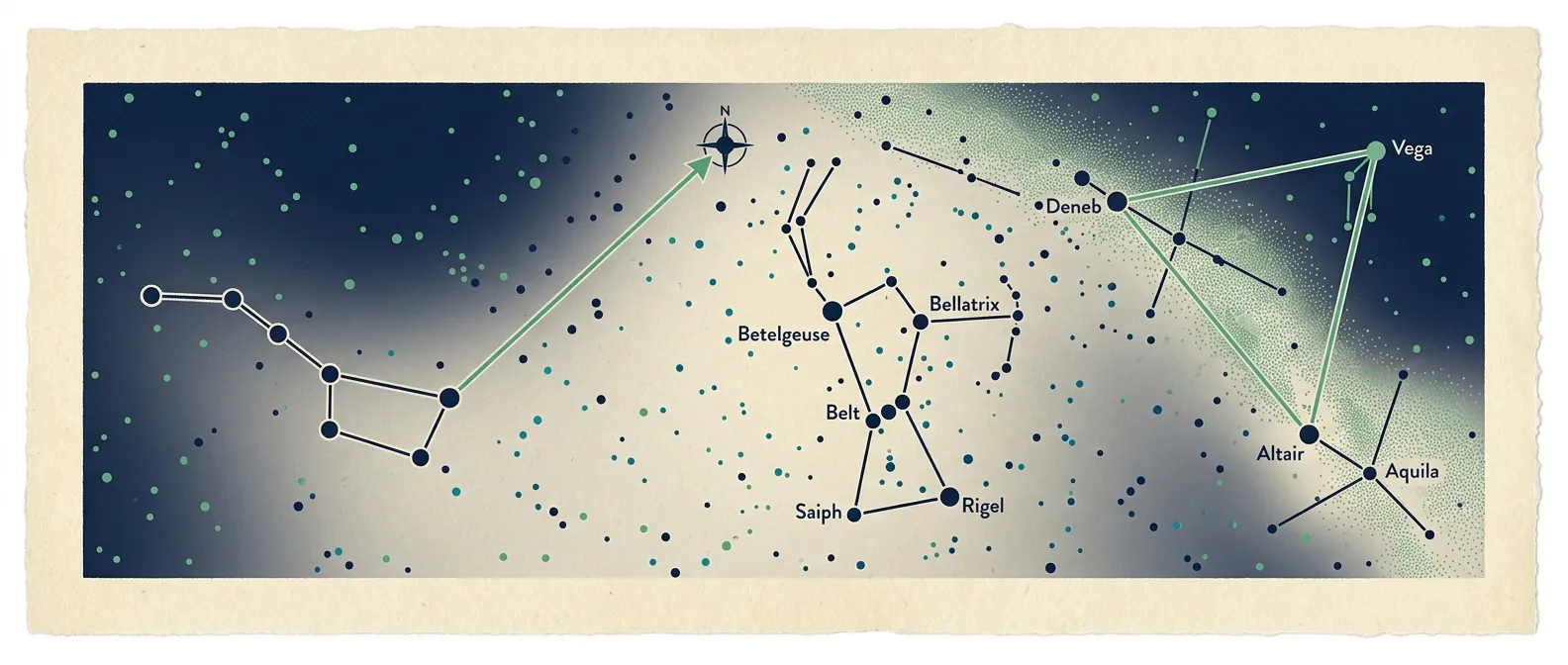
| The Big Dipper | Alioth, Dubhe, Alkaid, Mizar, Merak, Phad, Megrez (Mag 1.7 to 3.3) | ~25° end-to-end | Pointer stars (Merak & Dubhe) locate Polaris and Arcturus |
| Orion’s Belt | Alnitak (1.7), Alnilam (1.7), Mintaka (2.2) | 3.13° width | Points southeast to Sirius (21.66°) and northwest to Aldebaran |
| The Summer Triangle | Vega (0.03), Altair (0.76), Deneb (1.25) | 24° to 38° sides | Dominant northern summer/autumn anchor polygon |
| The Winter Hexagon | Sirius, Rigel, Aldebaran, Capella, Pollux, Procyon | 54° height × 46° width | Encompasses Orion and dominates northern winter sky |
| Great Square of Pegasus | Markab, Scheat, Algenib, Sirrah (Mag 2.0 to 2.8) | ~15° per side | Main northern autumn sky anchor |
| The Southern Cross (Crux) | Acrux (0.76), Gacrux (1.64), Mimosa (1.25) | 6.01° long axis | Points long axis directly toward South Celestial Pole |
| The Pleiades (M45) | Alcyone and 6 naked-eye stars (Mag 2.8 to 5.6) | 1.5° compact cluster | Frequently mistaken for a tiny dipper, UFO, or comet |
Star-hopping geometry: exact angular multipliers
Astronomers navigate the sky using “star-hopping” chains encoded as angular multipliers. You can measure angles accurately without instruments using your hand held at arm’s length:
- Pinky finger width: ~1 degree.
- Three middle fingers: ~5 degrees.
- Clenched fist: ~10 degrees.
- Open hand span (thumb to pinky): ~20 to 25 degrees.
Biomechanical studies (using 3D motion capture and pose estimation) confirm that hand-at-arm’s-length measurement carries a low coefficient of variation (6% to 8%) across observers because arm length scales proportionally with hand size.
Standard Star-Hopping Multiplier Chains
- Big Dipper to Polaris: Measure the distance between pointer stars Merak and Dubhe (5.37°). Extend that line 28.71° (5.34× pointer separation) to reach Polaris (+1.98 mag).
- Southern Cross to South Celestial Pole: Measure the long axis from Gacrux to Acrux (6.01°). Extend that line 27.59° (4.59× cross length) to locate the South Celestial Pole marker (Sigma Octantis).
- Orion’s Belt to Sirius: Orion’s Belt measures 3.13° from Alnitak to Mintaka. Extend southeast 21.66° (6.91× belt width) to land directly on Sirius (−1.46 mag).
- Orion’s Belt to Aldebaran & Pleiades: Extend northwest 21.30° (6.80× belt width) to hit Aldebaran (+0.86 mag), and continue 34.75° (11.09× belt width) to reach the Pleiades cluster.
10-minute field verification and educational adaptation
If you spot a suspicious, fixed formation of lights in the sky, execute this 10-minute field verification:
- Brace view against a roofline: Align the pattern against a fixed terrestrial landmark (building corner, tree branch, or telephone pole).
- Measure angular dimensions: Use a fist or open hand span at arm’s length to measure the spacing between the points.
- Wait 10 minutes: Check whether the points maintain their relative spacing. A true star pattern preserves every internal angle perfectly while moving westward at 15° per hour due to Earth’s spin.
- Capture a photo: Take a short night-mode photo. If the camera photo reveals fainter stars filling in the gaps between the bright points, you have confirmed an asterism.
If you have a photo of a sky pattern and want to check for camera artifacts or run astrometric plate solving, see our camera photo forensics guide. For historical reporting context, consult our analysis of official UFO investigation data.
For the light above you right now, open Astro and point your phone at the sky.
Open the live sky