Star or Planet? How to Tell the Difference
Twinkle is the fastest clue, but magnitude, orbital geometry, and ten minutes of patience provide the definitive answer.
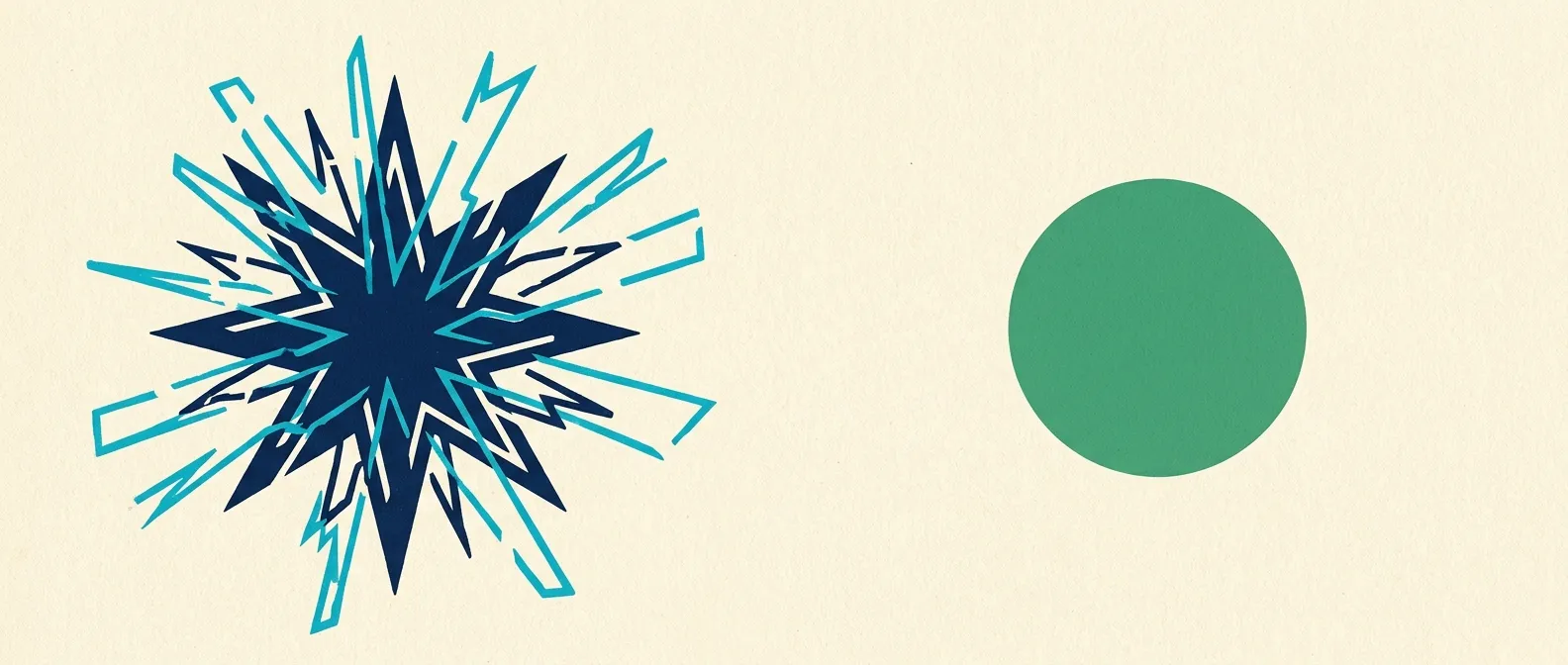
- Stars twinkle; planets glow steadily. Stars are point sources (<50 milliarcseconds) disrupted by air turbulence; planets are extended disks (3–60 arcseconds) that average out fluctuations.
- Planets follow the ecliptic band. Planets remain within 7° of the zodiac. Venus and Mercury trail sunrise/sunset and are never overhead at midnight.
- Venus and Jupiter outshine every star. Venus (up to −4.9) and Jupiter (−2.9) far surpass Sirius (−1.46), the brightest true star in the sky.
- A 10-minute test rules out illusions. Bracing against a roofline destroys autokinetic movement and confirms 15°/hour celestial drift.
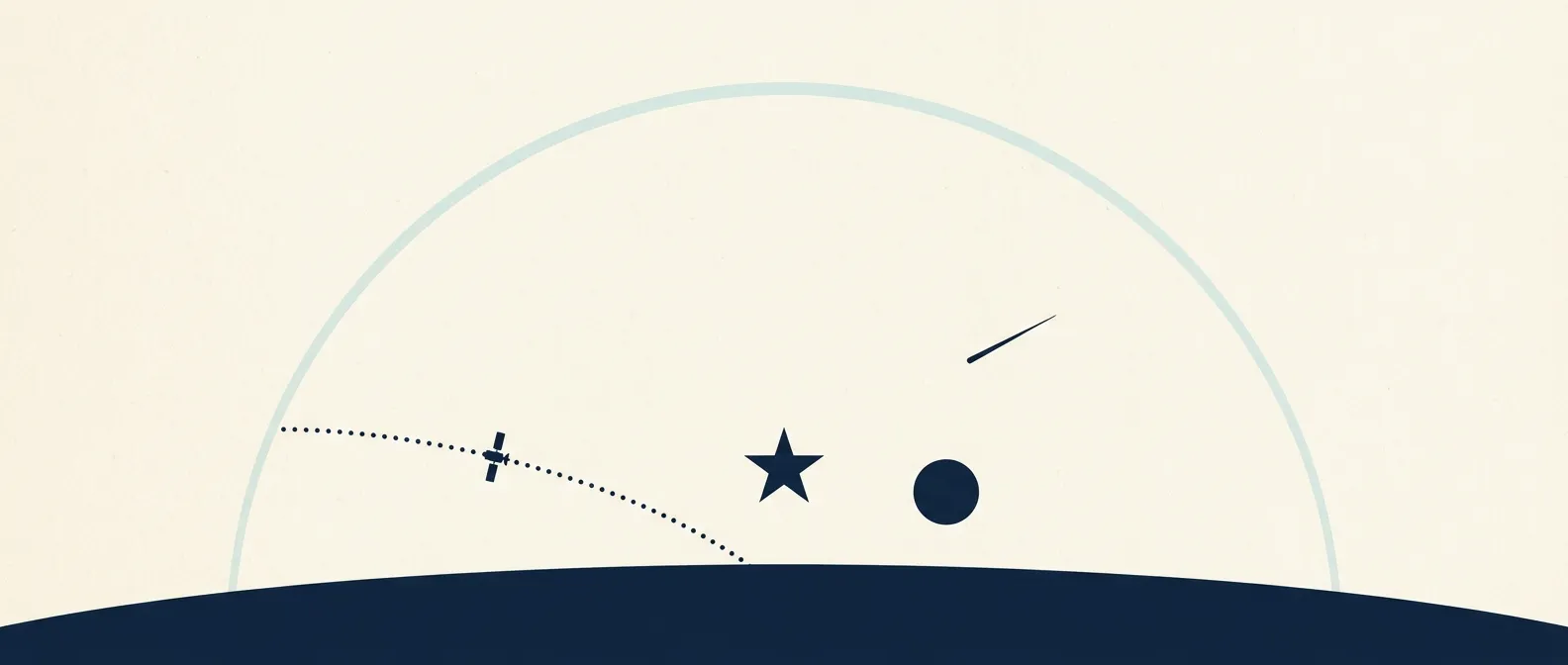
The single most common question in night-sky observation is whether a brilliant point of light is a star, a planet, or something artificial. While popular advice says “stars twinkle, planets don’t,” real observation requires understanding atmospheric physics, orbital geometry, and sensory illusions.
Before reaching for complex charts, check the light against our master sky field guide. To separate fixed point sources with precision, use this breakdown of scintillation, brightness tables, color mechanics, and practical field tests.
Why do stars twinkle while planets glow steadily?
The optical difference between a star and a planet comes down to angular diameter and atmospheric coherence length (quantified by the Fried parameter, r0). In visible wavelengths, atmospheric turbulence creates moving air cells roughly 10 cm in size across the upper atmosphere.
Stars: Point Sources
- Subtend under 50 milliarcseconds (<0.05”)
- Light beam enters through a single atmospheric cell (r0)
- Undergoes violent amplitude fluctuations (scintillation)
- Flickers rapidly and flashes color near horizon
Planets: Extended Disks
- Subtend 3.5 to 60 arcseconds (hundreds of times wider)
- Light beam spans multiple independent turbulence cells
- Fluctuations across the disk cancel each other out
- Glows with a steady, integrated, disk-like beam
Because human eyes have a resolving limit of roughly 60 to 120 arcseconds (1–2 arcminutes), both stars and planets look like dimensionless dots without a telescope. However, starlight originates from interstellar distances, while planets sit within our solar system.
The only exception occurs low on the horizon. Under the secant law of airmass, light passing at low elevation angles encounters hundreds of miles of dense troposphere, driving the atmospheric scintillation index (S4) toward saturation. As a result, even Venus or Jupiter will occasionally shimmer when sitting just a few degrees above a turbulent horizon.
Apparent magnitude: comparing stars and planets by brightness
Celestial brightness is measured on a reverse-logarithmic scale where lower or negative numbers mean brighter objects. Each step of 1.0 magnitude corresponds to a brightness factor of approximately 2.512.
Venus and Jupiter consistently outshine every single fixed star in the night sky. Mars can rival Jupiter during rare perihelic oppositions every 15 to 17 years, but dims during aphelion.
Naked-Eye Planetary Brightness Ranges
| Planet | Magnitude Range | Peak Condition | Observing Clue |
|---|---|---|---|
| Venus | −3.8 to −4.9 | Greatest brilliancy (~40° from Sun) | Blinding white; only near dawn/dusk; never at midnight |
| Jupiter | −1.6 to −2.9 | Opposition (closest to Earth) | Steady pale yellow-white; can sit high overhead at midnight |
| Mars | +1.8 to −2.9 | Perihelic opposition (e.g., 2003, 2018) | Distinct rust-red tint; brightness varies dramatically |
| Saturn | +1.2 to −0.54 | Opposition with rings wide open | Dull yellowish-gold; steady glow, fainter than Jupiter |
| Mercury | +5.5 to −0.5 | Greatest elongation (18°–28°) | Always trapped deep in twilight near horizon |
The Brightest True Stars
If you spot a brilliant point of light in the northern winter sky, Sirius is the only true star capable of approaching planetary intensity.
| Star | Apparent Mag | Spectral Class | Color Index (B–V) | Visual Appearance |
|---|---|---|---|---|
| Sirius | −1.46 | A0Va | +0.00 | Brilliant white; severe color flashing low down |
| Canopus | −0.74 | A9II | +0.15 | White-yellow; prominent in Southern Hemisphere |
| Arcturus | −0.05 | K1.5III | +1.23 | Distinct warm orange giant |
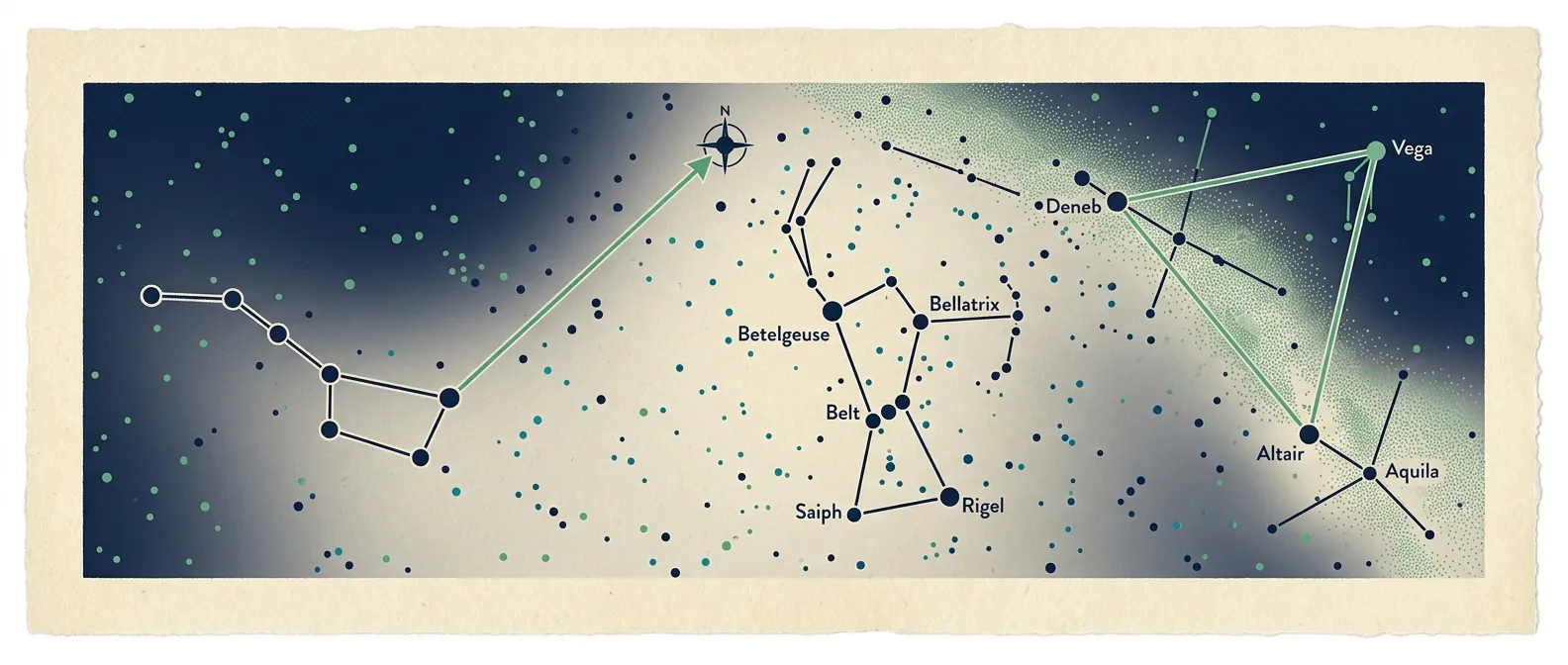
| Vega | +0.03 | A0Va | +0.00 | Pure blue-white anchor of the Summer Triangle |
| Capella | +0.08 | K0III / G1III | +0.80 | Rich yellow; strobes red and green low in northern sky |
| Rigel | +0.13 | B8Ia | −0.03 | Icy blue supergiant in Orion |
| Betelgeuse | +0.50 (var) | M1-M2Ia | +1.85 | Deep reddish-orange supergiant |
| Polaris | +1.98 | F7Ib | +0.60 | Modest magnitude 2 star marking true north (not bright!) |
Light Pollution and the Bortle Scale
Local sky conditions dictate what your naked eye can pick up. On the Bortle Scale, Class 1 (pristine dark sky) provides a limiting magnitude of +7.6 to +8.0, revealing thousands of stars.
In Class 8 or 9 (inner-city skies with limiting magnitude < +4.0), light pollution washes out faint stars entirely. In city centers like New York, London, or Tokyo, almost every visible point of light is either Venus, Jupiter, Mars, Saturn, or Sirius. If you see a brilliant overhead light from a downtown balcony, the probability of it being a planet approaches certainty.
Color diagnostics and why low stars flash red, green, and blue
Color offers direct evidence of an object’s physical composition and environment:
- Mercury: Slate grey, caused by bare silicate rock and graphite lacking tectonic activity.
- Venus: Piercing, blinding white, created by dense, highly reflective sulfuric acid clouds.
- Mars: Warm rust-red or deep orange, produced by surface iron-oxide dust.
- Jupiter & Saturn: Pale yellow-white and dull golden-yellow, reflecting sunlight from cloud decks.
Chromatic Scintillation
Observers frequently report mysterious lights strobing wildly in red, green, and blue. This natural optical effect is called chromatic scintillation and affects low-altitude bright stars like Sirius and Capella.
Earth’s atmosphere acts as a prism (atmospheric dispersion), refracting short blue wavelengths and long red wavelengths along slightly different optical paths. As turbulent air cells pass across your line of sight, they randomly push individual colors into your pupil. Planets rarely flash colors because light from different parts of their extended disk overlaps, blending back into steady white light.
When a star sits near the horizon, atmospheric extinction also scatters blue light away entirely, turning rising objects blood-red.
Where in the sky do planets appear? Ecliptic geometry
Planets do not appear randomly across the sky. Because all major planets formed within the same protoplanetary disk, their orbits lie on nearly the same plane. The projection of Earth’s orbit is the ecliptic (the Zodiac corridor).
Planetary orbital inclinations are strictly bounded: Mercury reaches 7.01°, Venus 3.39°, Saturn 2.48°, Mars 1.85°, and Jupiter 1.31°. If a bright fixed light appears near the celestial pole (like Polaris) or far outside the zodiac, it cannot be a planet.
Elongation Limits: Morning and Evening Stars
Because Mercury and Venus orbit inside Earth’s orbit (inferior planets), their angular distance from the Sun (elongation) is strictly limited:
- Venus maximum elongation: Approximately 47°. Venus can appear in the west after sunset (Evening Star) or in the east before dawn (Morning Star). It can never appear high overhead at midnight.
- Mercury maximum elongation: Between 18° and 28°. Mercury is permanently trapped deep in twilight near the horizon.
Superior planets (Mars, Jupiter, Saturn) orbit outside Earth and can reach opposition (180° from the Sun), placing them high overhead in the middle of the night.
Why bright planets are so frequently reported as UFOs
Historical investigation data reveals that bright astronomical bodies are the single largest source of optical misidentifications.
Between 1947 and 1969, the US Air Force’s Project Blue Book analyzed 12,618 reports. Roughly 90% were resolved as conventional objects, with astronomical phenomena accounting for 21.7% of all sightings. During the spring of 1953, Venus alone caused 35% of all UFO alerts. In 1979, astronomer Allan Hendry reviewed 1,307 civilian reports and found that 29% of misidentifications were bright stars or planets. Read more in our analysis of official UFO investigation data.
Famous Case Files
Jimmy Carter Sighting (1969): On January 6, 1969, in Leary, Georgia, future U.S. President Jimmy Carter reported a brilliant light 30° high in the western sky that appeared to change colors from white to red and blue. Subsequent astronomical analysis proved the object was Venus at peak brilliancy, with atmospheric dispersion causing chromatic scintillation.
Air Canada Flight 878 (2011): On January 14, 2011, a Boeing 767 First Officer waking from in-flight rest mistook brilliant Venus low on the horizon for an oncoming USAF C-17 transport plane. Experiencing spatial disorientation, he put the airliner into a sudden 400-foot nosedive, injuring 14 passengers and 2 crew members.
Stationary look-alikes: balloons, drones, GEO glints, and mind tricks
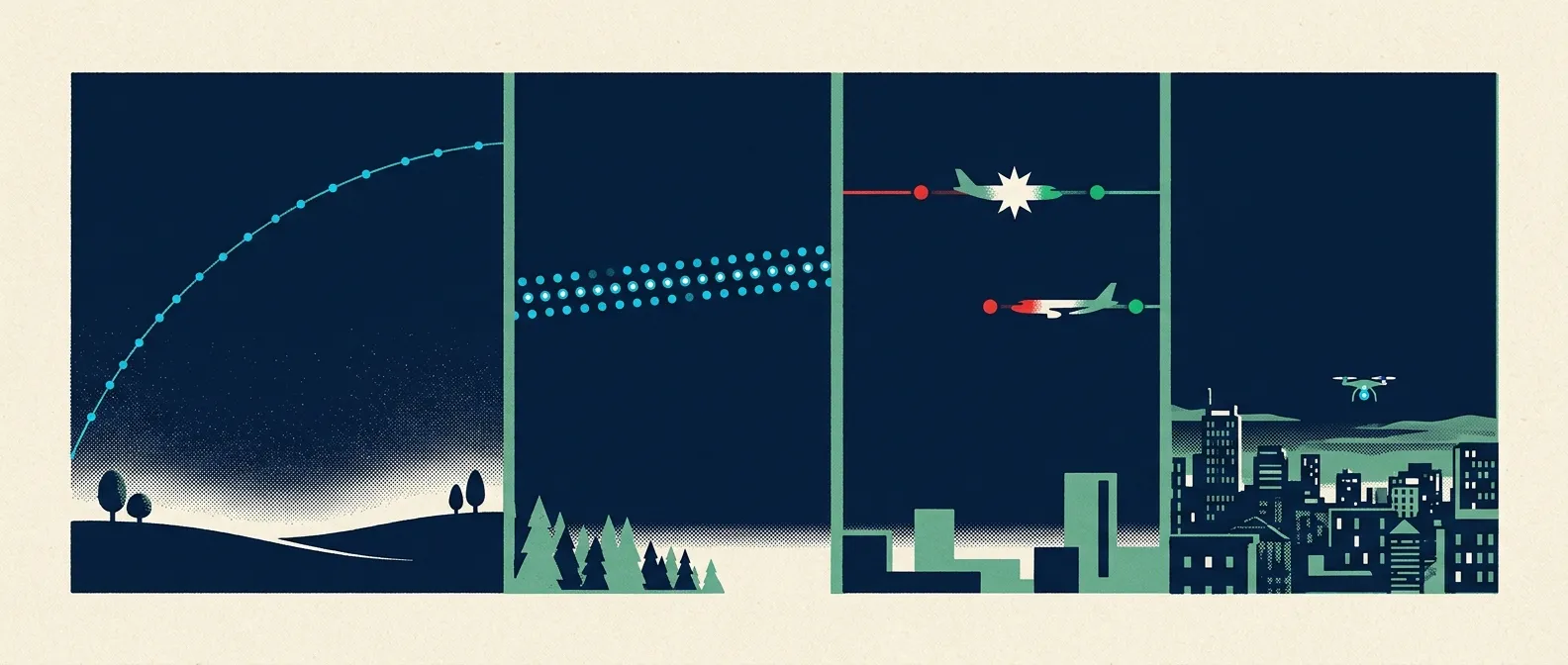
When a light is confirmed not to be a star or planet, it usually fits one of these categories:
- High-altitude weather balloons: Ascend to 60,000–110,000 ft, burst after 90–150 minutes, and reflect high-altitude sunlight long after local dusk.
- Commercial drones: Restricted to 400 ft altitude with battery limits of 20–30 minutes, eventually breaking hover to land.
- Chinese lanterns: Drift between 800 and 3,000 ft for 6–20 minutes as silent, glowing orange-yellow orbs.
- Geostationary satellite glints: GEO satellites at 36,000 km altitude appear fixed. Near equinoxes, their solar panels mirror sunlight directly down to Earth, brightening by up to 6 magnitudes for several minutes before vanishing. Compare with moving satellites and aircraft.
The Autokinetic Effect
First described by Alexander von Humboldt in 1799 (Sternschwanken), the autokinetic effect is a physiological visual illusion.
Staring at a solitary point of light against a featureless dark sky deprives the brain of visual reference frames. Involuntary microscopic eye twitches (microsaccades) are no longer compensated for, making a completely stationary star like Sirius or planet like Jupiter appear to dart, dance, or hover erratically.
How to identify a star or planet in 10 minutes
You do not need special equipment to resolve a sky mystery. Use your hand as an angular gauge and follow this field procedure:
- Pinky finger at arm’s length: Covers ~1 degree.
- Closed fist at arm’s length: Covers ~10 degrees.
- Open hand span (thumb to pinky): Covers ~20 to 25 degrees.
- Check the Scintillation: Stare at the point. Rapid flickering and color changes favor a star; a steady, solid beam favors a planet.
- Check Zodiac Alignment: Trace the path the Sun took earlier. If the object sits far outside this ecliptic corridor or near Polaris, rule out planets.
- Measure Elongation: If the light is in the west after sunset, count fists from the setting Sun. If it is more than 5 fists (50°) away, it cannot be Venus or Mercury.
- The 10-Minute Motion Parallax Test: Align the light precisely against a physical anchor (a building edge, chimney, or telephone pole). Hold your head steady for 10 minutes.
If the point darts around but its average center never shifts from the building edge, you are seeing the autokinetic illusion. If it moves laterally across the building, suspect an aircraft, drone, or balloon. If it creeps slowly westward at 15° per hour (0.25° per minute) with the background constellations, it is a true astronomical body.
To confirm star patterns or star clusters, see our constellation identification guide.
For the light above you right now, open Astro and point your phone at the sky.
Open the live sky