
Parent-Teacher Conferences Across Language Barriers
How to navigate parent-teacher conferences across language gaps: legal rights, demystifying academic jargon, and authentic family-school partnerships.
- Federal legal mandates guarantee access. Title VI and the Equal Educational Opportunities Act require public schools to provide free interpretation for all school meetings.
- Rebalancing epistemic authority. Parents bring vital expertise on the child at home; structured questions convert institutional jargon into collaborative growth plans.
- Eliminating reliance on child brokers. Using students to interpret parent-teacher conferences harms emotional development and violates professional ethics.
The Power Imbalance in Multilingual Parent Conferences
Over 5.3 million English Learners attend public schools across the United States. While parental engagement is the single strongest predictor of academic success, non-native speaking parents frequently encounter intimidating barriers during the standard 15-minute Parent-Teacher Conference (PTC).
Sociological discourse studies demonstrate that conferences are sites where "epistemic authority"—the acknowledged right to claim expertise—is heavily controlled by the school. Teachers often rely on standardized percentiles and specialized acronyms (like ELL, IEP, or BICS), leaving parents nodding to be polite without fully grasping their child's academic standing.
You are an equal expert in your child's education. The school is legally required to ensure you can participate meaningfully in every academic and behavioral decision.
Spoken Exchange in the Classroom
Opening a conference with genuine warmth and clarity allows both the educator and the parent to align on social-emotional growth and classroom participation.
Bilingual Audio Comparison
Listen to the natural spoken phrasing in both languages:
“Thank you for coming today. Sophia has been participating so enthusiastically in class.”
“Дуже дякую. Ми щодня запитуємо її про школу, вона з великим задоволенням ходить на уроки.”
Real-time voice translation allows spontaneous appreciation, removing the clinical stiffness that often plagues formal third-party telephonic translation.
Individualistic vs. Collectivistic Cultural Expectations
Misunderstandings during school meetings often stem from differing cultural values rather than academic deficits.
Western Educational Norms (Individualistic)
- Prizes speaking up, asking questions, and standing out from peers.
- Expects parents to actively question teachers and challenge decisions.
- Views independence and self-advocacy as the primary developmental goal.
Collectivistic Cultural Norms
- Prizes humility, respect for authority, and classroom group harmony.
- Views questioning a teacher as disrespectful or intrusive.
- Views cooperation and family responsibility as the primary metric.
When a teacher notes a student is "quiet during group discussions," a collectivistic parent may interpret this as positive politeness, while the teacher views it as a lack of engagement. Clarifying these expectations through open translation bridges the gap.
In-App Live Translation for Rapid School Meetings
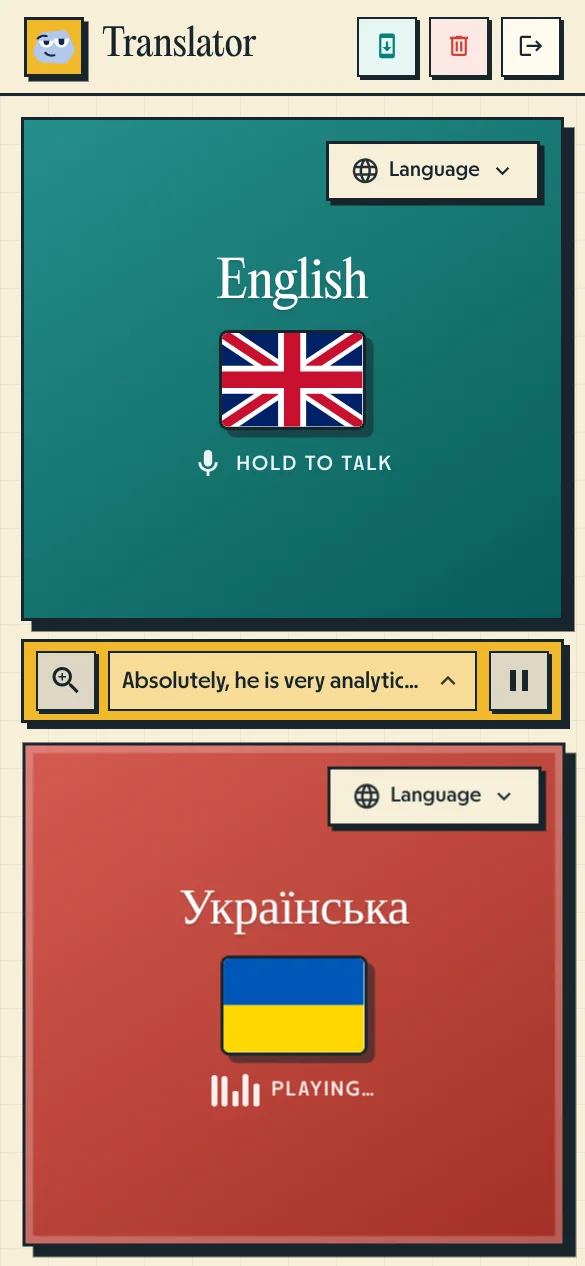
Voice Translator enables natural, bidirectional conversation during fast-paced school appointments, capturing detailed teacher feedback on reading benchmarks and peer collaboration.
Essential Questions to Ask During Your Conference
Do not let technical jargon distract from what matters most. Bring these 4 structured questions to your meeting:
- Academic Mastery: "Is my child reading on grade level, and what specific skills are they working on this semester?"
- Social & Emotional Integration: "How does my child interact with peers during recess and collaborative projects? Do they seem confident?"
- Home Practice Support: "What is one concrete activity or reading routine we should do at home in our native language to support their classroom learning?"
- Language Services & Growth: "How is their English language acquisition progressing, and are they receiving all mandated language support hours?"
To understand why having your child interpret these high-stakes conversations harms both family dynamics and accuracy, read our deep-dive on why children should never translate for parents. For guidance on decoding report cards and school notices, explore understanding report cards and school events.
Build strong relationships with teachers. Pallie translates classroom discussions in real time.
Open Pallie Translator