
Why Kids Should Not Translate for Parents
The psychological trauma, diagnostic hazards, and legal violations of child language brokering, and how technology restores healthy family hierarchies.
- The hidden burden of 'parentification'. Forcing minors to interpret adult legal, medical, and disciplinary topics reverses family hierarchies and causes chronic anxiety.
- Severe diagnostic and academic errors. Children lack technical vocabulary and often soften or alter difficult messages to protect parents from emotional pain.
- Direct violation of federal civil rights. Title VI and ACA Section 1557 explicitly prohibit schools and healthcare providers from relying on minors as interpreters.
The Cost of 'Child Language Brokering'
In millions of immigrant and multilingual households, children are routinely drafted into the role of the family's primary communicator. Known clinically as Child Language Brokering (CLB), this practice involves minors translating everything from school disciplinary hearings and mortgage documents to delicate medical prognoses and landlord disputes.
While low-stakes translation (such as ordering at a restaurant) can foster bicultural pride, high-stakes language brokering creates severe developmental and psychological strain. Longitudinal psychological studies show that adults who served as primary language brokers during childhood exhibit significantly higher rates of chronic anxiety, depression, and social alienation.
When a child translates adult conflicts or medical problems, the traditional family hierarchy collapses. The child is thrust into an adult caretaking role ("parentification"), while the parent feels infantilized and dependent.
Spoken Exchange in Front of the Educator
Communicating directly with school administrators without placing the child in the middle relieves immense psychological pressure and ensures transparent accountability.
Bilingual Audio Comparison
Listen to the natural spoken phrasing in both languages:
“It's so much better to talk directly like this, so your son doesn't feel responsible for translating difficult topics.”
“Так, це набагато зручніше, і знімає з дитини зайву напругу. Дякую за розуміння.”
Direct adult-to-adult dialogue allows teachers and parents to speak candidly about behavioral challenges and emotional needs without filtering feedback through the student.
Why Children Make Unreliable Interpreters
Even highly precocious, bilingual children cannot fulfill the duties of a trained professional interpreter.
Child Language Broker
- Lacks mature vocabulary for legal terms, IEP goals, and clinical conditions.
- Emotional bias: softens bad news to protect parents or avoid personal punishment.
- Absorbs vicarious trauma from hearing adult financial or health crises.
- Experiences role confusion and academic fatigue from missed class time.
Direct Professional / Voice Tech
- Translates specialized terminology accurately and completely.
- Strict neutrality: no filtering, editing, or emotional sugarcoating.
- Preserves parent-child boundaries and parental dignity.
- Fulfills federal legal standards under Title VI and FERPA.
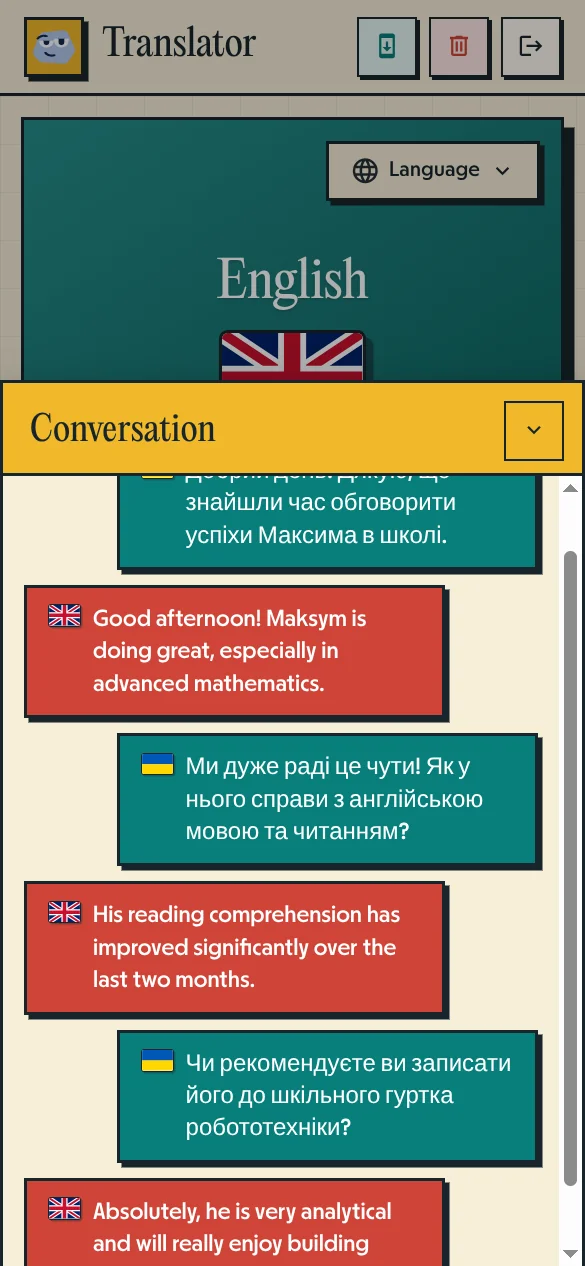
In-App History Feed for Direct Adult Communication
Voice Translator maintains a complete transcript of the conversation, allowing parents and school staff to verify details and review follow-up action items without putting the child in the middle.
How to Transition Your Child Out of the Interpreter Role
Shifting your family dynamic requires clear boundaries and compassionate communication:
- Reassure Your Child Explicitly: Tell them: "You have done a wonderful job helping our family, but adult conversations are my responsibility now. You only need to focus on school and being a kid."
- Inform Schools and Clinics in Advance: Tell receptionists: "Please do not ask my child to translate. We will use a professional interpreter or our voice translation tool."
- Use Voice Translation for Everyday Chores: Handle bakery orders, maintenance requests, and neighborhood chats directly using real-time speech translation.
For practical guidance on preparing for school meetings, see our pillar article on parent-teacher conferences across language barriers.
Protect your child's emotional well-being. Pallie handles adult conversations so your children can stay children.
Open Pallie Translator