Hosting an Exchange Student with a Language Barrier
How to establish household routines, lower the affective filter, and build mutual trust with an international student in their first weeks.
- Treat students as family members, not guests. Include them in daily chores, shared cooking, and casual routines from week one to foster genuine belonging.
- Lower the affective filter through patience. Avoid constant grammatical corrections. Model correct phrasing naturally and permit daily quiet time to prevent burnout.
- Combine visual house rules with spoken voice tools. Written schedules, food preference inventories, and two-way voice translation eliminate arrival anxiety completely.
Opening your home to an international exchange student is a deeply rewarding experience. But during the first few weeks, the language barrier can make even the simplest daily interactions—explaining how the shower works, navigating breakfast preferences, or agreeing on curfews—feel delicate and stressful.
An exchange student does not need perfect fluency to feel welcomed. Clear visual routines, low performance pressure, and supportive voice tools build lasting confidence.
What is the “mental wall” in exchange students?
Living in a total language immersion environment requires immense cognitive energy. When a student attends school in English and interacts with a host family in English all evening, their working memory operates at maximum capacity.
Exchange organizations call this the “mental wall.” By late afternoon, students often experience intense cognitive fatigue. They may retreat to their room, seem unresponsive, or sleep for 10 hours a night.
This withdrawal is not disrespect or homesickness; it is neurological recovery. Give your student space to recharge without taking their quietness personally.
The Affective Filter: how anxiety blocks language learning
Renowned linguist Stephen Krashen developed the Affective Filter Hypothesisto explain why some language learners progress quickly while others freeze up.
When a student feels self-conscious, anxious about making mistakes, or overwhelmed by constant corrections, their “affective filter” rises. This mental barrier prevents new words from being absorbed.
High Affective Filter (Inhibited Learning)
- Constant correction: Correcting every minor tense and preposition error.
- High-stakes testing: Putting the student on the spot in front of dinner guests.
- Fast speech: Talking at rapid native speed without pauses.
Low Affective Filter (Accelerated Learning)
- Natural modeling: Rephrasing the student's idea naturally without formal correction.
- Low-pressure chats: Asking open questions while cooking or doing hands-on activities.
- Extended wait time: Pausing 5 to 7 seconds after asking a question.
The “First Night Questions” protocol
Major exchange programs like Rotary and AFS recommend walking through a structured set of initial questions within the first 48 hours. Covering these topics early prevents compounding misunderstandings:
| Topic Area | Common Cultural Assumption | Host Family Best Practice | Clarification Script |
|---|---|---|---|
| Food & Snacking | Student waits to be offered food and starves quietly out of politeness. | Give an explicit tour of the pantry; designate open-access snack shelves. | “Help yourself to anything on these two shelves anytime you are hungry.” |
| Laundry & Chores | Student is unsure if host parents wash clothes or if they must do their own. | Demonstrate the washing machine step-by-step with visual labels. | “We wash dark clothes on Saturdays. Let us do a load together so you know the settings.” |
| Bathroom Routine | Different plumbing standards (e.g., wet rooms vs. dry bathroom floors). | Show how the shower curtain and ventilation fan work clearly. | “Keep the shower curtain inside the tub so water stays off the floor.” |
| Curfews & Transit | Assumptions about independent public transit vs. suburban car rides. | Establish school pickup spots and weekday evening curfews in writing. | “Text us whenever you leave school so we know when to start dinner.” |
5 daily communication practices for host parents
Incorporate these evidence-based techniques into your household routine:
- Post a visual family calendar: Keep a whiteboard in the kitchen with sports practices, dinner times, and weekend outings written clearly.
- Cook together: Preparing food is a universal, low-stress activity that builds vocabulary naturally without performance pressure.
- Limit home-country calls: Encourage the student to limit video calls with friends back home to once a week so they stay immersed in family life.
- Use supportive modeling:If the student says “Yesterday I go park,” reply warmly: “Oh, you went to the park yesterday? Was it fun?”
- Use voice translation for deep chats: When explaining complex topics like family values, school forms, or emotional feelings, use a real-time voice translator.
Safety & Compliance: High school exchange students under J-1 and F-1 visa regulations must follow strict rules: no driving motorized vehicles, no unauthorized travel, and no substance use. Make sure these rules are understood in their native language on day one.
Bridging arrival conversations with voice translation
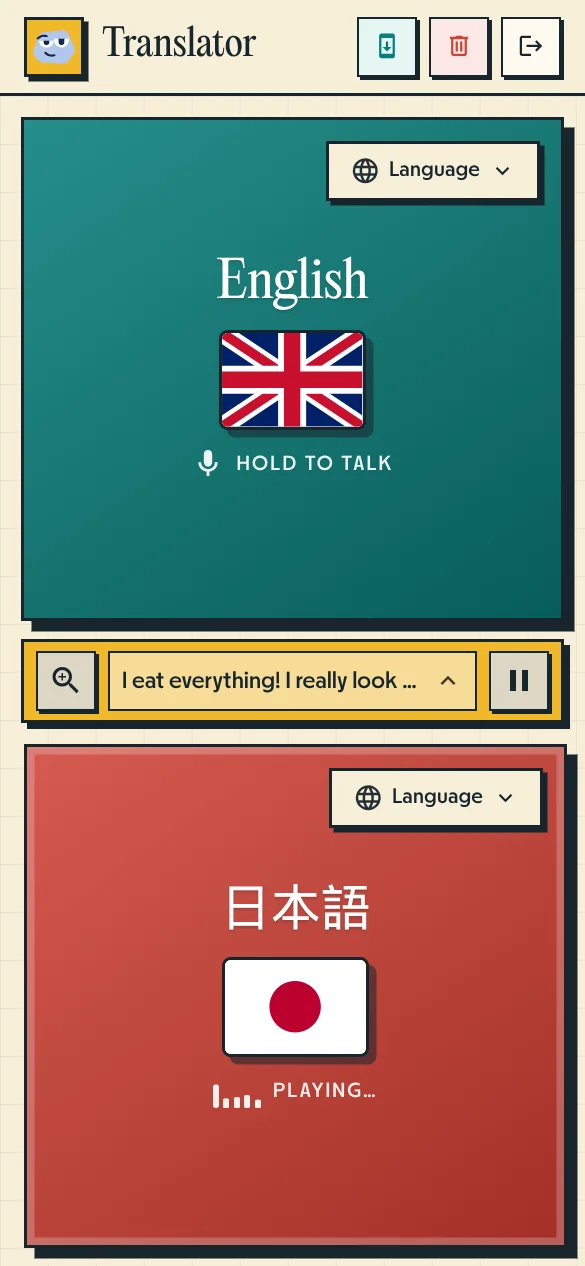
On arrival night, an exchange student is often overwhelmed by jet lag and nervousness. Speaking into a push-to-talk voice translator allows you to welcome them with warmth and make sure they understand important details like room keys, Wi-Fi passwords, and emergency contacts.
Pallie Voice Translator allows both host parents and students to speak in their native tongue and hear natural, polite spoken phrasing instantly.
Spoken Example: Welcoming an Exchange Student on Arrival
Listen to a warm host family welcome in English and Japanese:
“Welcome to our home, Kenji. Here is your room key and the Wi-Fi details on the desk.”
“温かく迎えていただきありがとうございます。お世話になります。よろしくお願いいたします。”
Building a lifelong international bond
Hosting is an educational journey for the entire family. As the initial language hurdles give way to shared laughter, inside jokes, and cultural exchanges, your student becomes a true member of your family.
With patience, clear visual expectations, and supportive voice translation, your home will be a place where an international student thrives and builds memories that last a lifetime.
Welcome international students with warmth. Pallie translates and speaks out loud with natural voice clarity.
Open Pallie Translator