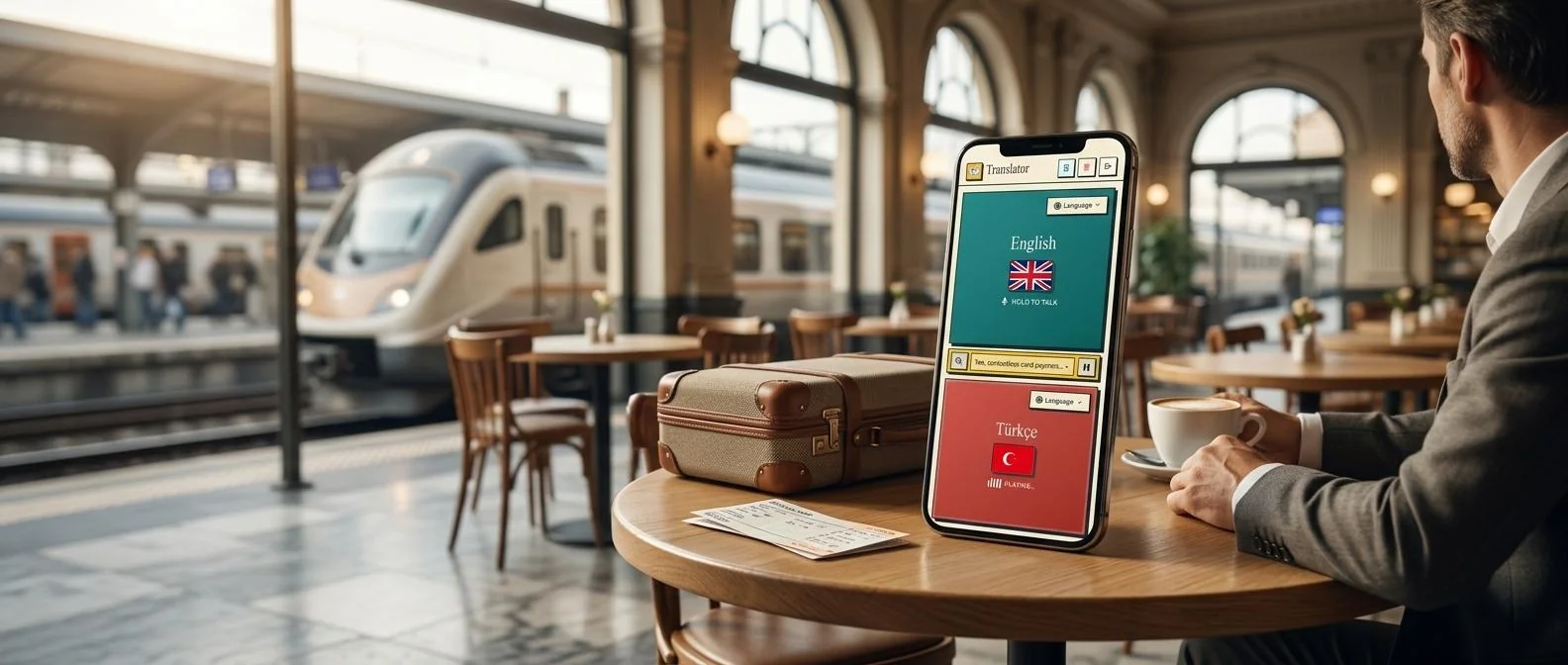
Everyday Spoken Conversations Abroad Guide
How to navigate spontaneous street conversations, bakery orders, train stations, and local markets beyond static phrasebooks.
- Prioritize function over grammatical perfection. Locals appreciate genuine effort. Focus on keywords, warm smiles, and clear intent rather than complex verb tenses.
- Master the 4-step conversational repair loop. When a word is unknown, use circumlocution to describe its function and listen for the local's response.
- Use spoken voice translation for complex navigation. Two-way voice translation lets locals explain multi-turn directions, bus stops, and market entrances in their native language.
Real travel begins when you step off the tourist trail into local markets, quiet neighborhood cafes, and bustling metro stations. But when you only know five basic tourist phrases, asking for directions or ordering fresh produce can feel intimidating.
You do not need fluency to explore confidently. Combining basic local courtesy, descriptive circumlocution, and push-to-talk voice translation turns daily errands into warm cultural connections.
Why do tourist phrasebooks leave travelers stranded?
Traditional phrasebooks teach you how to ask questions, but they never prepare you for the answers.
You might memorize: “Where is the market?” perfectly. But when a friendly local replies in rapid Turkish with three street turns, a landmark reference, and a metro tip, you are left bewildered.
Real communication is a two-way dialogue. Spoken voice translation bridges this gap by letting the local speak naturally at their own speed while you hear the clear translation in English.
Circumlocution: the secret to never getting stuck
Linguists find that the most effective travelers use circumlocution: describing what an object does when you do not know its exact name.
| Target Concept | Unknown Word | Descriptive Circumlocution | Local Outcome |
|---|---|---|---|
| Subway Transit Card | Istanbulkart / Metro Pass | “The plastic card to tap and ride the underground train.” | Clerk immediately hands you the correct transit card. |
| Lactose-Free Milk | Laktozsuz süt | “Milk for people whose stomach gets upset from dairy.” | Barista points to oat or almond milk options. |
| Pharmacy Fever Reducer | Ateş düşürücü | “Medicine for a hot forehead and body chills.” | Pharmacist dispenses standard paracetamol syrup. |
| Laundromat / Dry Cleaner | Kuru temizleme | “The shop that washes and irons wool coats.” | Local points down the street to the dry cleaner. |
Navigating street interactions and body language
How you approach someone on the street matters just as much as the words you use:
What Causes Anxiety
- Rushing up abruptly: Approaching someone too fast without a polite greeting.
- Shouting in English: Repeating words louder when someone does not understand.
- Staring at phone screens: Breaking eye contact during the interaction.
What Creates Warmth
- Local greeting first: Say “Hello” and “Excuse me” in the local language.
- Gentle smile and posture: Keep open hand gestures and respectful distance.
- Sharing the translation: Show the screen or let the audio play out loud.
5 daily protocols for spontaneous travel communication
Adopt these field-tested practices when exploring abroad:
- Master the Big 5 local phrases:Always learn: “Hello,” “Please,” “Thank you,” “Excuse me,” and “Goodbye.”
- Use landmark-based navigation: Ask for prominent visual landmarks (mosque, clock tower, post office) rather than obscure street numbers.
- Point and confirm prices: In markets, point to items and ask for the total on a calculator or translation screen before paying.
- Repeat key transit stops: When boarding a local bus or ferry, repeat the destination stop to the driver to verify you are on the right line.
- Use two-way voice translation: When asking complex questions, hold your phone between you and let the local respond freely.
Asking directions with real-time voice translation
When you need directions to a historic landmark or local transit connection, relying on hand gestures can lead you in the wrong direction.
With Pallie Voice Translator, you can ask naturally in English and let locals hear your question in polite Turkish. The local replies in Turkish, and you receive clear spoken directions in seconds.

Spoken Example: Asking for Directions to the Historic Market
Listen to a friendly street navigation exchange in English and Turkish:
“Could you tell me how to get to the historic Old Market from this metro station?”
“Çıkıştan sağa dönüp düz yürüyün. 5 dakika sonra tarihi kapıyı göreceksiniz.”
Embracing the adventure of travel
Traveling is about stepping outside your comfort zone and connecting with people from different walks of life. When you combine cultural humility, descriptive circumlocution, and voice translation tools, every street corner becomes an opportunity for meaningful connection.
Travel with conversational independence. Pallie translates and speaks out loud instantly across 100+ languages.
Open Pallie Translator