Why Translation Apps Fail in Noisy Places
Why background chatter, cafe noise, and low signal-to-noise ratios break speech recognition, and how acoustic engineering solves the problem.
- The Signal-to-Noise Ratio (SNR) cliff. When ambient noise lowers SNR below 10 dB, ASR word error rates spike from 5% to over 35%, causing catastrophic translation hallucinations.
- Non-stationary 'babble noise' defeats basic filters. Overlapping human voices in cafes corrupt frequency models; neural noise suppression front-ends are required to isolate target speech.
- Proximity beats software filtering. Halving the distance between mouth and phone microphone quadruples the voice signal strength according to acoustic physics.
The Signal-to-Noise Ratio (SNR) Cliff
Voice translation apps that perform flawlessly in quiet offices frequently collapse on busy street corners, crowded cafes, or train platforms. In controlled benchmark tests, state-of-the-art transformer ASR models achieve near-human parity with Word Error Rates (WER) of 3% to 5%.
However, real-world acoustics suffer from what acoustic engineers call a "brittle performance cliff." Research shows that for every 5 decibels (dB) of SNR reduction, speech recognition error rates jump 10% to 20%. In a bustling restaurant with 0 dB SNR, error rates can exceed 40%, garbling critical words before translation even begins.
Translation quality is entirely bounded by input audio quality. If the speech recognition model mishears the source sentence, even the most sophisticated language model will output nonsense.
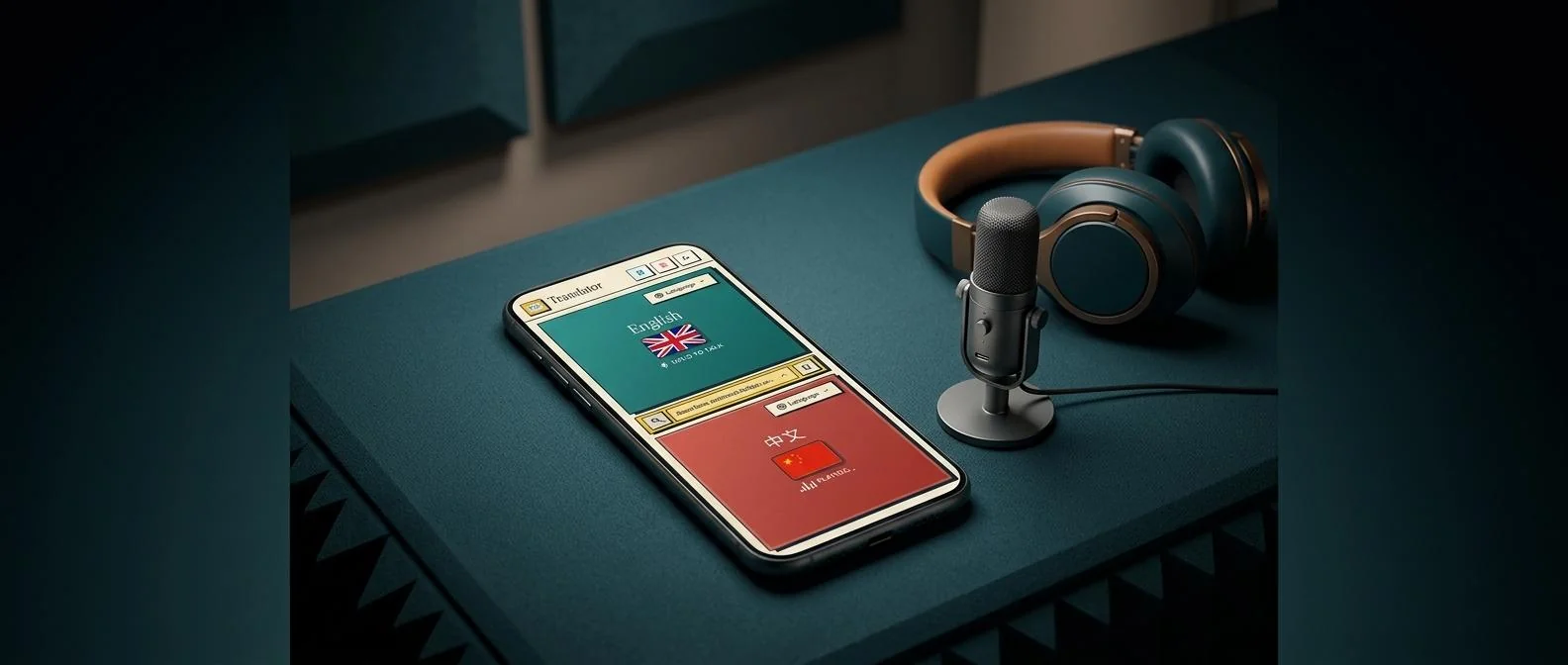
Spoken Demonstration of Microphone Isolation
Holding the phone close isolates your voice from surrounding chatter, preserving pristine acoustic fidelity.
Bilingual Audio Comparison
Listen to the natural spoken phrasing in both languages:
“Holding the microphone close isolates your voice from background street and restaurant noise.”
“贴近麦克风录音能够有效过滤周围噪音,确保翻译的准确率”
Proper proximity ensures that neural speech models process clean vocal fundamentals rather than ambient room reverberation.
Acoustic Profiles and Word Error Rates
Compare how different ambient sound profiles impact automatic speech recognition accuracy:
| Acoustic Environment | Estimated SNR | Standard App Error Rate (WER) | Noise-Hardened ASR |
|---|---|---|---|
| Quiet Office / Living Room | 20+ dB | 3% – 5% (Human Parity) | < 3% (Pristine) |
| Doctor Exam Room / Store | 10 – 15 dB | 12% – 18% (Minor Drops) | 5% – 7% (Reliable) |
| Bustling Cafe / Restaurant | 0 – 5 dB | 35% – 50%+ (Severe Cliff) | 12% – 16% (Usable) |
| Subway Station / Siren Nearby | < 0 dB | 70%+ (Total Failure) | 25% – 30% (Requires PTT) |
Stationary vs. Non-Stationary Background Noise
Why can apps filter an airplane engine easily but struggle in a busy coffee shop?
Stationary Noise (Predictable)
- Air conditioners, refrigerator hums, highway tire road noise.
- Constant spectral energy across consistent frequencies.
- Easily subtracted using standard spectral filtering algorithms.
Non-Stationary Noise (Chaotic)
- Overlapping human voices ("babble noise"), clinking silverware, sirens.
- Shares exact frequency bands and pitch variations with human speech.
- Triggers false word boundaries and hallucinations in open-mic VAD.
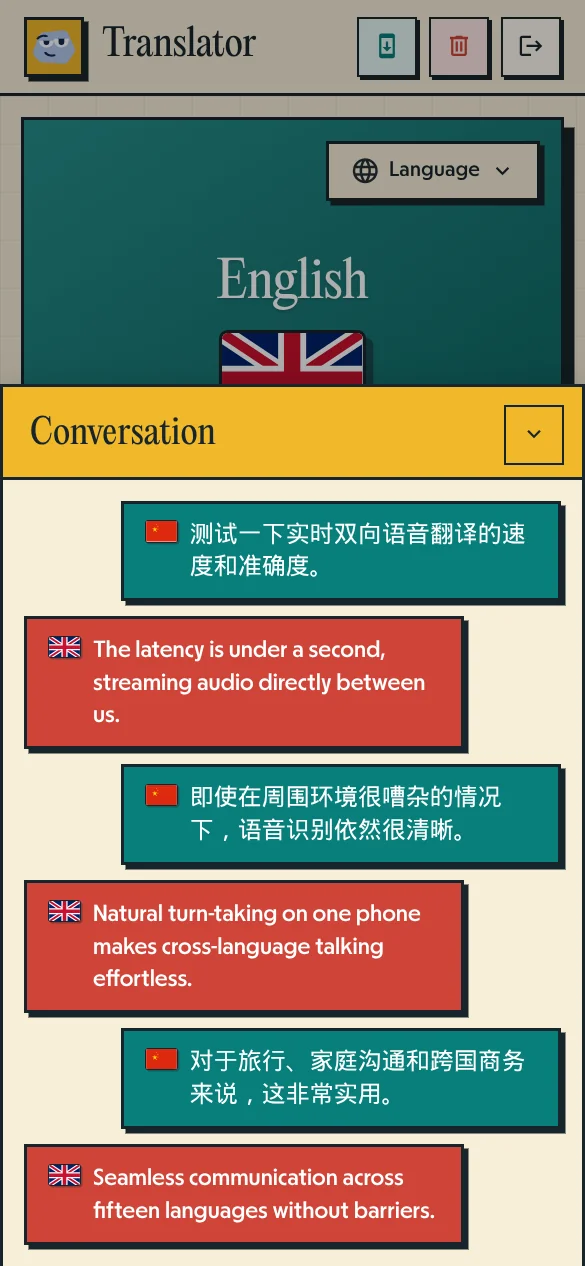
Live Verification in Voice Translator
Voice Translator displays real-time transcription history so speakers can instantly verify that their words were captured cleanly before acting on the translation.
3 Physical Rules for Beating Ambient Noise
Apply these acoustic practices whenever communicating in loud venues:
- Follow the Inverse-Square Law: Hold the phone microphone 4–6 inches from your mouth rather than resting it flat on a table. Proximity quadruples your vocal signal relative to room noise.
- Use Push-to-Talk (PTT): Press the mic button right as you start speaking and release it the moment you finish. This prevents open-mic confusion.
- Choose Strategic Seating: In restaurants, choose booth seating with upholstered backs or corner tables to dampen room reverberation. Read our guide on talking on dates in noisy restaurants.
For guidelines on how to share a translation phone naturally with another person, explore our guide on two-person, one-phone translation etiquette.
Cut through background noise with clarity. Pallie isolates your voice for accurate translation in loud venues.
Open Pallie Translator