Electronically Assisted Astronomy: How Cameras See What Your Eyes Can't
Sensors accumulate photons, Poisson SNR scales as √time, dual-band filters isolate emission lines, and smart telescopes automate urban deep-sky imaging.
- Poisson SNR scales as √integration time. Because noise equals √sky background, quadrupling total exposure time doubles signal-to-noise ratio.
- City light pollution adds a 13× time penalty. Shooting in Bortle 8 requires 13.18 times more total exposure than a Bortle 4 site for identical target SNR.
- Narrowband filters provide 5× to 9× contrast gain. 3–12 nm H-alpha and OIII filters block 99% of LED skyglow and moonlight on emission nebulae.
- Smart telescopes automate alt-az live stacking. All-in-one scopes (Seestar, Dwarf 3, Odyssey) stack 10–30s sub-exposures to build color images in minutes.
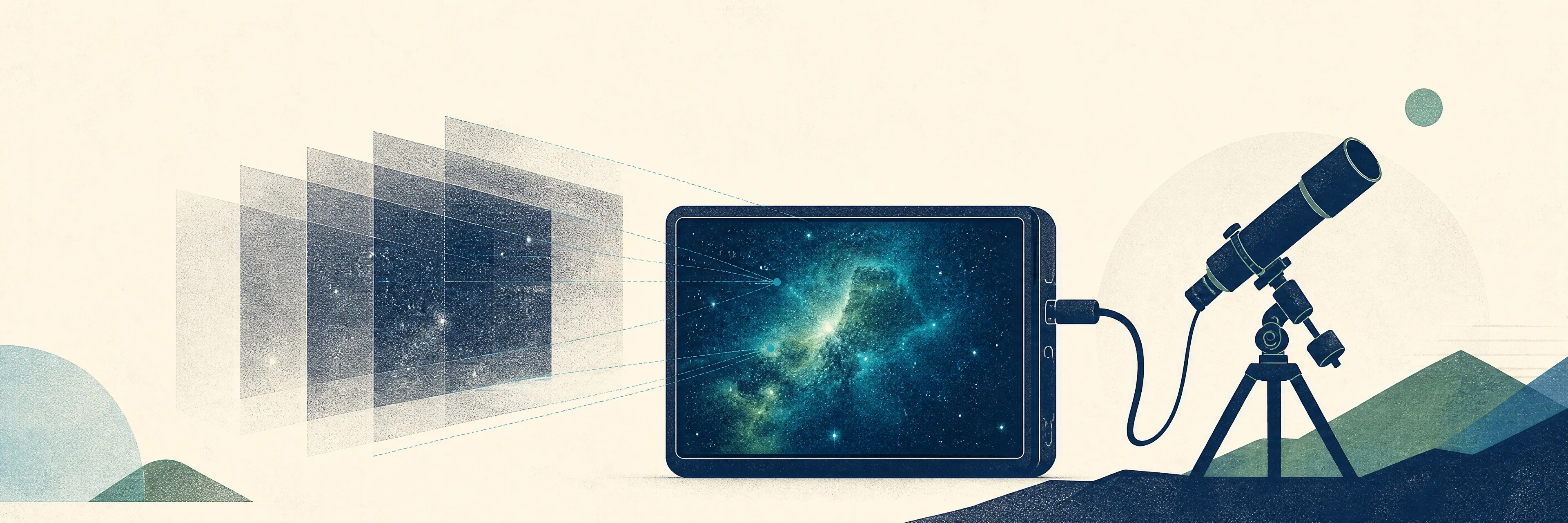
Electronically Assisted Astronomy (EAA) bypasses human visual limits by using digital CMOS sensors to continuously accumulate photons, apply live dark/flat calibration, and stack sub-exposures on screen. It transforms urban stargazing by revealing colorful nebulae and galaxy spiral arms from light-polluted backyards in minutes.
What governs signal-to-noise ratio (SNR) in light-polluted skies?
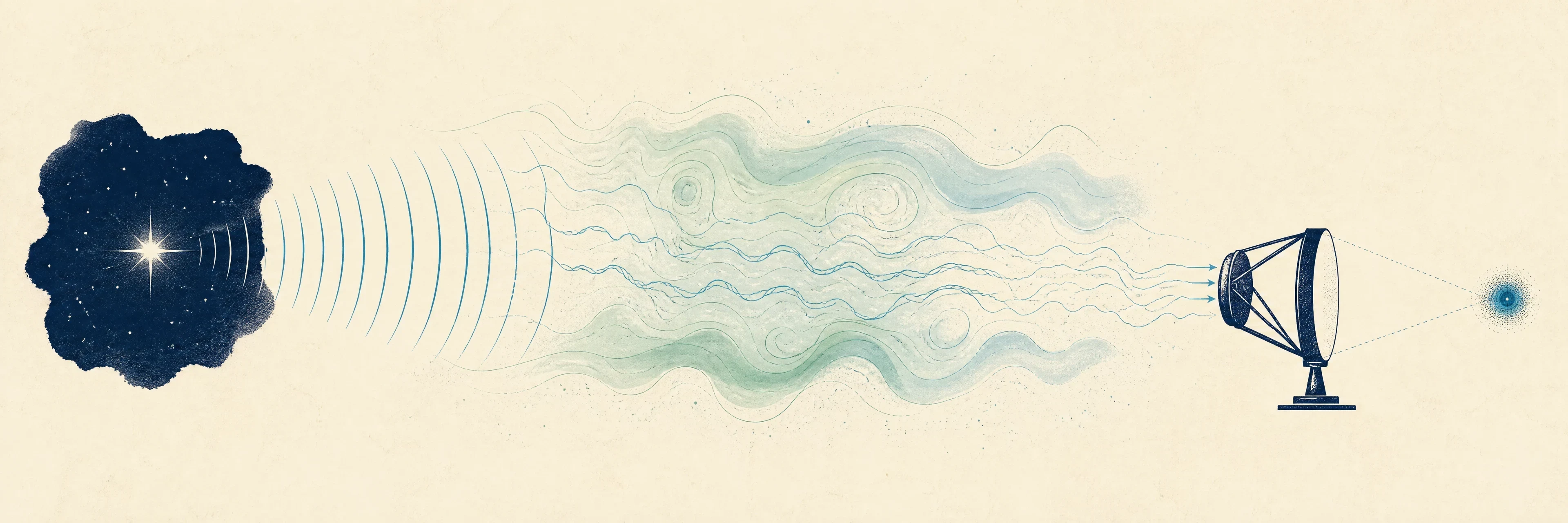
Image quality is defined by the Poisson photon-transfer equation: SNR = (S · t) / √(S · t + B · t + D · t + R²), where S is target signal, B is sky background, D is dark current, and R is read noise. In urban skies, background skyglow noise (√B) dominates. Doubling SNR requires 4 times the total exposure time; tripling SNR requires 9 times.
| Sky Quality Shift | SQM Difference (mag/arcsec²) | Exponential Shot Noise Penalty Formula | Integration Multiplier for Equal SNR |
|---|---|---|---|
| Bortle 1 to Bortle 3 | ~0.5 mag/arcsec² | 2.5120.5 | 1.20× (20% extra time) |
| Bortle 1 to Bortle 4 | ~0.7 mag/arcsec² | 2.5120.7 | 1.91× (nearly double time) |
| Bortle 4 to Bortle 8 | 2.8 mag/arcsec² | 2.5122.8 | 13.18× extra total exposure time |
| Bortle 1 to Bortle 8 | 4.0 mag/arcsec² | 2.5124.0 | 39.81× to 43.00× total exposure penalty |
How calibration frames and stacking algorithms clean raw data
- Dark Frames: Taken at matched exposure, ISO/gain, and temperature with the lens covered. Subtracts sensor thermal dark current and hot pixels. Stacking N dark frames reduces injected dark noise by √N.
- Flat Frames: Evenly illuminated exposures that map optical vignetting and dust motes. Dividing light frames by Master Flats equalizes background illumination across the field.
- Bias Frames: Fast 1/8000s exposures isolating fixed electronic readout noise offsets.
- Sigma-Clipped Rejection: Calculates standard deviation across pixel stacks, discarding satellite trails and cosmic rays exceeding 3-sigma while averaging true celestial signal.
Which filters work against urban skyglow and LED streetlights?
Visual UHC & Narrowband Filters
- UHC Filters: 95%–97% transmission at H-beta (486 nm), OIII (496/501 nm), and H-alpha (656 nm). Yields 5× visual contrast gain.
- Narrowband Filters (3–12 nm): H-alpha, OIII, and SII filters block 99% of city LED skyglow and full moonlight, yielding 9× contrast gain.
- Target Rule: Narrowband works ONLY on emission nebulae; gives zero gain on galaxies, star clusters, or reflection nebulae.
Broadband Filters & Fast Optics Blueshift
- Broadband CLS/LPS Filters: Ineffective against continuous-spectrum white LEDs; blocks target starlight along with skyglow.
- Bandpass Blueshift at Fast Focal Ratios: Steeper light cones on f/2 to f/4 optics blueshift filter coatings, requiring pre-shifted high-speed filters.
Consumer smart telescope comparison and smartphone pipelines
| Smart Telescope Model | Retail Price | Optical Aperture & Focal Specs | CMOS Sensor Specs | Built-In Filter Systems |
|---|---|---|---|---|
| ZWO Seestar S50 | ~$500 | 50 mm Apo Triplet (150 mm f/5) | Sony IMX462 (2.0 MP) | Internal Dual-Band Nebula Filter + External Solar Filter |
| Dwarf 3 Smart Scope | ~$499–$549 | 35 mm Telephoto (150 mm FL) | Sony IMX678 (8.3 MP) | Astro (IR-cut), Dual-Band (OIII/Ha/Hb), VIS, Solar |
| Unistellar Odyssey | ~$2,099–$3,999 | 85 mm Reflector (320 mm f/3.9) | Sony IMX415 (4.1 MP) | Magnetic Smart Solar Filter ($199 option); limiting mag 17.2 |
Primary EAA references: Cosgrove’s Astro Exposure Explorer, Astronomik Filter Specifications, and ZWO Seestar Technical Guide.
Astro combines your local Bortle class with live sky geometry to recommend achievable EAA targets.
Open the live sky