Dark Sky Reserves and Astrotourism: Where the Real Night Sky Still Exists
A dark-sky destination combines certified SQM surface brightness, ERA5 clear-night climate, low horizon obstruction, and safe logistics.
- 83% of global population lives under light pollution. Over 99% of residents in the US and Europe live under light-polluted skies, hiding the Milky Way from 80% of North Americans.
- DarkSky certifications guarantee SQM ≥ 21.2. Sanctuaries, Reserves, and Parks require measured SQM surface brightness ≥ 21.2 mag/arcsec² and annual compliance reports.
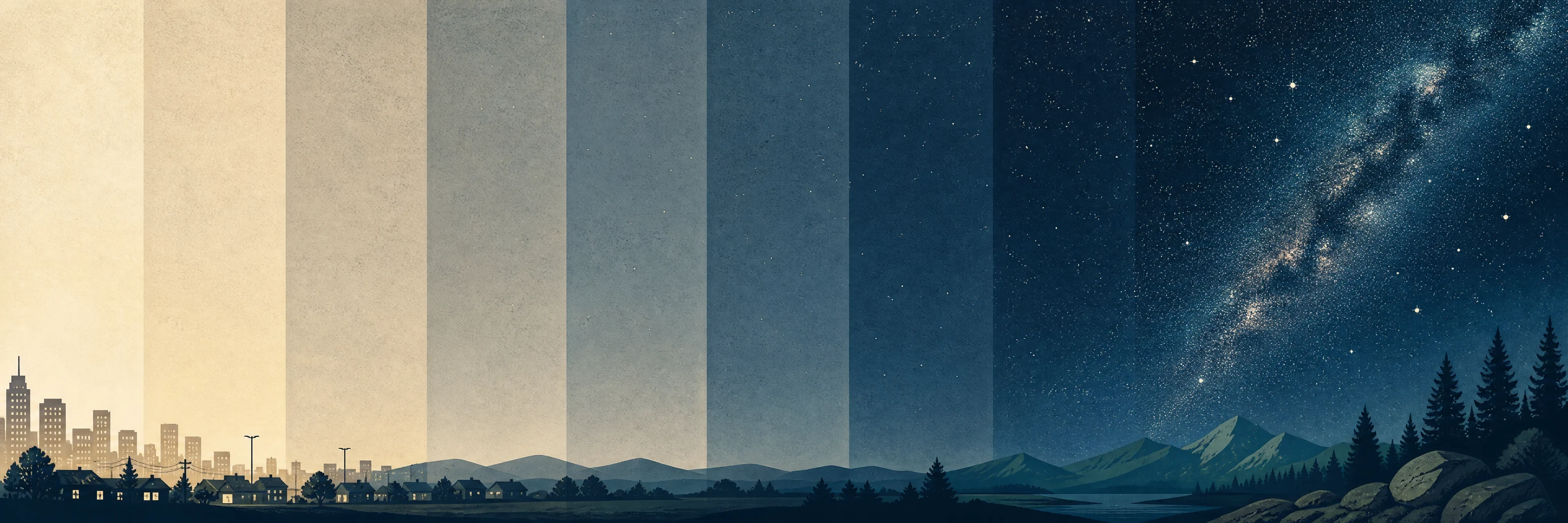
- Walker's Law governs city distance. Skyglow decays as distance to the 2.5 power (d^-2.5); major metropolises require driving 125+ miles (200 km) to reach Bortle 1–2.
- Drowsy driving poses severe return trip risk. Being awake for 24 hours impairs cognitive function equivalent to 0.10% BAC—exceeding legal drunk driving thresholds.
Dark-sky reserves, parks, and sanctuaries protect areas where artificial skyglow remains low enough to reveal the Milky Way, zodiacal light, and faint nebulae. With 83% of the global population and 99% of US and European residents living beneath light-polluted skies, finding natural darkness requires deliberate travel based on SQM surface brightness ratings and climate data.
What do official dark-sky designations require?
| Certification Tier | Primary Environment | SQM Surface Brightness Requirement | Governance & Monitoring Mandates |
|---|---|---|---|
| International Dark Sky Sanctuary | Remote, geographically isolated wilderness | SQM ≥ 21.2 mag/arcsec² (Bortle 1–2) | Pristine core protection; annual dark-sky monitoring report due Oct 1 |
| International Dark Sky Reserve | Dark core surrounded by populated buffer | Core SQM ≥ 21.2 mag/arcsec² | Multi-stakeholder outdoor lighting ordinances across surrounding towns |
| International Dark Sky Park | Public or private conservation land | SQM ≥ 21.2 mag/arcsec² | 100% compliant park outdoor lighting plus annual public education programs |
| International Dark Sky Community | Incorporated city or town | No fixed SQM minimum | Legally binding outdoor lighting codes (full cutoff, <3000K warm LEDs) |
| Urban Night Sky Place | Park near urban metropolitan core | Urban skyglow accepted | Promotes urban lighting abatement and local public outreach |
Notable global dark-sky destinations and measured sky quality
| Destination | Region | Measured SQM / Bortle | Altitude | Mean Clear Nights / Year | Logistics & Travel Notes |
|---|---|---|---|---|---|
| NamibRand Nature Reserve | Namibia, Africa | 21.6 to 22.0 (Bortle 1) | 1,000 m | ~300 nights | Gold-tier IDA Reserve; accessible via 4x4 or light aircraft; high-desert climate |
| Cosmic Campground | New Mexico, USA | 21.89 to 21.99 (Bortle 1) | 1,600 m | ~250 nights | IDA Sanctuary in Gila National Forest; free tent/RV camping, 65 km from light source |
| Elqui Valley (Gabriela Mistral) | Coquimbo, Chile | 21.9+ (Bortle 1–2) | 1,500 m | ~300 nights | World's 1st Dark Sky Sanctuary; high-altitude desert, exceptionally low humidity |
| Hanle Dark Sky Reserve | Ladakh, India | Bortle 1 (>21.8) | 4,500 m | ~300 nights | Extreme high-altitude desert; requires inner-line permit and cold acclimatization |
| Westhavelland Nature Park | Brandenburg, Germany | 21.6 to 21.7 (Bortle 2) | Near sea level | <100 nights | IDA Reserve 70 km from Berlin; extremely flat 0°–2° horizon; low clear-night yield |
| Aoraki Mackenzie Reserve | South Island, New Zealand | 21.9+ (Bortle 1) | 700 m | >200 nights | 436,700 hectare reserve; premier southern hemisphere dark-sky oasis |
Site-selection parameters: climate, horizon, and Walker's Law
Artificial skyglow intensity decays inversely with distance raised to the 2.5 power (I ∝ P · d−2.5). However, site selection requires evaluating four additional parameters:
Horizon & Elevation Parameters
- Horizon Obstruction: Target sites with <5° horizon blockage. Southern horizon clarity is critical in the Northern Hemisphere.
- Elevation Advantage: High plateaus (1,500–2,500 m) sit above the dense aerosol boundary layer, boosting transparency.
- Ground Surface Thermal Mass: Grass and soil reach thermal equilibrium in 1–2 hours; concrete/asphalt radiate heat for 4–6 hours.
ERA5 Cloud Climatology vs Darkness
- The Darkness Paradox: Many dark sites (e.g. Scotland, Westhavelland) suffer from low clear-night counts (<100/yr).
- High Deserts Win: High deserts (Atacama, Namib, Colorado Plateau) combine Bortle 1 skies with >250 to 300 clear nights.
- Copernicus ERA5: Evaluate 20-year hourly ERA5 reanalysis data to confirm clear-sky probability before booking travel.
Astrotourism economics and night-time driving safety
- Economic Market Expansion: The global stargazing tourism market is projected to reach $4.57 billion by 2034 (10.8% CAGR). The 2024 total solar eclipse delivered direct economic impacts exceeding $100M to Ohio and $150M to Indiana.
- Drowsy Driving Physiology: Remaining awake for 18 hours causes cognitive impairment equivalent to a 0.05% Blood Alcohol Concentration (BAC). Remaining awake for 24 hours equals 0.10% BAC—exceeding legal drunk driving limits in all US states.
- Hypothermia & Radiative Cooling: Clear night skies act as a 200 K heat sink. Observers lose heat rapidly through radiation and convection. Clinical hypothermia initiates when core body temperature drops below 35°C (95°F).
- Red-Light Etiquette & Land Access:White light instantly bleaches retinal rhodopsin, requiring 30–45 minutes to restore dark adaptation. Use dim red lights (>650 nm) and secure overnight park permits before setting up.
Primary datasets: Falchi New World Atlas, DarkSky International Directory, and Sleep Foundation Drowsy Driving Study.
Astro matches your location to nearby dark-sky reserves, driving distances, and real-time cloud conditions.
Open the live sky