The Best Time to See the Stars Tonight
Astronomical darkness, lunar phase, light pollution, transparency, seeing turbulence, and space weather dictate night-sky visibility.
- Wait for −18° solar depression. Astronomical darkness begins when the Sun drops 18° below the horizon, settling natural sky brightness at 21.8 to 22.0 mag/arcsec².
- Observe during moonless windows. A full Moon delivers 0.1 to 0.3 lux of illuminance, raising sky brightness and suppressing faint stellar targets to magnitude 9.5.
- Keep targets above 30° altitude. Viewing at 30° altitude cuts through 2.0 airmasses; going lower doubles atmospheric extinction and turbulence.
- Differentiate transparency and seeing. Clean dry air (high transparency) is required for faint galaxies; stable thermal layers (low seeing FWHM) sharpen planets.
The optimal time to see stars tonight occurs during astronomical darkness when the Sun is at least 18° below the horizon, the Moon is below the horizon or in a thin crescent phase, and atmospheric extinction remains low. Evaluating six core physical metrics determines whether a site will yield clear views of the Milky Way or limit targets to bright planets.
Which physical conditions control night-sky observability?
Six measurable parameters govern what can be seen from Earth on any given night. While light pollution and solar position set the baseline background darkness, weather factors like humidity, aerosol extinction, and atmospheric thermal turbulence decide image sharpness and contrast.
| Condition | Optimal Threshold | Quantitative Metric | Primary Astronomical Impact |
|---|---|---|---|
| Solar Darkness | Sun below −18° | 21.8 – 22.0 mag/arcsec² | Eliminates scattered sunlight in upper atmosphere |
| Lunar Illuminance | Moon absent or phase <0.1 | 0.1 – 1.0 mlux (New Moon) | Preserves deep-sky contrast for faint nebulae |
| Light Pollution | Bortle 1 to 3 | SQM >21.3 mag/arcsec² | Exposes Milky Way dust lanes and naked-eye structure |
| Transparency | Aerosol Index <0.7 | kV ≈ 0.16 mag/airmass | Maximizes light transmission for diffuse galaxies |
| Seeing Turbulence | FWHM <1.0 arcsec | Fried parameter r0 > 15 cm | Resolves planetary bands, lunar craters, and double stars |
| Moisture & Dew | Spread >5 K, RH <70% | Air-to-dew-point gap | Prevents optic fogging and atmospheric scattering haze |
When does the sky reach absolute darkness?
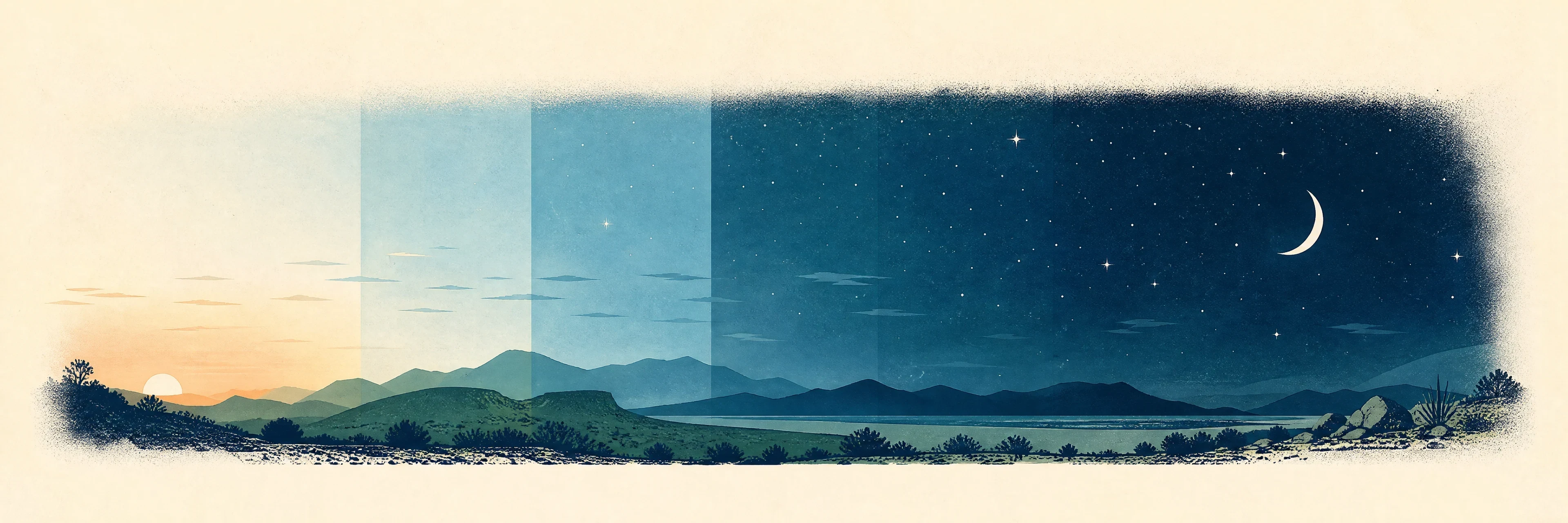
The progression from sunset to true night passes through three distinct solar depression angles. Scattered sunlight completely dominates civil twilight (0° to −6°). During nautical twilight (−6° to −12°), sky brightness drops from 14.5 to ~20.0 mag/arcsec². In urban centers with heavy skyglow, background light plateaus around 16 to 17 mag/arcsec², meaning nautical and astronomical twilight yield no functional difference in darkness.
Absolute astronomical darkness requires a solar depression of at least −18°. Under pristine conditions, zenith sky brightness reaches a natural floor of 21.8 to 22.0 mag/arcsec², bounded only by starlight, zodiacal light, and natural airglow. At latitudes above 48.55° near the summer solstice, the Sun never reaches −18°, creating continuous astronomical twilight (white nights) where deep-sky imaging is constrained.
How does the lunar cycle degrade sky brightness?
The Moon acts as the primary natural light source, altering background sky illumination by orders of magnitude across its 29.5-day synodic cycle. Peak illuminance occurs at full Moon, delivering 0.1 to 0.3 lux (over 100 mlux). By comparison, a quarter Moon yields 10 to 100 mlux, a crescent Moon generates 1.0 to 10 mlux, and an astronomical new moon drops to a baseline of 0.1 to 1.0 mlux.
Lunar brightness exhibits a non-linear surge known as opposition surge. Albedo increases by approximately 7% at exact full opposition phase angle. Scattered photons from a full Moon restrict unguided short-exposure limiting magnitude to roughly 9.5 for stellar point sources, making faint targets fainter than 18.5 AB magnitude virtually undetectable without long integration times.
Why does local light pollution override sky darkness?
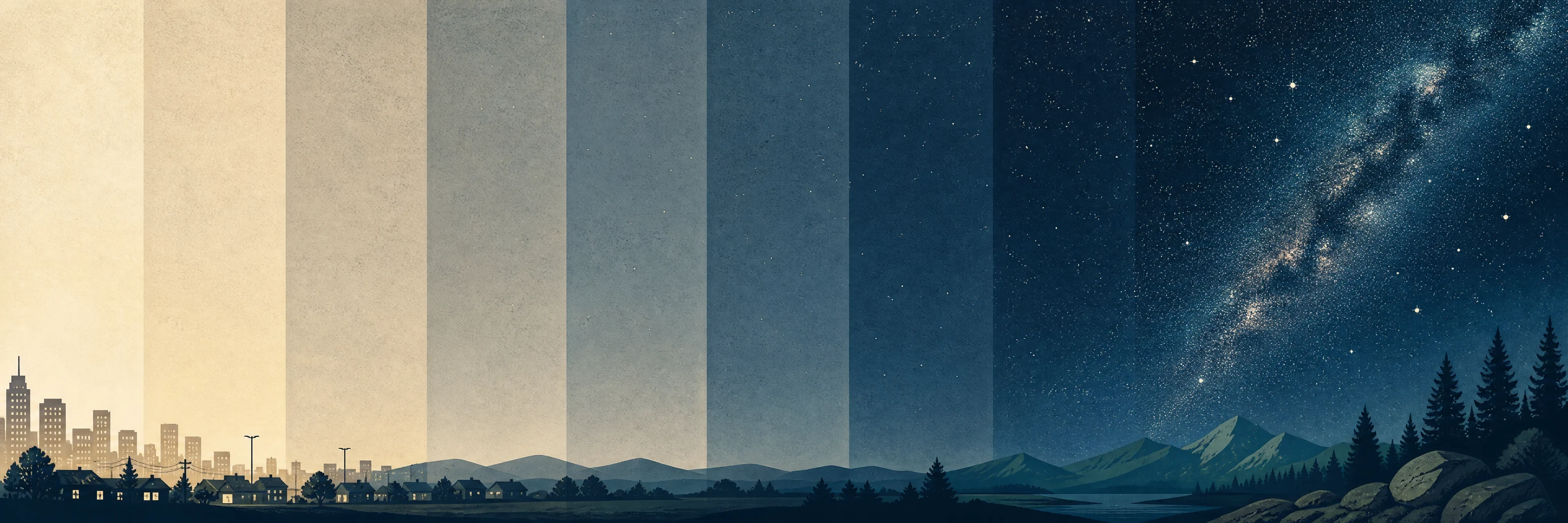
Anthropogenic skyglow is classified using the 9-level Bortle Dark-Sky Scale and measured in magnitudes per square arcsecond using Sky Quality Meters (SQM). Excellent dark sites (Bortle 1) read above 21.7 mag/arcsec² with a naked-eye limiting magnitude (NELM) of 7.6 to 8.0. In contrast, city skies (Bortle 8) read 17.8 to 18.3 mag/arcsec², while inner-city cores (Bortle 9) drop below 17.8 mag/arcsec².
Data from the global citizen-science program Globe at Night revealed that global artificial skyglow is expanding at 9.6% per year. Satellite radiometry historically reported a 2% annual increase because satellite sensors like VIIRS DNB are blind to short-wavelength blue light emitted by white LEDs. Because blue light scatters more efficiently via Rayleigh scattering and matches human scotopic visual sensitivity, visual skyglow from the ground has escalated faster than orbital models estimated. Falchi et al. demonstrated in the New World Atlas of Artificial Night Sky Brightness that 80% of the global population and over 99% of residents in the US and Europe live under light-polluted skies.
How do transparency and seeing determine target selection?
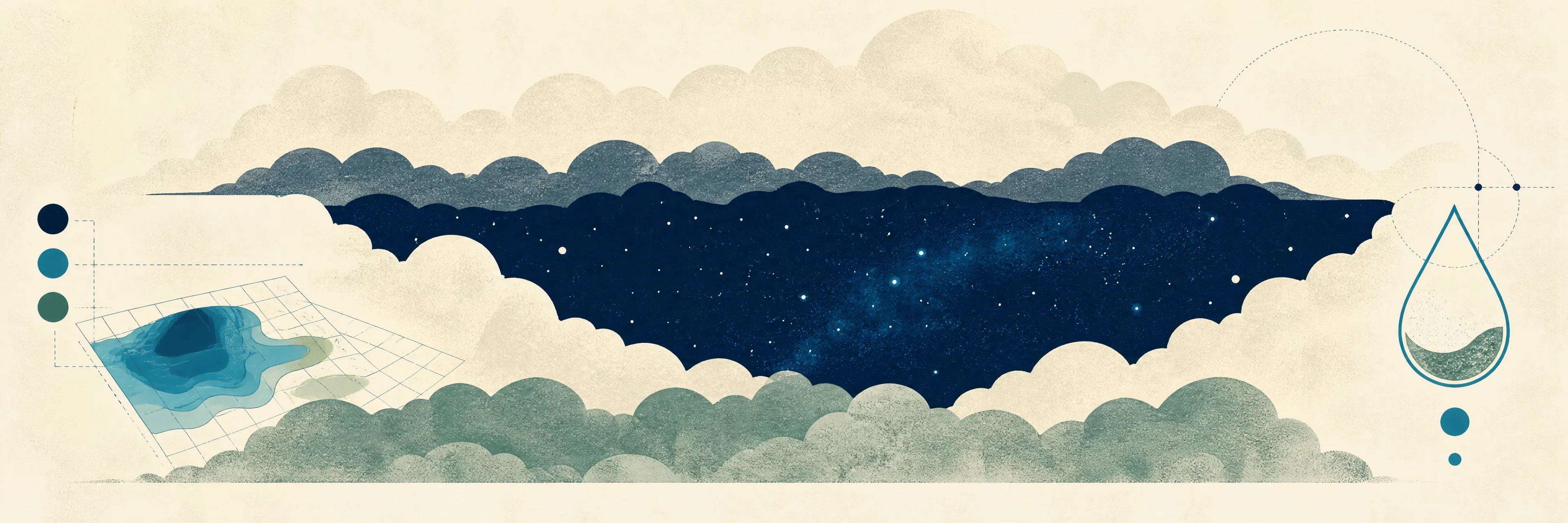
Atmospheric Transparency
- Dictated by aerosols, smoke, dust, and water vapor content.
- Measured via atmospheric extinction coefficient kV ≈ 0.16 mag/airmass.
- Critical for observing low-surface-brightness galaxies, nebulae, and comets.
- Requires observing targets above 30° altitude to stay under 2.0 airmasses.
Seeing Turbulence
- Dictated by thermal air boundary layers and jet-stream shear.
- Measured by Full Width at Half Maximum (FWHM) of atmospheric point spread function in arcseconds.
- Constrained by Fried parameter r0 (5 to 20 cm in visible light).
- Critical for high-magnification planetary, lunar, and double-star details.
Observing at low altitudes incurs severe airmass penalties. Airmass (X) equals 1.0 at zenith and increases to 2.0 at an altitude of 30°. Below 30°, light passes through twice as much atmospheric gas, doubling extinction losses. When moisture accumulates and the temperature-to-dew-point gap shrinks below 2 K, optical condensation becomes imminent and low-level atmospheric haze drastically degrades visual contrast.
What role do space weather and ephemerides play in nightly planning?
Transient phenomena require real-time ephemeris data and satellite telemetry. Low Earth Orbit (LEO) satellite tracking relies on Two-Line Element (TLE) sets processed by SGP4 algorithms. Due to upper atmosphere drag, SGP4 position predictions decay by 1 to 3 kilometers per day, limiting reliable pass forecasts to a 7-day window.
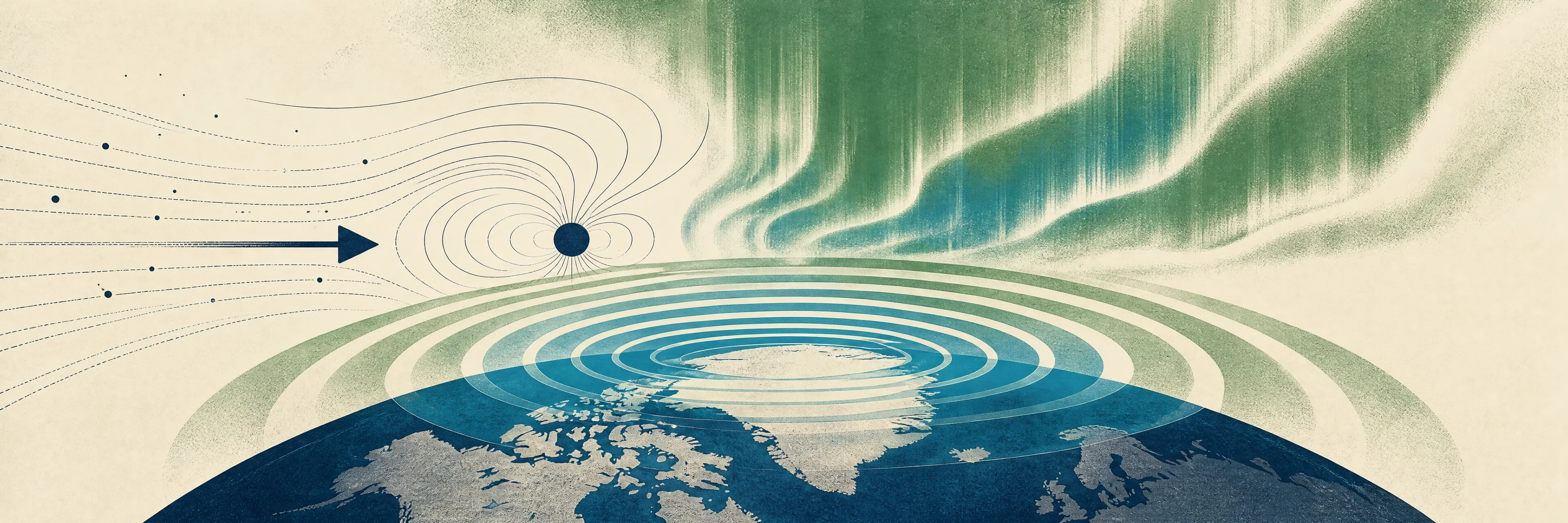
Mid-latitude auroral displays depend on solar wind activity monitored at the L1 Lagrange point by spacecraft such as DSCOVR. Auroral visibility requires a southward interplanetary magnetic field (Bz < 0) to connect with Earth’s magnetic field. Space weather is indexed via the Kp scale (0 to 9). At Kp 0, the auroral oval boundary resides near 66° geomagnetic latitude; a Kp 5 storm pushes the oval equatorward to 56°, and a severe Kp 9 storm brings auroras down to 48° geomagnetic latitude. Solar Cycle 25 peaked in late 2024 with a smoothed sunspot number of 160.8, sustaining elevated auroral potential through the mid-2020s.
How to plan your stargazing session tonight
- Determine astronomical twilight limits. Identify the precise time when the Sun drops past −18° solar depression for your latitude.
- Check lunar phase and rise/set times. Schedule faint deep-sky targets during intervals when the Moon is set or less than 10% illuminated.
- Review ECMWF clear-sky model data. Inspect high-resolution cloud cover forecasts (~9 km grid) and verify that high, mid, and low cloud layers remain near 0%.
- Verify dew-point spread and relative humidity. Ensure the air temperature remains at least 3 K above dew point and humidity stays below 70% to prevent lens fogging.
- Select targets above 30° altitude. Filter target selection to constellations overhead to minimize airmass extinction (X ≤ 2.0).
- Check live Kp index and Bz telemetry. If Bz turns negative and Kp exceeds 5, prioritize dark northern horizon lines for auroral activity.
Live astronomical telemetry: NOAA SWPC Aurora Forecast, Airmass Extinction Model, and HNSKY Sky Brightness Metrics.
Astro matches your exact coordinates to real-time ephemerides and atmospheric parameters so you know when to look up.
Open the live sky