Civil, Nautical, and Astronomical Twilight: When Does the Sky Actually Get Dark?
Solar depression angle sets baseline darkness; latitude, lunar phase, and retinal physiology dictate your usable observing window.
- Absolute darkness starts at −18°. Astronomical twilight ends when the Sun drops 18° below the horizon, settling sky brightness near 21.8 to 22.0 mag/arcsec².
- Summer dark windows shrink by latitude. Above 48.55° latitude, astronomical twilight runs continuously through midnight around the summer solstice.
- Full Moon obliterates 90% of stars. A full Moon produces up to 0.3 lux of illuminance, brightening the sky to 18 mag/arcsec² and cutting visible stars from 3,000 to 300.
- Full dark adaptation takes 30–45 minutes. Cones adjust in 5–10 minutes; rod cells require 30–45 minutes of unbroken darkness for a 100,000× sensitivity gain.
The transition from daylight to night is not an instantaneous switch but a multi-stage decay of atmospheric solar scattering. Determining when the sky gets dark requires tracking three distinct solar depression zones, accounting for high-latitude seasonal shifts, and measuring lunar illuminance interference.
What are the exact solar depression angles of twilight?
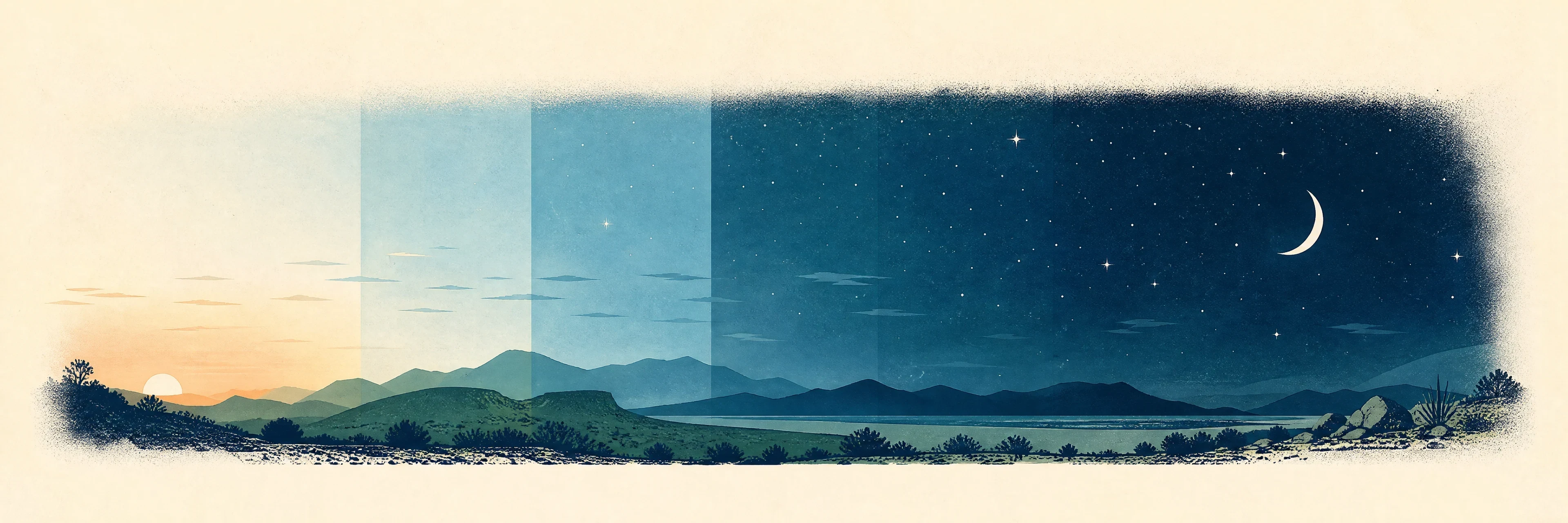
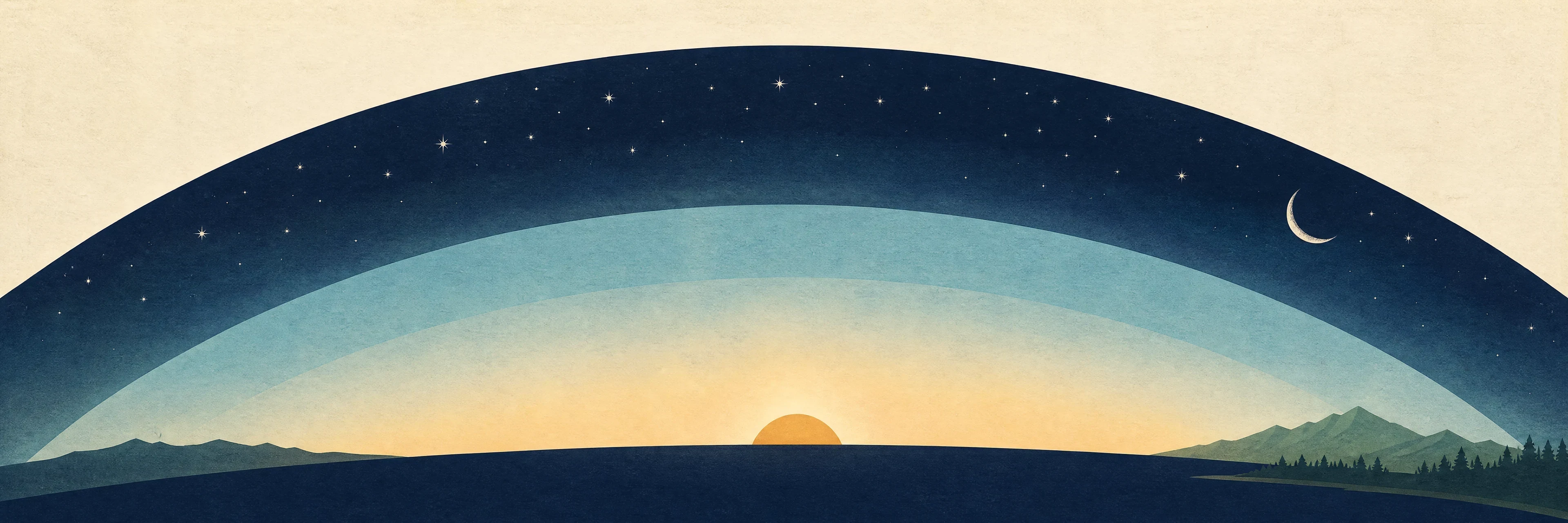
Twilight is governed by Rayleigh scattering of sunlight through atmospheric nitrogen and oxygen molecules. As the Sun sinks deeper below the horizon, Earth’s shadow rises through higher atmospheric layers, restricting solar illumination to upper altitude regions.
| Twilight Phase | Solar Altitude (h) | Zenith Sky Brightness | Dominant Optical Phenomena & Targets |
|---|---|---|---|
| Civil Twilight | 0° to −6° | ~13.1 mag/arcsec² | Rayleigh first-order scattering; Na (589 nm) and O (630 nm) emissions; Venus, Jupiter, Sirius visible |
| Nautical Twilight | −6° to −12° | 13.1 to 19.3 mag/arcsec² | Second-order multiple scattering; 99% of zenith shadowed; sea horizon fades |
| Astronomical Twilight | −12° to −18° | 19.3 to 21.8 mag/arcsec² | Upper atmosphere residual scattering; green O (557.7 nm) airglow dominates |
| Astronomical Night | Below −18° | 21.8 to 22.0 mag/arcsec² | Natural background limit; deep-sky galaxies, nebulae, and Milky Way structure revealed |
At −18° solar depression, indirect solar illumination on a horizontal surface drops to 6 × 10⁻⁵ lux, contributing less than 0.1% of background sky brightness. This is the baseline required for sensitive deep-sky imaging.
How does latitude change annual dark hours?
The duration of twilight depends on latitude and solar declination, calculated via the hour angle equation cos(H) = (sin h − sin lat × sin dec) / (cos lat × cos dec). Near the summer solstice (dec = +23.44°), the Sun plunges at a shallow angle relative to the horizon.
At latitudes above 48.55°, cos(H) < −1 at midnight, meaning the Sun never reaches −18°. Astronomical twilight persists all night, wiping out true astronomical darkness for weeks. Nautical twilight remains continuous above 54.55°, and civil twilight persists above 60.55° (White Nights).
| Latitude | Annual Astronomical Dark Hours (Sun < −18°) | Summer Solstice Darkness Status |
|---|---|---|
| 0° (Equator) | 3,463.8 hours | Full darkness every night (~70 min total twilight) |
| 30° N / S | 3,293.7 hours | ~6.5 hours of astronomical darkness |
| 40° N / S | 3,106.7 hours | ~4.5 hours of astronomical darkness |
| 48.55° N / S | 2,751.2 hours | Threshold boundary; 0 hours of true darkness at solstice |
| 60° N / S | 2,217.4 hours | Continuous civil/nautical twilight all night in summer |
| 70° N / S | 1,901.8 hours | Midnight Sun in summer; 24-hour dark windows in winter |
Why is moonlight non-linear and how does it destroy contrast?
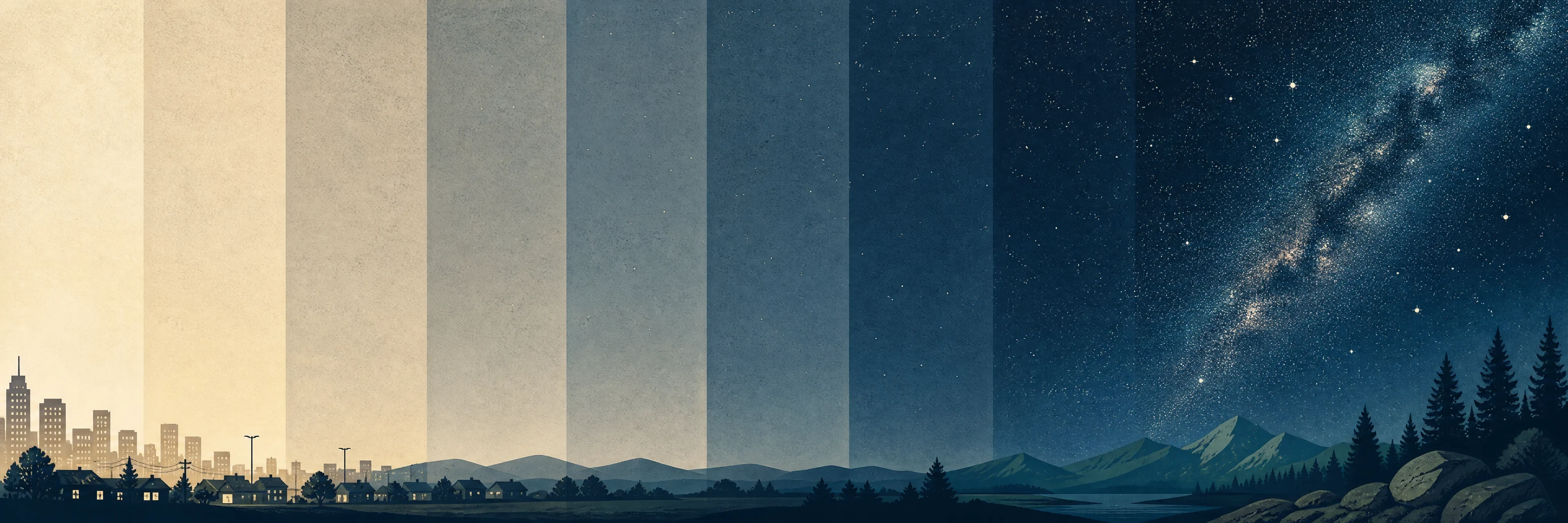
A zenith full Moon produces up to 0.3 lux of ground illuminance, brightening the zenith sky to ~18.0 mag/arcsec²—a 40-fold spike in background light relative to a moonless night (22.0 mag/arcsec²). This reduces visual limiting magnitude by 2 to 4 magnitudes, cutting naked-eye visible stars from ~3,000 down to 300 (a 90% loss).
Opposition Surge & Regolith Shadowing
- Lunar surface regolith casts micro-shadows at phase angles >0°.
- A First Quarter Moon (50% area) is only 1/9th as bright as full Moon.
- Coherent backscatter causes a 40%+ albedo spike within 4° of zero phase.
Telescopic Imaging Impact
- Full Moon increases background noise floor exponentially.
- Telescopic integration times must increase 40× for equal S/N.
- Rayleigh scattering dims blue filters much more than red/IR filters.
How do human physiological adaptation and age alter viewing?
Human dark adaptation involves two distinct photoreceptor phases: cone adaptation (photopic) and rod adaptation (scotopic). Cone cells adjust within 5 to 10 minutes, but rod sensitivity depends on the biochemical regeneration of rhodopsin (visual purple), which has a half-life of roughly 5 minutes.
- Cone-Rod Break (10 minutes): Regenerating rod cells surpass cone sensitivity after 10 minutes of darkness.
- Full Scotopic Adaptation (30–45 minutes): Complete rhodopsin restoration yields up to a 100,000× increase in visual sensitivity.
- Red Light Protection (>650 nm): Rhodopsin is insensitive to deep red wavelengths, preserving rod adaptation while allowing cone vision to read charts.
- Averted Vision: The central fovea contains zero rods. Looking 8° to 15° off-center places target light on rod-dense parafoveal retina.
- Senile Miosis Impact: Maximum dark-adapted pupil size contracts by 0.043 mm per year (~0.6–1.0 mm per 20 years). A 20-year-old pupil (7.0–8.8 mm) admits 1.5 to 8 times more light than an 80-year-old pupil (4.5 mm).
Ephemerides precision references: Skyfield Python Library, ELP/MPP02 Lunar Theory, and Royal Society Pupil Lifespan Data.
Astro matches your location and target coordinates to real-time twilight and lunar ephemerides.
Open the live sky