
When to Lift vs Run: Avoiding the Interference Effect
The molecular tug-of-war between AMPK and mTOR, the 6–9 hour rule, same-day ordering — and the nutrition that quietly saves the session.
- Separate days > 6–9 hour gap > back-to-back.Different days is ideal. If you must stack, leave at least six hours — three is the hard floor, below that you blunt strength gains.
- Lift first if you must share a day.Fresh nervous system, protected mTOR signal. Pair the lift with a later easy swim or Zone-2 bike, not a track session.
- Refuel aggressively between sessions.1.0–1.2 g carbs per kg per hour suppresses AMPK; 20–40 g leucine-rich protein after the lift re-lights mTOR.
Strength helps. Most triathletes now accept that. The next, harder question is where to put it in the week without wrecking the endurance sessions it is supposed to support. The answer sits at the cellular level — in a small molecular argument between two signalling pathways that run on almost exactly the same timescale as a training day.
What the interference effect actually is
The phenomenon has a date. In 1980, exercise physiologist Robert Hickson ran a 10-week intervention at the University of Illinois: one group trained endurance only, one trained strength only, and one did both. The concurrent group still improved, but their strength gains were dramatically smaller than the pure-strength group — and the degradation got worse over time (Hickson, 1980). That blunting of one adaptation by the other is the interference effect, and forty-five years of molecular biology have since pinned down its mechanism.
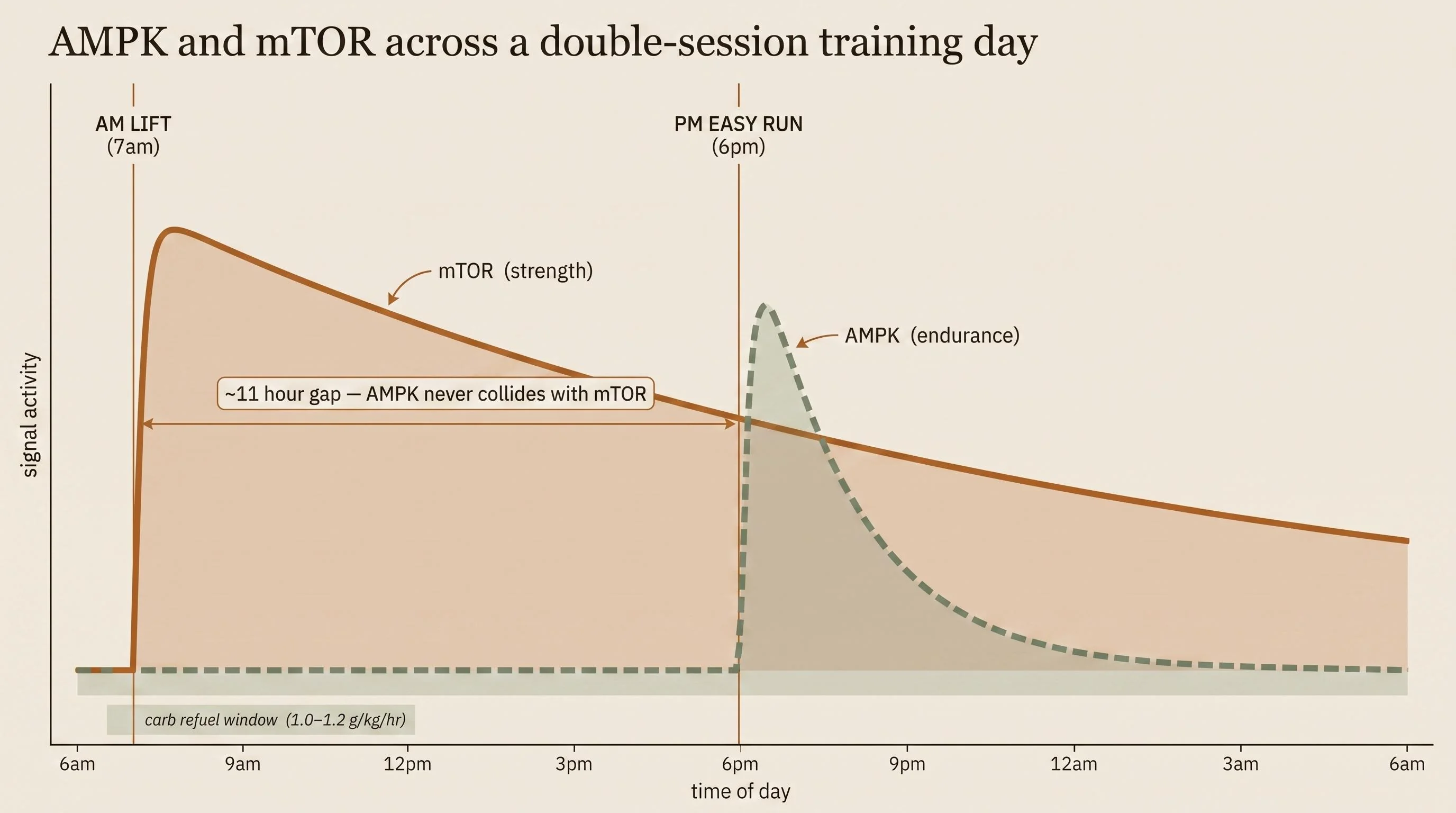
Strength training activates the mammalian target of rapamycin (mTOR) pathway — a master regulator of cell growth and muscle protein synthesis. The mTOR signal fires within minutes of a heavy set and stays meaningfully elevated for 24 to 36 hours (Coffey & Hawley, 2014). Endurance training — especially glycogen-depleting work at or above threshold — activates a different sensor, AMP-activated protein kinase (AMPK), which tells the cell to conserve energy, build mitochondria, and burn fat. AMPK is a short, sharp spike that resolves inside three to six hours.
The problem is that those two pathways are not neutral roommates. AMPK directly inhibits mTOR. If the AMPK spike from a hard run overlaps the mTOR window from a heavy squat, the endurance signal physically shuts down the strength signal. The gym work still hurts. It just stops adapting.
The AMPK spike from a hard run actively shuts down the mTOR signal your squats just fired. Same muscle, same day — the second stimulus silences the first.
The 6-to-9 hour separation rule
If two signals are in conflict and one clears in 3–6 hours while the other runs for 24–36, the fix is obvious: don't fire them at the same time. Separate-day scheduling is cleanest — AMPK on Monday, mTOR on Tuesday, neither interrupts the other. Most triathletes can't afford that. Double-days are how the volume gets done.
The working compromise, supported by a 2020 narrative review on concurrent-training molecular timing, is a minimum three-hour gap between sessions and a strong preference for six to nine hours (Methenitis, 2018). Inside that window AMPK has time to clear, glycogen has time to resynthesise, and the mTOR signal from the later lift runs unopposed. The pattern below is what that looks like over a training day — an AM strength session, a refuel window, and a PM easy endurance block.
| Gap | Interference | When to use | Example pairing |
|---|---|---|---|
| < 3 hours | Severe | Never. Pick one session and do it properly. | Hard track intervals → heavy squats same hour. |
| 3–6 hours | Moderate | Tolerable with strict refueling; low-intensity endurance only. | Easy swim AM → heavy lift at lunch; refuel in between. |
| 6–9 hours | Low | The default working window for double-days. | AM heavy lift → PM Zone-2 bike or easy run. |
| Next day | Minimal | Always the first choice if schedule allows. | Mon strength, Tue hard run — nothing overlaps. |
“Gap” is measured end-of-first-session to start-of-second. The rule is asymmetric — the six-hour guideline matters most when the earlier session was high intensity or glycogen-depleting.
Same-day ordering: lift first, endurance later
When the calendar forces both on the same day, order matters almost as much as gap length. The logic is straightforward: protect the session whose adaptation you want most, and protect it by going first.
- CNS fresh. The morning lift sees full motor-unit recruitment and a genuine heavy load.
- mTOR protected. The signal fires into a clean background — no pre-existing AMPK suppression.
- Endurance tolerates fatigue.Zone-2 or easy technique work doesn't need a rested CNS the same way maximal lifting does.
- Best pair: AM heavy squat → PM easy swim, Zone-2 bike, or recovery jog.
- Only when endurance is the priority session. Threshold run, hard brick, long ride — these must come off fresh legs.
- Accept interference. The lift that follows will be neurally fatigued and the mTOR signal partially suppressed.
- High-intensity endurance → heavy lifting is the worst pairing. Don't follow a track session with a squat session even four hours later.
- Best pair: AM key interval session → PM maintenance-intensity lift (low volume, moderate load).
The pragmatic default for an amateur triathlete with a morning training window and an evening one: AM is strength day, PM is the easy aerobic block.Hard intervals move to a different day entirely. This is the schedule shape Rønnestad's cycling studies consistently used, and it maps cleanly onto a work-life calendar (Rønnestad et al., 2010).
Intensity matching: not all endurance interferes equally
The interference effect is modality-dependent. Running produces the most interference with lower-body lifting, because every foot strike is an eccentric contraction — the muscle lengthens under load, and eccentric work is the type of stimulus that causes the deepest muscle damage and the longest-running inflammatory response. Cycling is far gentler; the pedal stroke is almost purely concentric. Swimming is the easiest stack of all — it loads a completely different muscle group.
The practical implication is the pairing rule. If the gym day has to include endurance, the endurance partner should be:
- Swim before lift. Upper-body stimulus, no lower-body damage, negligible glycogen cost if the session is technique-focused.
- Easy bike before or after lift. Low eccentric load, moderate glycogen cost. Pair with Zone-2 spinning, not threshold intervals.
- Recovery jog after lift. 20–30 minutes of Zone-1 shakeout is fine the same evening as an AM lift.
- Avoid: hard track intervals or tempo runs on any day with lower-body lifting, regardless of order.
The nutrition bridge
The 6–9 hour rule exists because AMPK needs time to decay. You can actively accelerate that decay with food. AMPK is triggered in part by low muscle glycogen, so deliberately refilling the tank tells the sensor that the energy crisis is over and it can stand down (Hawley, GSSI).
The common failure mode is fasted concurrent training — skipping breakfast, running hard on empty, then lifting at lunch with a protein shake and nothing else. The AMPK signal never clears, mTOR never properly activates, and both sessions were compromised. If you lift in the morning after fasted endurance, put food between them.
A worked model week
The table below is one coherent build-phase week for a well-trained short-course triathlete, applying every rule above. It isn't the only shape that works, but it is a shape that works.
| Day | AM (~6am) | Refuel / mid-day | PM (~5pm) |
|---|---|---|---|
| Mon | Hard run: 60' track intervals | Aggressive carbs (1.2 g/kg/hr ×3h) | Heavy lift: 45' squat focus, 4×4 @ 85% |
| Tue | Easy bike: 90' Zone 2 | Balanced macros, mobility 15' | Rest or 20' yoga |
| Wed | Hard swim: 60' threshold | Moderate carbs, full lunch | Easy run: 45' Zone 1–2 |
| Thu | Heavy lift: 45' deadlift / plyo | 30 g whey + carbs immediately post-lift | Easy bike: 60' spin |
| Fri | Rest | High protein day (~2 g/kg) | Rest |
| Sat | Long brick: 3h bike + 30' run | In-session fuel, post-session carbs | Rest |
| Sun | Long run: 90' steady | Normal intake | Rest |
Two heavy lifts (Mon PM, Thu AM) live on days that also carry a key endurance session, separated by an eleven-hour gap and bridged by deliberate carbohydrate refueling. Friday is a true rest day to protect the mTOR tail from Thursday and set up the weekend volume. Notice what is not on the schedule: there is no day that pairs a hard run with a heavy lower-body lift inside six hours.
Rather than re-type this into a spreadsheet, build your own week automatically from race distance, phase and hours available.
DOMS, the Repeated Bout Effect, and not abandoning the plan in week one
Every new block starts sore. Delayed onset muscle soreness peaks 24 to 72 hours after unaccustomed eccentric work — that first set of back squats, the first set of step-downs, the first plyometric session — and for the two or three days afterwards every stride feels like it is carrying twenty extra pounds (review of DOMS mechanisms).
The good news is evolutionary. The Repeated Bout Effect (RBE) means that by the second session of the same exercise, soreness drops sharply; by the fourth, it is largely gone, even as loads climb. The protective effect lasts up to six months. But the RBE requires exposure. Skipping session two because session one hurt, or rotating in a different set of exercises every week, keeps the athlete stuck in perpetual week-one soreness.
Two rules protect adherence through the first block:
- Under-dose the first two sessions. Leave 4–5 reps in the tank. You are trying to trigger the RBE, not set a PR.
- Don't rotate exercises for 4–6 weeks. Squat, hinge, push, pull — hold the core movements long enough for the body to adapt to those specific patterns.
Scheduling mistakes that quietly cost you
- Hard run in the morning, heavy squats at nightThe interval run spiked AMPK, the legs are pre-fatigued, and the evening lift is a signal suppressed by its own warm-up. Either push the lift to the next day or demote the AM run to Zone 2.
- Lift the day before the long run24 hours is the minimum gap between lower-body lifting and a key long run. Sunday's pace is going to be slower, form breaks down sooner, and the run's aerobic purpose gets diluted.
- Chasing soreness with more lifting“I'm still sore so I'll do abs instead.” Low-level concentric movement (easy swim, 20' Zone 2 spin, mobility) clears DOMS faster than rest or extra volume. Don't add load.
- Fasted hard endurance + fasted liftingStacking two glycogen-depleting stimuli without food keeps AMPK chronically elevated and guarantees interference. Fasted Zone 2 is fine; fasted concurrent is not.
- AM lift → PM easy bike → ~ 11h gapThe clean default. Heavy lift opens the mTOR window, refuel carries through the morning, and an evening Zone-2 spin doesn't generate enough AMPK to interfere.
Bottom line
Put strength on a different day from your hardest endurance session. If you can't, leave six to nine hours between them, put the lift first, and bridge the gap with carbohydrate. Don't stack a hard run with heavy lower-body lifting on the same day, in any order. Everything else — yoga, easy swim, Zone-2 spin — is fair game the same day as the gym.
The interference effect is not a reason to skip strength training. It is a reason to schedule it.