

Masters Runner Training Plan: How to Train After 40, 50 and 60
Not a slower version of a younger plan — longer microcycles, stricter polarisation, real strength, recovery as training.
The masters runner — usually defined as 40+ in endurance sport — is not a slower version of a 25-year-old. Recovery kinetics, hormonal response, tendon stiffness and intensity tolerance all shift. Forcing a younger template onto an older body is the fastest route to overtraining and Achilles tendinopathy. Masters runners now account for more than half of all marathon finishers, and the programming literature has caught up. What follows is what the research actually says.
The physiology shift at 40+
Three physiological realities set the shape of every masters training plan. The first is VO2max decline. Sedentary adults lose roughly 10% per decade after 30; trained endurance athletes still lose about 5–7% per decade, driven largely by a drop in maximal heart rate (~0.5–0.7 bpm per year) caused by electrical remodeling of the sinoatrial node. This decline cannot be stopped — but the rate can be slowed with appropriately dosed high-intensity work.
The second is sarcopenia. Adults lose 3–8% of muscle mass per decade from their 30s, accelerating after 70. The loss is not uniform: Type II fast-twitch fibers go first, which is why force production (and therefore running speed and power) declines faster than raw mass. Strength is lost 2–5 times faster than muscle, which is why heavy lifting becomes mandatory rather than optional.
The third — and the good news — is preserved running economy. Highly trained 60-year-old runners can demonstrate the same oxygen cost per kilometer as trained 25-year-olds. Lactate threshold, expressed as a percentage of the (declining) VO2max, stays stable or even rises. Masters programming therefore becomes an exercise in limitation management: protect the VO2max ceiling, fight sarcopenia with load, and ride the preserved aerobic base for as long as possible.
Why the 7-day week stops working
Every mainstream training plan is built on a 7-day calendar week with two or three quality sessions and a long weekend run. That template was inherited from work schedules, not physiology. For a masters runner it quietly fails.
A hard interval session that needed 24 hours of recovery at age 30 can require 48–72 hours at 55 — driven by slower protein synthesis, elevated inflammatory response, and anabolic resistance, the aging body's reduced ability to convert training stimulus into muscle repair. Run three hard workouts in seven days and the third one happens in a fatigue hole. Quality drops, form breaks down, and overuse injuries compound.
The evidence-based fix is to stretch the microcycle. 9-day and 10-day cycles let a 50+ runner insert a true easy day — or even a full rest day — between each stress. The week stops being the organising unit; the cycle does.
Not sure which version of the cycle fits your life? Build your masters microcycle.
Your training week by decade
40s — the transition decade
Most athletes in their 40s can still run a 7-day week, provided they enforce easy days ruthlessly. The temptation is to train like a 30-year-old and absorb it with stubbornness. That works for a year or two, then breaks down as niggles accumulate.
- Microcycle: 7 days, occasionally stretched to 8 during higher-volume blocks.
- Hard sessions: 2 per week (1 VO2max, 1 threshold or tempo).
- Recovery: 1 complete rest day or active recovery day, minimum.
- Deload: 2:1 or 3:1 depending on total load and life stress.
50s — the adaptation decade
By the 50s the cost of ignoring recovery becomes undeniable. “Catching up” on missed workouts is the fastest way into overtraining. This is the decade where the 9- or 10-day microcycle actually earns its keep.
- Microcycle: 9 days is the sweet spot. If life demands a 7-day schedule, run hard/easy/easy/hard rather than hard/easy/hard.
- Hard sessions: 2 per microcycle, strictly polarized.
- Recovery: at least 2 clearly distinct recovery days per week.
- Deload: 2:1 — two weeks of progression then one week of cut-back volume and intensity.
60+ — the preservation decade
At 60+ the job is no longer “improve” — it's “preserve the ceiling”. VO2max work still happens, but in short, surgical doses. Overuse injury risk is the primary constraint.
- Microcycle: 10–14 days.
- Hard sessions: 1–2 per week maximum across all disciplines. For runners specifically, consider replacing one high-impact interval session with a moderate tempo or cross-training effort to spare the joints.
- Recovery: minimum 72 hours between hard efforts.
- Deload: 2:1, with the deload week genuinely easy.
The 9-day microcycle blueprint
Here's what a canonical 9-day cycle looks like for a 50s runner with strength training. The same skeleton works for 60+ with reduced volume and shorter intervals on Day 1.
| Day | Focus | Session | Complementary work |
|---|---|---|---|
| 1 | High intensity | VO2max intervals (Zone 4) | Heavy strength, 70–85% 1RM |
| 2 | Recovery | 30–45 min Zone 1 | 10-min prehab (hip/knee/ankle) |
| 3 | Volume | 60–90 min aerobic base (Zone 2) | — |
| 4 | Volume | 45–60 min Zone 2 | 10-min prehab |
| 5 | Moderate | Threshold / tempo (Zone 3) | Heavy strength, 70–85% 1RM |
| 6 | True rest | Complete rest | 10-min prehab |
| 7 | Volume | 60 min Zone 2 | — |
| 8 | Long | Long run (Zone 2) | — |
| 9 | Recovery | Active recovery or rest | Restorative mobility |
Two hard days (1 and 5), one long day (8), three Zone-2 days, two recovery/rest days, one true rest day.
Intensity distribution: the ratio shifts with age
Here's the counter-intuitive finding. As a runner ages, total weekly volume goes down, but the proportion of high-intensity time actually goes up. The reason: VO2max is the ceiling you're trying to preserve, and it responds specifically to time spent near that ceiling. Moderate “grey zone” work is too fatiguing to leave room for real VO2max sessions, and not strong enough to preserve the ceiling on its own. As masters runners age, grey-zone work is the first thing to cut.
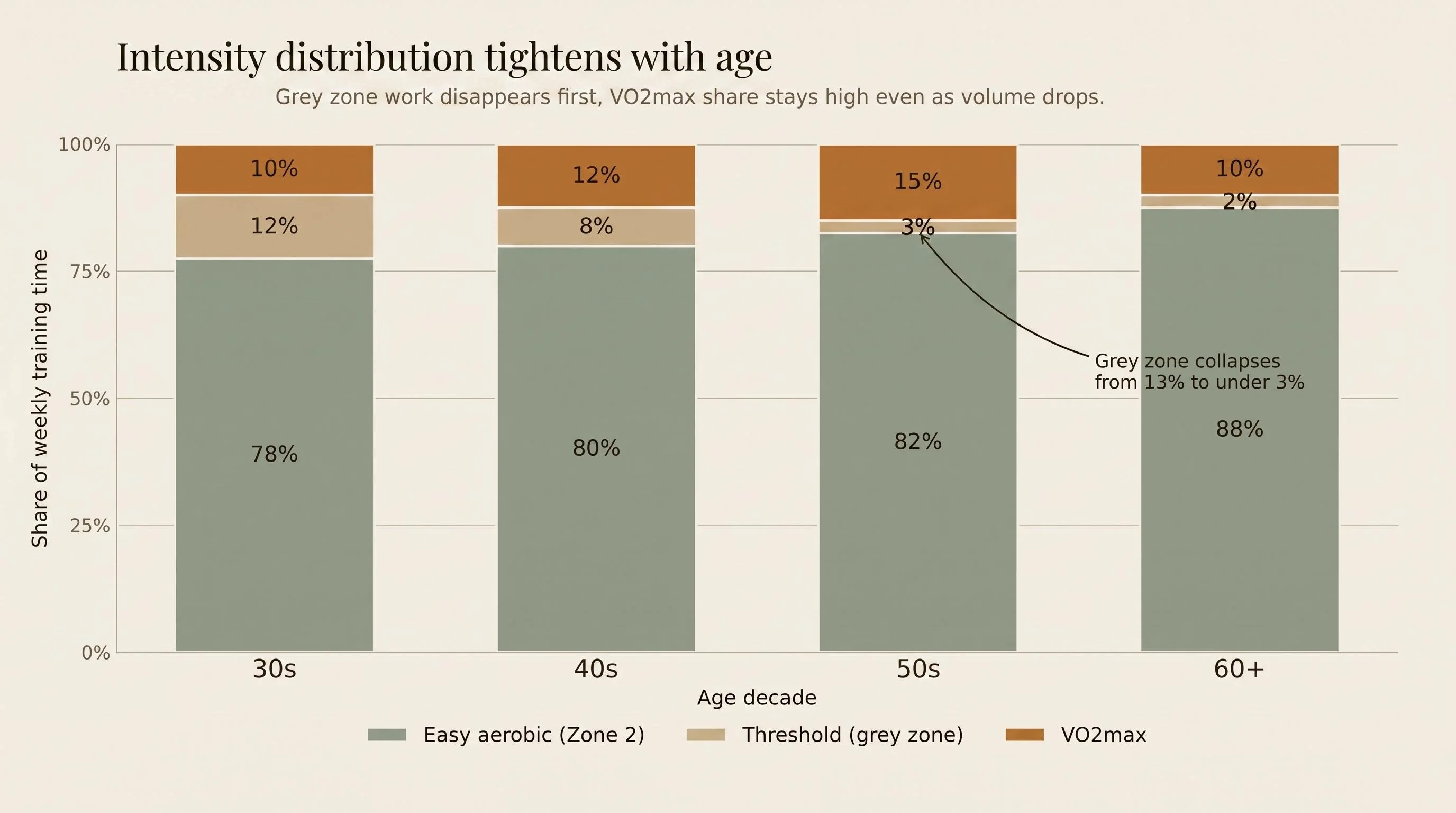
| Age | Weekly hours | Model | Zone 2 | Threshold | VO2max |
|---|---|---|---|---|---|
| 30–39 | 10–14+ | Pyramidal / polarized | 75–80% | 10–15% | 5–10% |
| 40–49 | 8–12 | Polarized | 80% | 5–10% | 10–15% |
| 50–59 | 6–10 | Strictly polarized | 80–85% | < 5% | 15% |
| 60+ | 4–8 | Reverse polarized / hybrid | 85–90% | 0–5% | 10%* |
* At 60+ high intensity is maintained in amplitude (true VO2max effort) but severely restricted in frequency. Percentages refer to time-in-zone, not session count.
Zones by field test, not by formula
The classic “220 minus age” formula is unreliable for masters athletes because maximal heart rate drops at an individual rate. Calibrate with a 20-minute threshold test (use 95% of the average heart rate and pace as your threshold baseline) or the Zone-2 talk test — the fastest pace at which you can still recite a continuous paragraph without gasping.
Interval prescriptions by decade
- 40s: classic VO2max — 3–6 minutes at 3K–5K pace, 2–3 minutes easy, 4–6 reps.
- 50s: shorter and sharper — 30/30s or 60/60s all-out/easy for 10–20 reps, or 3–4 minutes hard with 3 minutes full recovery.
- 60+: surgical reps — 30–60 seconds at maximal effort, 1:2 work-to-rest (1 min hard, 2 min easy). Enough cardiovascular stimulus without burying the neuromuscular system.
Deloads: the 2:1 rule
A deload is not a week of nothing. It's a week of intentionally reduced stimulus so the body can finish the repair work the last two weeks started.
- Volume cut 50–60%
- Intensity time cut 30–40%, not eliminated
- Short strides or one mini-interval set to keep snap
- More sleep, light mobility, easy cross-training
- Skipping all intensity — the body loses its edge
- “Making up” a missed hard session
- Heavy yard work or travel-stacked weekends
- Replacing rest with extra lifting volume
The other piece of the rhythm is daily recovery. Masters athletes should take at least two rest or active-recovery days per week, and treat rest days as actual off-loading — not days to catch up on yard work or long errands. Sleep is the ceiling on all of this: under seven hours and most endurance adaptations quietly stall.
Strength and prehab in 90 seconds
Endurance running does not preserve tendon stiffness or Type II muscle fibers. Only loaded resistance training does. The minimum effective dose is two heavy sessions per week at 70–85% 1RM, 3–5 sets of 3–6 reps, with 1–2 reps in reserve. Drop to one session and the adaptations attenuate fast.
Stiff tendons act like inflated tires — they store and return elastic energy efficiently. Soft, over-stretched tendons absorb energy and ruin running economy. Heavy lifting plus eccentric work (slow lowering of calf raises, for example) is the only protocol with robust evidence for tendon remodeling.
Prehab is the other half. A 5–10 minute daily routine targeting hips, knees and ankles prevents the slow-build overuse injuries that define the masters years — IT band syndrome, patellofemoral pain, Achilles tendinopathy. The full protocol — hip activation, knee tracking, ankle stability — plus dosing by exercise lives in the companion guide: Masters runner strength and prehab.
Recovery days: what “easy” actually means
The single most common masters-runner mistake is running easy days too fast. The morning-after-hard-session jog is supposed to be shake-out volume — strictly Zone 1, conversational, and short. If it raises heart rate into the low Zone 2 range, it's already eating into the recovery window from the previous session.
The rule of thumb: if someone asked you a question mid-run and you needed more than one breath to answer, you're going too hard for an easy day. Walk for a minute. Reset.
Most masters athletes don't overtrain on hard days. They overtrain on easy days that aren't easy.
Return to training after illness or layoff
Every lifelong runner takes time off — a virus, surgery, a travel block, an injury. The mistake is trying to re-enter at the previous volume to “make up for lost time.” Because detraining is rapid and retraining takes longer with age, that approach guarantees re-injury.
| Layoff | Expected VO2max loss | Return strategy | Time to regain |
|---|---|---|---|
| < 1 week | ~0% | Resume as scheduled. | Immediate |
| 2 weeks | 5–7% | 1 week easy aerobic at 50–75% volume, then resume. | 3–4 weeks |
| 1 month | 10–14% | Phases 1–3 progression. Regress strength loads. | ~8 weeks |
| 3 months | 16–20% | Treat as a beginner. 4–6 weeks of base before any intensity. | 12+ weeks |
The four-phase comeback, at a glance:
- Phase 1 — habitShow up. 50% volume, strict Zone 1–2, regressed strength. 1–2 weeks.
- Phase 2 — volumeGrow duration. Aerobic base only. Expect paces 1–2 min/mi slower. 1–3 weeks.
- Phase 3 — intensityCap volume at ~80%. Introduce short strides and brief threshold blocks. 1–2 weeks.
- Phase 4 — periodiseReturn to standard age-appropriate microcycle with 2:1 deloads.
Rule of thumb: regaining prior fitness takes about twice the layoff duration. Post-viral athletes — especially post-COVID — should extend Phase 1 and gate progress with HRV and subjective fatigue rather than the calendar.
Bottom line
A masters runner who trains well is not a compromised 30-year-old; they're a different biological system with its own rules. Honour the 9- or 10-day microcycle as you cross 50. Polarize the intensity — cut grey zone first. Deload every third week. Lift heavy twice a week. Treat recovery as training.
Do that consistently for a decade and the result isn't decline — it's a long plateau, followed by a much shallower slope than the population average. The masters years reward consistency and patience more than any other stage of an athlete's life.