

Strength and Prehab for Masters Runners: The Full Protocol
Two heavy lifts a week and ten minutes of daily prehab — not mileage, not stretching — is what keeps a 40+ runner healthy.
- Endurance alone doesn't hold an older body together.Running preserves the aerobic engine. It does not preserve Type II fibres, tendon stiffness, or hip stability — those need a separate mechanical stimulus.
- Strength: 2× heavy sessions per week, 70–85% 1RM.One session isn't enough; three usually overlaps the run plan. The goal is neuromuscular recruitment and tendon stiffness — not hypertrophy, not a 1RM.
- Prehab: 10 minutes, daily, small targeted loads.Hips, knees, ankles get micro-doses of load that keep the tendons inside their tolerance band. Daily consistency beats a long weekly session.
After 40, endurance training stops being enough to hold the body together. Running preserves the aerobic engine — it does not preserve tendons, Type II muscle fibers, or hip stability. Those need a separate stimulus. This is the protocol: the strength dose, the daily prehab routine, and the one paradox most masters runners get wrong.
Why strength and prehab after 40
Three aging realities set the shape of what follows. The companion pillar — the masters training plan — covers the programming side; here we focus on the structural side.
Sarcopenia. Adults lose 3–8% of muscle mass per decade from the 30s. The loss is not even — Type II fast-twitch fibers go first, which is why propulsive force and running speed drop faster than raw mass. Strength is lost two to five times faster than muscle, so force production degrades even when weight looks stable. Endurance running does not reverse this; loaded resistance training does.
Anabolic resistance. The aging body converts protein and training stimulus into muscle synthesis less efficiently. To get the same repair a 25-year-old gets from a given session, a 55-year-old needs a larger nutritional and mechanical stimulus. That means heavier loads, concentrated protein feeds (0.3–0.5 g/kg per meal with 2.5–3 g leucine), and real recovery days.
Connective-tissue remodeling slows. Collagen synthesis and tendon-cell turnover run at reduced tempo. A tendon that used to absorb twenty thousand foot strikes per week now protests at fifteen thousand. Prehab is the mechanical counter-pressure — small daily doses of targeted load that keep the hips, knees and ankles inside their tolerance band.
The strength prescription
Two heavy sessions per week is the floor and — for most masters runners also running 30+ km — the ceiling. The goal is neuromuscular recruitment and tendon stiffness, not hypertrophy or a personal best. Lift heavy, stop short of failure, recover hard.
Core movements
- Squat pattern — back squat, goblet squat or split squat. Drives quad and glute force production.
- Hinge pattern — trap-bar deadlift, Romanian deadlift or single-leg RDL. Posterior chain, hamstrings, glute max.
- Unilateral lower — Bulgarian split squat or step-up. Corrects left/right asymmetries running reinforces.
- Calf raise, eccentric — barbell or single-leg, 3–5 second lowering phase. Direct Achilles stimulus.
- Horizontal push + row — push-up progression and bent-over row. Keeps posture honest on long efforts.
Eccentric focus
The slow lowering phase of every lift is where tendons remodel. A 3–5 second eccentric on squats, deadlifts and calf raises rebuilds collagen cross-sectional area, improves load tolerance at the Achilles and patellar tendons, and reduces the injury rate in longitudinal studies of masters athletes. Don't drop the weight — earn every rep on the way down.
Plyometrics: later, not first
Plyometrics (box jumps, pogo hops, bounds) are the fastest way to upgrade tendon elasticity and rate of force development — and the fastest way to injure a masters runner who skipped the strength base. Build 6–8 weeks of consistent heavy lifting first. Then introduce one short session per week: 2 sets of 6–8 reps, with full recovery between jumps.
The tendon-stiffness paradox
Here's the counter-intuitive finding most runners have backwards. In a trained endurance athlete, stiffer tendons make you faster and more economical — not more flexible ones. A tendon behaves like a spring. When the foot strikes the ground, the Achilles lengthens, stores elastic energy, and recoils to help propel the next stride. A stiff spring stores and returns that energy efficiently; a compliant one absorbs it like a deflated ball, forcing muscles to work harder to produce the same forward motion.
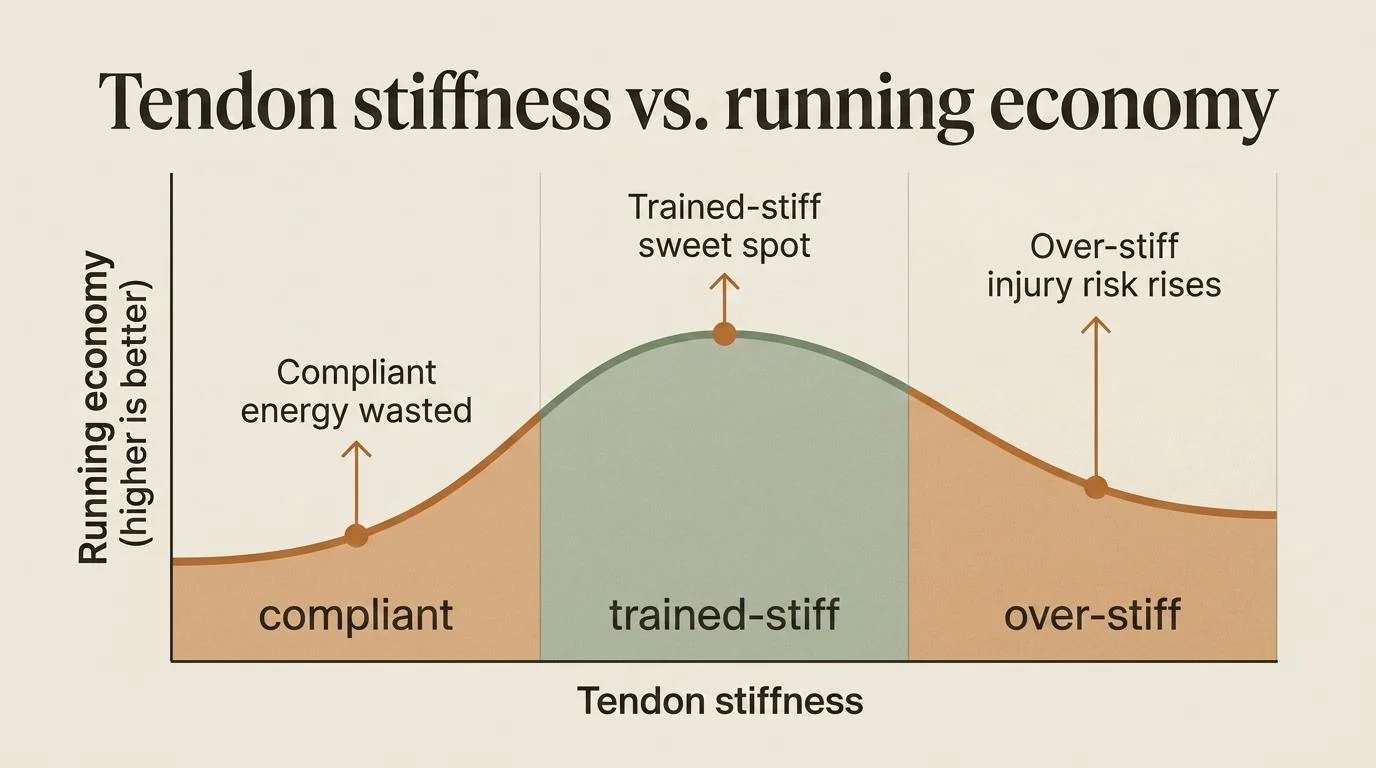
A 2010 study of distance runners found an inverse correlation between sit-and-reach flexibility and running economy — the least flexible hamstrings and calves produced the most efficient runners. Static stretching for longer than 90 seconds before a run further impairs performance by softening the exact spring you're relying on. Lifting heavy is what moves runners from the compliant tail into the trained-stiff sweet spot.
Lifting form: do and don't
- Leave 1–2 reps in reserve on every working set
- Control a 3–5 second lowering phase
- Full range of motion, especially single-leg work
- Six hours between lifting and a hard endurance session
- Log loads — progression is the point
- Grind to absolute failure for one more rep
- Drop the weight — the eccentric is the work
- Static-stretch for 2 minutes before a heavy lift
- Lift heavy the day before a long run or VO2max session
- Chase high-rep endurance sets (12–20 reps) instead of heavy 3–6s
The 10-minute daily prehab protocol
Strength is the monthly structural stimulus. Prehab is the daily maintenance load. Five to ten minutes, every day, targeting the three joints that carry the highest overuse-injury risk in masters runners: hips, knees and ankles. Do it as a dynamic warm-up, after a run, or on rest days — whenever fits. Consistency beats intensity.
Stabilise the pelvis on each foot strike. Weak glute medius drops the hip, collapses the knee inward, and drives IT-band and patellofemoral pain.
- Clamshells2 × 15 per side
- Side-lying leg raises2 × 15
- Fire hydrants2 × 15 per side
- Banded monster walks2 × 20 steps
Keep the quadriceps firing to guide the kneecap smoothly through its groove. Shallow range, slow tempo, no knee pain.
- Single-leg mini squats2 × 10 per leg
- Hip flexion w/ rotation2 × 10 per side
- Marching glute bridges2 × 15, 3s hold
- Terminal knee extensions2 × 12 per leg
The ankle absorbs and returns the largest peak forces in running. Eccentrics remodel the Achilles; balance work rebuilds single-leg control.
- Eccentric heel drops3 × 15, 5s lower
- 3-way banded ankle2 × 15 each way
- Single-leg balance (eyes closed)3 × 30–60 s
- Toe yoga / short-foot drill2 × 10 per foot
Want this built into your week alongside your runs? Build my lift + run week.
Yoga: when it helps, when it hurts
The question isn't yoga or no yoga. It's which style, when in the week, and what you're chasing. The wrong answer makes masters runners slower.
- Stabilizer strength — planks, bridges, half-moon, warrior III. Hip and core control without impact.
- Breath regulation — nasal breathing, extended exhalation. Transfers directly to Zone-2 pacing.
- Restorative, post-run — supine twists, supported hips. Parasympathetic reset.
- Functional mobility — enough hip extension and ankle dorsiflexion to stride cleanly.
- Hot / extreme flexibility — softens tendons you need stiff. Correlates with slower economy.
- Pre-workout deep flows — static holds over 90 s before intervals impair force output.
- Replacing strength with yoga — no yoga load is heavy enough to drive tendon adaptation.
- Daily hamstring stretching — no injury benefit; measurable running-economy cost.
Tendons are springs. Don't spend a year loosening what the next decade of running will ask you to tighten.
Fitting it into the training week
The logistical challenge masters runners hit first: where do two heavy lifts and seven prehab blocks go in a week that already has two hard runs, a long run and a deload every third week?
- Lift on hard-run daysSame-day pairing, six-plus hours apart. Run in the morning, lift in the evening (or the reverse). Protects easy days.
- Not the day before a key runHeavy legs + next-day tempo = compromised session and elevated injury risk. Leave 48 hours before the long run.
- Prehab daily, 5–10 minUse it as a warm-up before runs, after runs, or standalone on rest days. The point is frequency, not volume.
- Skip heavy lifting on deload weeksDrop to one lighter session at 50–60% loads. The whole point of the deload is to let tissues finish remodelling.
Bottom line
The masters runner's durability rests on three pieces: two heavy lifts a week, ten minutes of daily prehab, and enough sense to treat yoga as a supporting tool rather than the main programme. Everything else — intensity distribution, microcycle length, deload rhythm — lives in the masters training plan.
Consistency wins. Lift at 70–85% for 3–6 reps, take the eccentric seriously, leave reps in reserve, and give the hips, knees and ankles their ten minutes every day. Do it for a decade and your 55-year-old stride will look remarkably like your 40-year-old one.