

Aerobic Base Building for Runners: Why Easy Miles Make You Faster
Why most of endurance training is slow — what a built base does to your body, and how long before you feel it.
Aerobic base building is the systematic accumulation of low-intensity running volume — paces so easy they feel like you're barely training — in order to drive a specific set of structural adaptations in the heart, blood, capillaries and muscle cells. Everything fast you can do in a race is paid for by what those adaptations can sustain.
What changes inside your body
Consistent work below the first lactate threshold triggers a cascade of structural and cellular adaptations that physiologists split into two groups: central (oxygen delivery) and peripheral (oxygen utilisation). Both matter. Either one alone caps performance.
Central: the athlete's heart
Long, moderate-volume work stretches the left ventricle — a phenomenon called eccentric cardiac hypertrophy, or “athlete's heart”. The ventricle fills more fully between beats and ejects more blood per stroke. Resting stroke volume in an untrained adult is around 70 mL per beat; well-trained endurance athletes reach 100–140 mL, an increase of 50–60%. Because the heart now delivers the same cardiac output with fewer contractions, resting heart rate drops 10–20 bpm. Blood plasma expands 4–15% within the first few weeks of consistent training, improving sweating, thermoregulation and stroke volume in parallel.
Peripheral: capillaries and mitochondria
In the muscle itself, steady aerobic pulsing stimulates angiogenesis — the growth of new capillaries around slow-twitch fibres. Meta-analyses of muscle-fibre adaptations suggest Zone 2 volume lifts the capillary-to-fibre ratio by roughly 21%, and adding occasional high-intensity intervals pushes it as high as 54%. More capillaries mean more “delivery lanes” for oxygen and substrates and faster clearance of metabolic byproducts like lactate.
At the same time, mitochondrial biogenesis kicks in. Mitochondria are the cellular factories that oxidise fat and carbohydrate into ATP. Easy aerobic work upregulates metabolic enzymes — citrate synthase, cytochrome c oxidase — and grows both the number and quality of the mitochondria themselves. A single 45–120 minute Zone 2 session can raise mitochondrial protein synthesis by more than 150% in the hours that follow. Over weeks, denser mitochondria let the muscle generate more ATP aerobically at any given pace, sparing glycogen and delaying fatigue.
How race distance uses your base
A common myth is that shorter endurance events — 5K, 10K — are primarily anaerobic and reward only interval work. The energy math disagrees. Even a one-mile race is roughly 80% aerobic. The longer the distance, the more overwhelmingly the aerobic system dominates — and the more the base you've built dictates the ceiling on race pace.
| Distance | Aerobic % | Primary limiter | Base-phase goal |
|---|---|---|---|
| 10K | 90–95% | Lactate clearance (LT2) | Dense mitochondria to buffer and recycle lactate at high speed. |
| Half-marathon | 97–99% | Aerobic Deficiency Syndrome | Push aerobic threshold closer to LT, build musculo-skeletal durability for 90–120 min of sustained work. |
| Marathon | ~99% | Glycogen depletion | Maximise fat oxidation and metabolic flexibility to spare glycogen and avoid hitting the wall. |
“Aerobic Deficiency Syndrome” (ADS), described by Uphill Athlete and others, is what happens when a runner has a high VO2max and sharp short-distance speed but a weak aerobic threshold. A 19:00 5K runner stuck running a 1:45 half (8:00/mi vs 6:07/mi) is the textbook case: the engine is powerful, but it can't hold a sub-threshold cruise because the base underneath is thin.
How long does it take
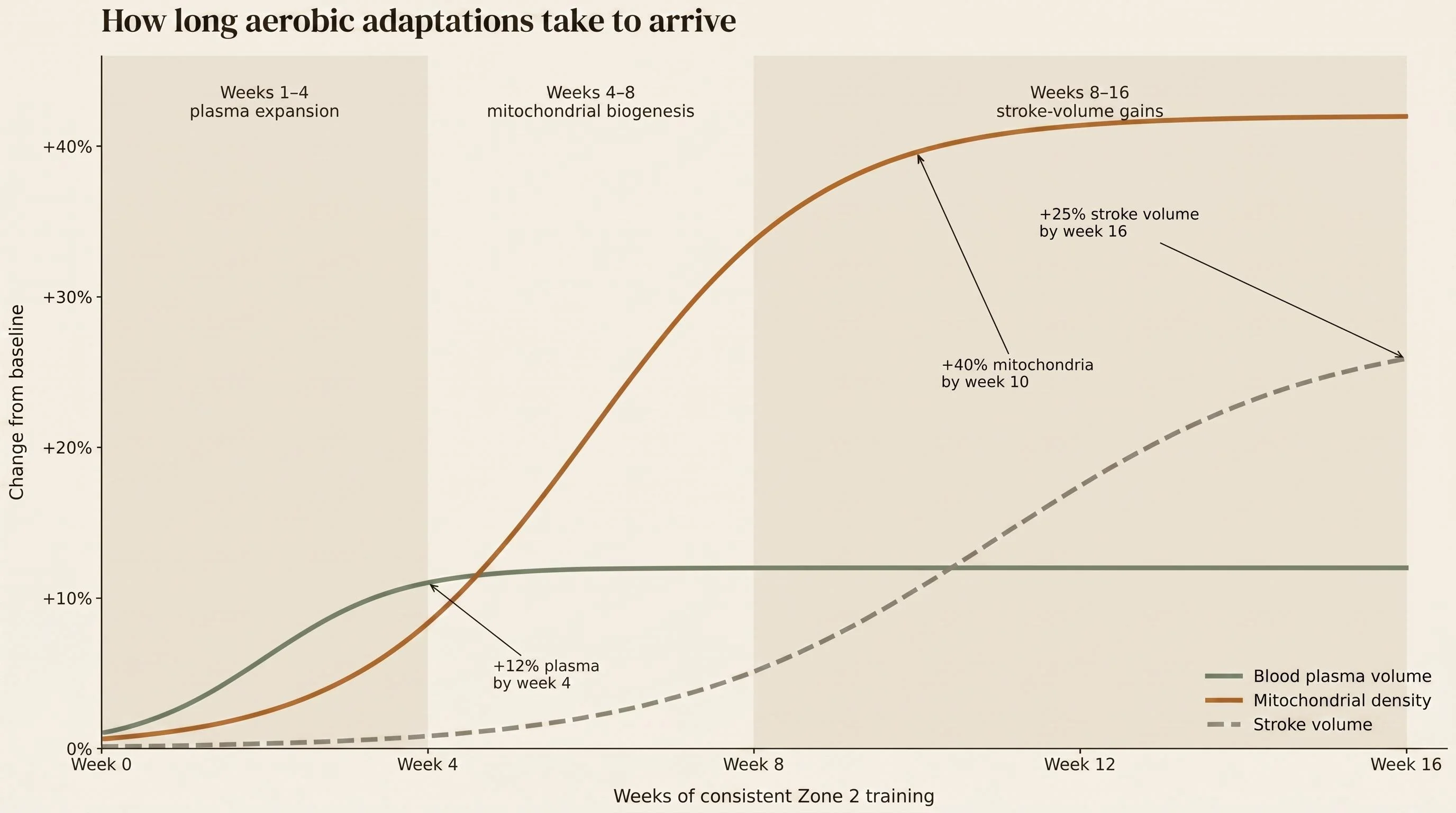
Patience is the hardest part of base training. Different adaptations show up on different timelines, and the changes that matter most for race pace — denser mitochondria, a larger stroke volume — are the slowest to arrive.
| Window | What's happening | Measurable signal |
|---|---|---|
| Weeks 1–4 | Blood plasma expands 4–15%, sweat response improves, neuromuscular recruitment tightens. | Slightly lower resting HR; legs often feel heavy as the body shifts off pure sugar burning. |
| Weeks 4–8 | Mitochondrial size and number increase; capillary density grows; fat oxidation enzymes upregulate. | Faster same-HR pace, lower HR at any given pace, fewer fade-outs on long runs. |
| Weeks 8–16 | Stroke volume peaks, aerobic threshold rises toward LT, race-pace economy improves. | Noticeable drop in HR at any given pace; decoupling on long steady runs slides below 5%. |
| Months–years | Running economy, connective-tissue durability, and metabolic flexibility compound. The base of one season becomes the starting line for the next. | Same loop, same HR, progressively faster pace — the single most reliable long-run diagnostic you have. |
That last row is the quiet payoff. Greg McMillan and other coaches in the Arthur Lydiard lineage describe the same diagnostic: pick a flat 5–8 mile loop, run it at a fixed Zone 2 heart rate, and note the pace. Repeat two months later. If the pace has dropped and the heart rate has held — without any change in how the effort feels — the base is working.
Wondering whether your base has matured enough to add intensity? Check your aerobic decoupling.
The 80/20 dose — and the grey zone trap
Exercise physiologist Stephen Seiler spent two decades reverse-engineering elite training logs — Olympic marathoners, Tour de France cyclists, cross-country skiers. The same pattern turns up everywhere: about 80% of sessions at low intensity, about 20% hard. The ratio is about session distribution, not stopwatch time in each zone, and it's the shape that lets athletes accumulate massive annual volume (elite mountain runners log 400–1,000+ hours a year) without chronic burnout.
The failure mode is the grey zone: the tempo-ish pace between your aerobic and lactate thresholds. It feels productive — you're sweating, breathing hard, your watch looks impressive on Strava — but physiologically it's the worst of both worlds. Hard enough to shift you into carbohydrate dominance and accumulate fatigue. Not hard enough to trigger the VO2max adaptations of real intervals. Run there often enough and you get the stress cost of intensity with the adaptation payoff of neither end of the spectrum.
The grey zone is hard enough to fatigue you, easy enough not to adapt you. Make easy days easy so hard days can be hard.
True Zone 2 should feel disconcertingly easy. The robust field test is the talk test: if you can't speak in full sentences — or can't breathe through your nose alone for two minutes — you're out of it. On hills, walk. On hot days, slow down or move the session indoors. Ego discipline is the entire game.
What “enough” volume looks like
There is no universal number. Base-phase weekly volume depends on training age, race target, and recovery capacity. But a few rules carry most of the load:
- Progression: build weekly volume by no more than 5–10% per week.
- Structure: frequent 45–60 minute aerobic runs, plus one dedicated long run of 90–120 minutes to push musculo-skeletal durability.
- Recovery: every 3–4 weeks, cut total volume 10–25% for a down week. Tissue repair and adaptation happen during these weeks, not the build weeks.
- Intensity placement: the 20% hard work is most often 1–2 sessions per week — short VO2max intervals (e.g. 4–6 × 4 min at 8–9/10 effort, with 5–10 min easy recovery) or a targeted threshold session, not a random tempo run.
Signs your base is built
Some signs you'll feel subjectively: runs that used to feel tempo now feel conversational; long runs no longer leave you wrecked the next day; your morning resting heart rate trends down; you recover between intervals faster. The decisive objective test is aerobic decoupling.
Developed by coach Joe Friel, the test is simple: run a flat, steady aerobic effort for 60–120 minutes. Split the session in half and compute the ratio of average pace to average heart rate for each half. The percentage change is your decoupling (also called Pa:HR drift).
- < 5% driftBase is built — cleared to add intensity.
- 5–10% driftAerobic durability is still developing — give it a few more base weeks.
- > 10% driftEither the effort was above LT1, or the base needs substantial rebuilding.
Heart rate is sensitive to heat, hydration, caffeine and sleep, so only test on a cool, flat route in rested conditions. For a guided walkthrough with the math done for you, try our aerobic decoupling tracker.
Common mistakes
- Walk hills to keep HR in Zone 2.
- Use a treadmill or indoor bike on hot days.
- Drop pace off the watch face; show only HR.
- Pulse 1–2 weekly hard sessions, treat the rest as sacred easy.
- Re-test decoupling every 4–6 weeks.
- Running the grey zone because it “feels productive”.
- Chasing Strava segments on easy days.
- Adding intensity before the base block is complete.
- Stacking 5–6 hard days and one “easy” tempo.
- Ignoring down weeks and progressing volume past 10%/week.
Bottom line
Aerobic base building is microscopic biology on a macroscopic timescale. The left ventricle stretches, capillaries branch, mitochondria multiply. None of that happens quickly, none of it feels dramatic in the session itself, and none of it shows up on the watch until months later.
But it's the only way to build the floor that your race-pace ceiling sits on. Do the easy miles truly easy. Keep the hard work short, rare, and sharp. Trust the cellular scoreboard over Strava. The inevitable result is an athlete who goes further and faster, powered almost entirely by fuel they already carry.