

Heat Acclimation for Kona
A practical sequence for changing the body before race day, measuring what it loses, and cooling it when the lava starts giving heat back.
- Build the main heat dose over 10–14 days.Blood-volume changes begin early; sweating and sodium-conservation adaptations need repeated exposure across the second week.
- Measure loss before prescribing replacement.Sweat rate and sweat sodium are separate variables, and neither gives permission to force fluid faster than the body can handle.
- Pace is the first cooling system.Ice and water remove heat, but reducing power or pace is what stops metabolic heat production from outrunning every aid station.
Kona heat acclimation is not a contest to see who can tolerate the hottest room. It is a controlled training block that repeatedly raises thermal strain enough to trigger adaptation while preserving the swim, bike, run, sleep, and recovery work that still determines race fitness.
Why does Kona heat damage the body from the inside?
Heat redirects blood toward the skin while working muscle still demands oxygen. Stroke volume falls, heart rate drifts upward, and reduced blood flow through the gut can weaken its barrier long before the athlete feels cooked.
Muscle is inefficient machinery: most of the energy released during endurance exercise becomes heat rather than forward motion. In Kona, humid air slows sweat evaporation while dark road and lava add radiant load. The body responds by opening skin blood vessels. That helps move heat outward, but it also lowers central blood volume and ventricular filling. Heart rate must rise to defend cardiac output at the same pace or power—the familiar pattern of cardiovascular drift.
Telemetry from age-group athletes at Kona found a mean core temperature of 38.55 ± 0.64°C around mile 10 of the marathon and persistent post-finish hyperthermia. The same redistribution of blood that supports cooling can reduce splanchnic flow substantially. A review of exercise-induced gastrointestinal injury describes how heat and hypoperfusion can disrupt intestinal tight junctions, allowing bacterial products into circulation and amplifying inflammation.
How many weeks does it actually take to heat-acclimate?
Most athletes need 10–14 days of repeated exposure for a broad response. Plasma volume begins changing in the first four days; earlier sweating, greater sweat capacity, and sodium conservation develop later.
Heat acclimation is staged rather than binary. The first useful change is hemodynamic: fluid retention expands plasma volume, supporting stroke volume while more blood is sent to the skin. Resting and exercise heart rate can begin falling at a fixed workload. Later exposures shift the sweating threshold earlier, increase total sweat capacity, lower resting core temperature, and improve sodium reabsorption in the sweat gland. The Korey Stringer Institute and CDC/NIOSH guidance both emphasize gradual exposure rather than jumping directly to a full dose.
- Days 1–4Expand the circulating buffer
Plasma volume begins rising; heart rate and perceived strain may start to settle.
- Days 5–8Share blood flow more effectively
Skin blood-flow capacity improves and resting core temperature can move lower.
- Days 9–14Sweat sooner and conserve sodium
Sweating begins earlier, capacity rises, and acclimated sweat becomes more dilute.
Sauna, hot bath, or overdressing—which method works?
Direct exercise in heat is the most specific method, but post-exercise sauna and 40°C hot-water immersion can extend core-temperature elevation with less neuromuscular cost. Overdressing is accessible but difficult to dose safely.
In a controlled chamber, an isothermic protocol raises core temperature toward approximately 38.5°C and then reduces mechanical intensity to hold the thermal target. It is precise, but pace and power must fall as the body warms. Extra clothing traps metabolic heat indoors and can create a similar stimulus, yet the athlete cannot see the real dose without core temperature monitoring, which makes unobserved spikes more likely.
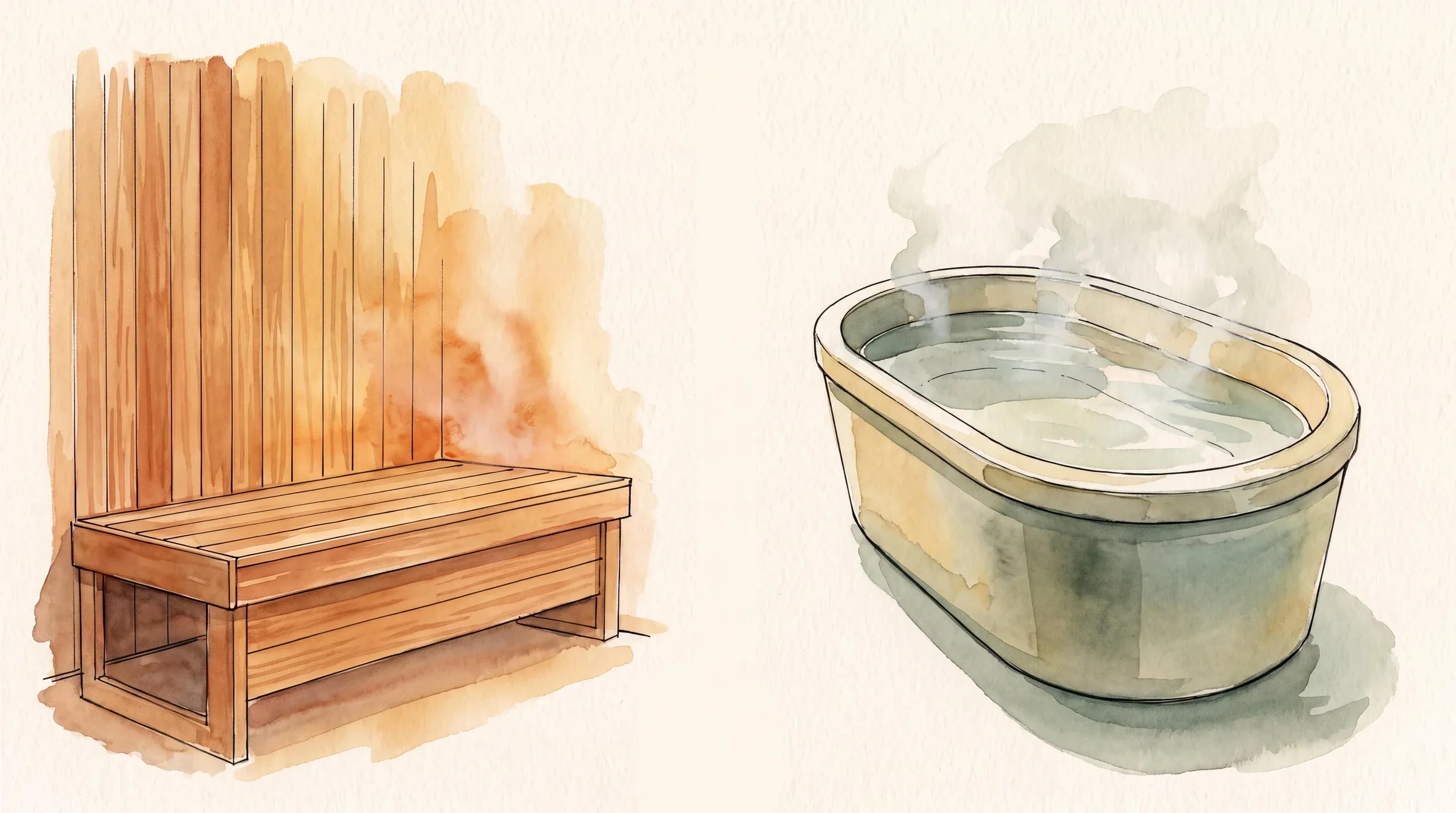
| Method | Studied dose | Best use | Main limitation |
|---|---|---|---|
| Hot chamber | Maintain ~38.5°C for ~60 min | Precise, race-specific work | Access and training-quality cost |
| Overdressing | Progressive easy indoor work | Low-cost active exposure | Thermal dose is hard to quantify |
| Dry sauna | 80–90°C for 20–30 min after exercise | Passive volume expansion | Evidence includes very small samples |
| Hot-water immersion | 40°C for 20–40 min after exercise | Accessible passive exposure | Rapid core-temperature rise |
A widely cited sauna study reported a 7.1% plasma-volume expansion and improved run-to-exhaustion performance, but included only six athletes; a later review cautions against treating the exact effect size as universal. Trials ofpost-exercise hot-water immersion used 40°C water for 20–40 minutes across repeated days and found lower resting and exercise core temperatures plus improved hot-condition performance.
How fast does heat acclimation fade before race week?
Adaptation begins fading once heat exposure stops. Modeled declines are about 2.3% per day for heart-rate adaptation and 2.6% per day for core temperature, so a completed block still needs maintenance.
Different adaptations disappear at different speeds. Plasma volume can contract before every sweating change is lost, and an athlete returning to heat usually re-acclimates faster than during the first block. Areview of heat-acclimation decay found that a heat exposure roughly every fifth day could preserve heart-rate and core-temperature adaptations for up to 25 days, while one session per week was less reliable.
How do you find your real sweat rate and sodium loss?
Weigh nude before and after a race-like session, record every drink and urine loss, then divide net fluid loss by session hours. Sweat sodium requires a separate validated collection test; sweat rate alone cannot reveal it.
Individual sweat rate can span roughly 0.3–2.4 L/hour, while sweat sodium can range from about 400 to more than 2,000 mg/L. Heat acclimation can change both, so a cool-weather test from months earlier is weak evidence for Kona. Research on fluid balance in long-course triathlon also shows why a single universal replacement rate is not credible.
Use kilograms and liters; 1 kg of acute mass change is approximated as 1 L of water.
- Use a session long enough to settle into representative sweating.
- Match expected race-day heat, humidity, clothing, intensity, and time of day.
- Weigh without wet clothing immediately before and after.
- Record fluid consumed and any urine produced during the session.
- Repeat on at least two similar days; treat a large spread as uncertainty, not precision.
The result sets a boundary for later fueling rehearsals; it is not an instruction to replace 100% of every loss. Hyperhydration and sodium loading can expand retained fluid in some protocols, but they also create gastrointestinal distress, weight gain, and clinical risk. Test any such strategy under qualified sports-medical guidance, never for the first time on race morning.
What actually cools you mid-race—ice, water, or slowing down?
Slowing down reduces new metabolic heat; water and ice remove accumulated heat. The strongest plan combines both early, before heart rate, digestion, and coordination show that thermal reserve is already gone.
Trying to preserve cool-condition power while heart rate drifts upward is a trap. Lowering power or pace by a small amount can reduce heat production continuously. External cooling then widens the gradient for heat transfer: cold water over the head, neck, arms, and torso; ice under a cap or inside clothing where it stays comfortable; and repeated dousing at aid stations rather than one dramatic intervention.

| Cooling action | What it changes | Limit |
|---|---|---|
| Reduce pace or power | Lowers metabolic heat production | Requires early restraint |
| Cold-water dousing | Supports conductive and evaporative heat loss | Less evaporation in high humidity |
| Ice at cap, neck, or clothing | Provides local conductive cooling | Must not chafe, numb, or impair movement |
| Pre-start ice slush | Creates a temporary internal heat sink | Short-lived; can upset the stomach |
| Menthol rinse | Reduces perceived heat | Does not lower core temperature |
Cooling should make a sustainable pace easier. It should not be used to disguise warning signs so an unsustainable pace can continue.
How does heat preparation fit the rest of Kona training?
Add heat as a measured layer around ordinary endurance training: one progressive block, a small maintenance dose, repeated sweat testing, and cooling rehearsals inside course-specific sessions.
The athlete still needs non-wetsuit swimming, durable aero riding, controlled climbing, patient marathon pacing, sleep, and recovery. Heat work succeeds when it protects those qualities rather than replacing them. Use the Kona course overview to see the whole chain, then use the segment-by-segment guide to place cooling, pacing, and exposure where they meet the actual course.