
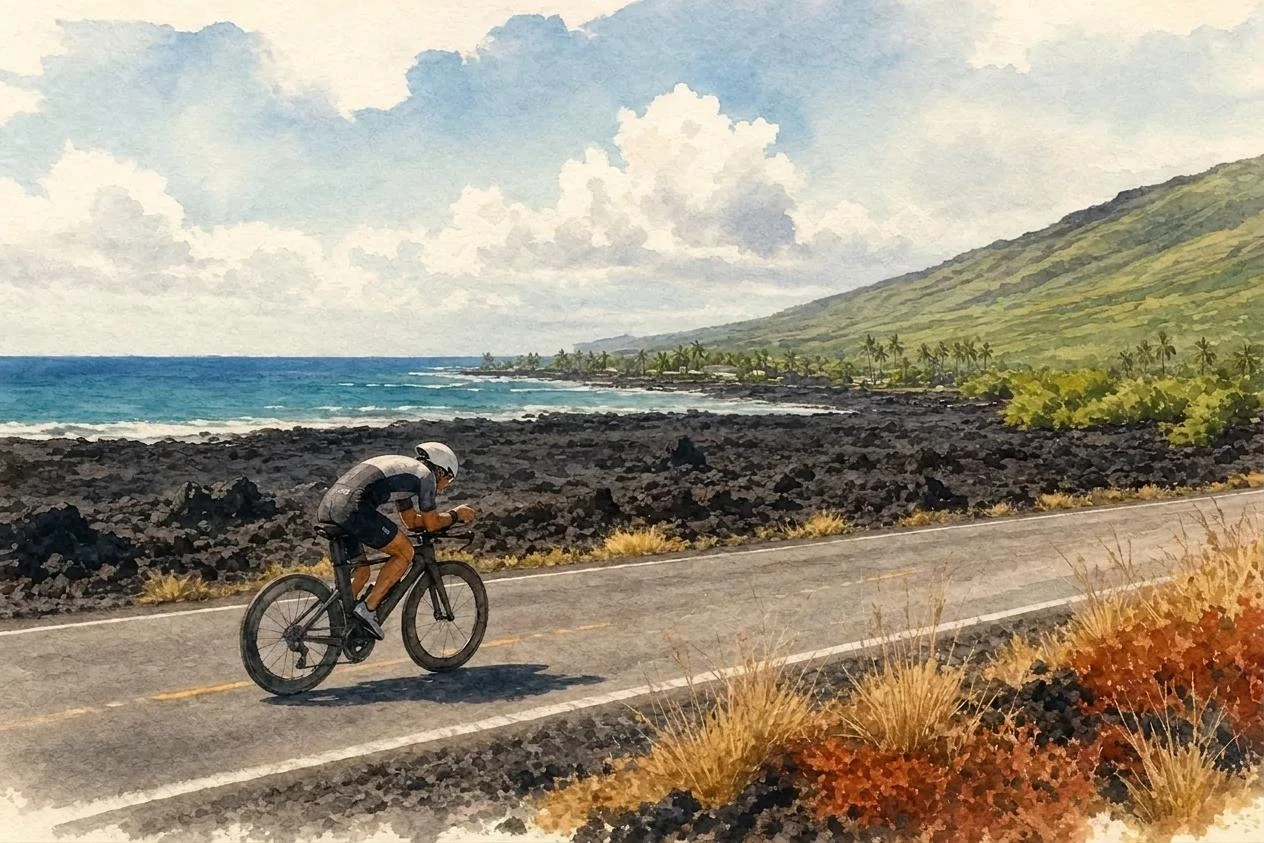
Kona is not one long test. It is a chain of different problems.
A conventional long-course plan develops the fitness to swim, ride, and run for most of a day. Kona-specific training has a narrower purpose: it teaches an athlete to preserve that fitness while the course keeps changing its cost.
The race begins in warm ocean water, rises sharply out of town, crosses exposed lava fields, climbs toward Hawi, and returns to a marathon where shade is scarce. None of those demands replaces the need for aerobic durability. Together, however, they determine how that durability must be used.
The first adjustment happens before the bike.
The 2.4-mile swim leaves Kailua Pier and returns through warm, saline water. With water temperatures commonly around 75–79°F, it is typically a non-wetsuit swim. That matters because a wetsuit does more than keep a swimmer warm: it lifts the hips, reduces drag, and makes a stable body line easier to hold.
Without that support, small weaknesses in body position become more expensive. Rolling swell interrupts rhythm. Sighting lifts the head and can drop the legs. Contact at the start encourages athletes to swim harder than intended. A strong pool swimmer can therefore leave Kailua Bay having spent too much energy before the longest part of the race begins.

The bike is a lesson in controlling effort.
Kona does not wait for an athlete to settle. Soon after T1, Palani Road introduces a short, steep climb. The body has just spent roughly an hour horizontal in the water; now it is asked for high torque while adrenaline is still high. The sensible response is not to prove climbing strength. It is to use an appropriate gear, keep the effort contained, and arrive on the Queen K without having made the day harder.

Farther north, the highway looks simpler than it rides. The Queen Kaʻahumanu Highway rolls across dark, unshaded lava. Wind can shift from headwind to crosswind, while the basalt returns solar heat to the rider. Near Hawi, a long gradual ascent adds sustained load; the return adds descending and crosswind handling when fatigue is already present.
This is why average speed is a poor master on this course. Trying to hold it through every rise and gust creates repeated power spikes. The better skill is steadiness: stable handling, a durable aero position, smooth output across rolling terrain, and enough restraint to continue eating and drinking on schedule.
The marathon starts with decisions made hours earlier.
The opening miles on Aliʻi Drive can feel generous. The road is relatively flat, spectators are close, and the change from bike to run often creates a false sense of freedom. Then the route climbs Palani Road, reaches the exposed Queen K, and eventually turns into the Natural Energy Laboratory—the Energy Lab—around the hardest part of the marathon.

By then, the relevant fatigue is not only in the legs. Core temperature has been rising for hours. Fluid and carbohydrate deficits may already be accumulating. There is little shade, the road radiates heat, and the quieter surroundings remove the energy of town. A pace that was reasonable in cool training can become unsustainable without any sudden change in fitness.
The run therefore exposes what happened on the bike. An athlete who rode above a sustainable effort, delayed fueling, or improvised cooling reaches the Energy Lab with fewer options. Run training alone cannot repair that chain of decisions.
Specificity is a layer, not the foundation.
Kona does not require every session to imitate race day. The base remains ordinary and important: consistent aerobic volume, strength, technique, recovery, and enough time to absorb the work. Course specificity is added on top of that base.
In practice, that layer means swimming without borrowed buoyancy, riding smoothly when speed fluctuates, becoming familiar with heat rather than merely tolerating it, and rehearsing food, fluid, cooling, equipment, and pacing as one connected system. The goal is not to make training theatrical. It is to remove surprises.
The overview explains why. The deeper guides explain how.
- Read guide
Training the course, segment by segment
Kailua Bay, Palani Road, Queen K, Hawi, and the Energy Lab.
- Read guide
Heat acclimation for Kona
Hot training, sauna timelines, cooling, adaptation windows, and safety.
- Read guide
Cutoffs and age-group pacing
What the course clocks require, translated into useful pacing ranges.
- Read guide
Course-driven equipment choices
Wind handling, wheel constraints, gearing, and non-wetsuit preparation.
- Read guide
Fueling a long race in the heat
Carbohydrate, fluid, sodium, gut training, and GI rescue across a long hot day.