
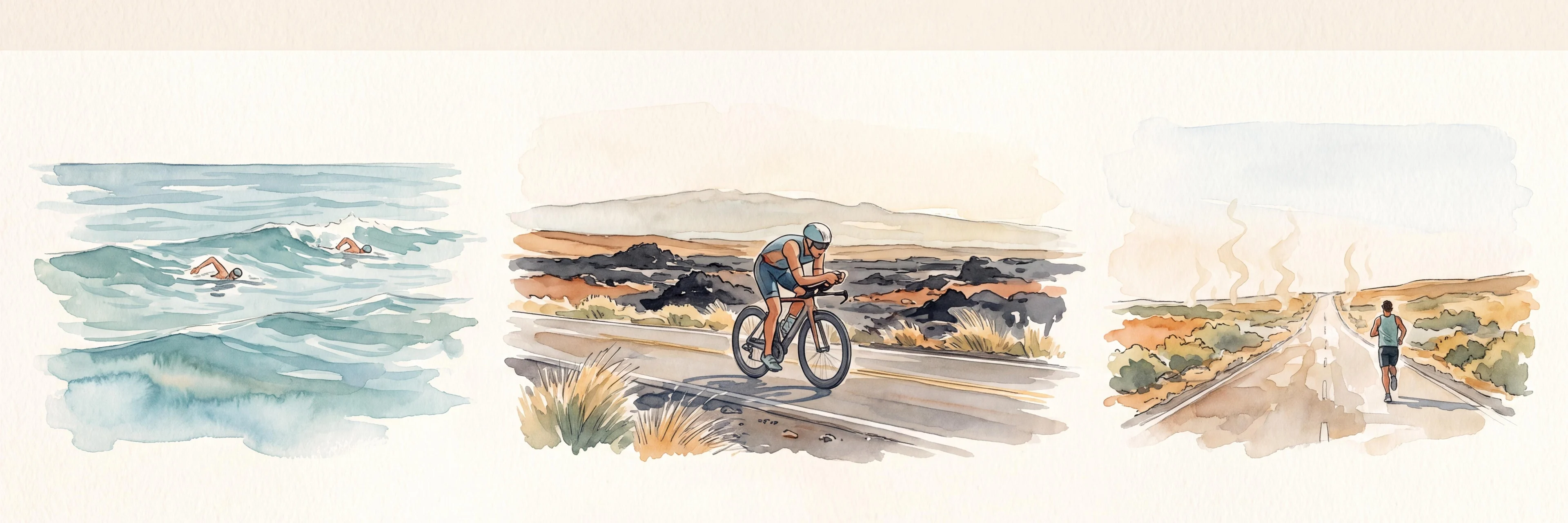
The Kona Course, Segment by Segment
Seven stretches of water and road, seven different ways the course can take energy from you—and the training response for each one.
- Palani is a gearing problem before it is a fitness test.Spin the outbound pitch near 80 rpm instead of spending fast-twitch fibers and glycogen in the first minutes of the bike.
- The Queen K rewards steadiness, not average speed.Keep power smooth across rollers, stay stable in aero, and let speed change when the Mumuku wind changes.
- The Energy Lab is managed before you enter it.Heat preparation, cooling, fueling, and patient Aliʻi pacing decide how many options remain after mile 15.
A useful Kona course breakdown does more than name the famous landmarks. It maps each landmark to a cost: extra drag in Kailua Bay, torque on Palani, unstable air on the Queen K, sustained load toward Hawi, and thermal plus eccentric damage during the marathon. Training becomes specific when each cost gets its own rehearsal.
Why is the Kailua Bay swim harder without a wetsuit?
Removing neoprene raises drag and energy cost because the hips and legs no longer receive targeted buoyancy. Salt water helps, but it does not reproduce the body-position correction of a wetsuit.
Kona begins with a single-loop ocean swim through rolling water. The relevant difference from a calm pool is not merely visibility. Every sighting movement, swell, current, and contact event perturbs the stroke. A comparison of wetsuit and non-wetsuit swimming found an energy cost near 763 J/m without neoprene versus roughly 644–648 J/m with it—an increase of about 18% in that dataset. A matched swimming speed can also produce a higher heart rate.
| Condition | Measured consequence | Kona meaning |
|---|---|---|
| Entry-level wetsuit | 648 ± 126 J/m | Lower drag through supported body position |
| High-end wetsuit | 644 ± 119 J/m | Similar metabolic advantage in the cited test |
| No wetsuit | 763 ± 174 J/m | Body line and ankle position matter more |
| Effective drafting | 11–25% lower oxygen uptake in studies | Useful only while clean contact with the draft holds |
Values summarize the studies cited in the source report; they are not personal predictions. Ocean state and swimming skill change the result.

How much torque does Palani demand immediately after T1?
Enough to recruit expensive fast-twitch fibers if the gear is too large. The correct response is an early downshift and a controlled cadence, not matching the athletes who attack through town.
The abrupt transition matters. After an hour or more supported horizontally in the water, the body is asked to stand, stabilize, and produce high pedal force on a short steep pitch. Heavy gearing raises force per stroke and can turn the first minutes of a 112-mile ride into a glycolytic effort. Spectators and fresh legs disguise the cost; the marathon reveals it.

| Crank and cassette | Easiest ratio | Who it suits |
|---|---|---|
| 53/39 with 11–23 | 1.70 | Very strong riders; little protection from torque |
| 53/39 with 11–28 | 1.39 | Strong age-groupers with tested climbing cadence |
| 50/34 with 11–28 | 1.21 | Balanced choice for many age-group athletes |
| 50/34 with 11–34 | 1.00 | Maximum cadence protection for lower-power riders |
How do you ride the Queen K without blowing up in the wind?
Let speed fluctuate while effort stays smooth. For many age-group athletes that means a Variability Index at or below 1.05 and an Intensity Factor around 0.65–0.75, adjusted for heat and durability.
The Queen Kaʻahumanu Highway looks open and simple. In practice its rollers invite small surges, dark lava returns solar heat, and sea breezes strengthen as the day develops. The source report describes common crosswinds of 5–15 mph outbound and 15–20+ mph later on the return, with stronger gusts possible. Rear solid disc wheels are prohibited on this course, so wheel selection and handling skill must leave a margin for the actual conditions.

What should you do when a crosswind gust hits?
Stay low when it is safe, keep the upper body supple, and avoid a rigid death grip. Weight through the front end, a subtle lean into the wind, and continued pedaling help preserve directional control. Some experienced riders lower cadence by about 10 rpm in a slightly harder gear to keep tension through the drivetrain. That is a skill to practice progressively in ordinary wind—not to discover on race morning.
What does the climb to Hawi require—and how do you descend it?
The climb requires sustained pressure without low-cadence mashing; the descent requires relaxed control while gusts change around cuts in the landscape. Both are easier from a durable aero position.
The roughly 15-mile approach toward Hawi rises on long 1.5–4% grades. Those numbers look modest, but the combination of duration, headwind, and false flats accumulates muscular load. An approximate 80 rpm climbing cadence is a useful starting point: low enough to avoid unnecessary cardiovascular cost, high enough to limit force per stroke. The correct number remains individual.
Hawi is not one climb. It is a long negotiation between grade, wind, cadence, and the run legs you still need to keep.
On the return, topographic openings can expose the rider to abrupt crosswind. Stay compact, keep a firm but mobile grip, look through the turn, and watch vegetation or riders ahead for warning. Pedaling maintains forward intent; coasting rigidly while sitting tall gives the gust more body and bike to move. Safety overrides aerodynamics: reduce speed or move to the base bars when control requires it.
How should you pace the first 10 miles of the marathon?
Slower than the crowd makes sensible. The opening miles should absorb the bike-to-run transition and protect thermal reserve; they should not prove that your legs still know race pace.
Aliʻi Drive supplies spectators, flatter road, and the psychological release of leaving the bike. That combination creates an overpacing trap. Blood flow and motor recruitment are still reorganizing after 112 miles in the saddle. A first mile above sustainable intensity spends a buffer that naturally narrows as core temperature and fatigue rise later in the run.
The run up Palani Road then changes the mechanics. Uphill running increases force demand, ground-contact time, and oxygen cost. A planned walk on the steepest portion can be faster for the whole marathon than forcing a run gait that sends heart rate upward and leaves the calves and quadriceps loaded before the Queen K.
How do you prepare for the heat of the Energy Lab?
Accumulate heat exposure before race week and enter the segment with cooling, fluid, carbohydrate, and pace already under control. No workout can compensate for arriving overheated and underfueled.
The Energy Lab combines little shade, hot road and lava surfaces, afternoon exposure, and psychological quiet. The physiological response is cardiovascular drift: more blood is sent toward the skin for cooling, so heart rate rises at the same running speed. Research on Kona athletes recorded core temperatures averaging 38.55 ± 0.64°C by mile 10 of the marathon — well before this segment — and found a strong inverse relationship between core temperature and performance in that sample. That heat load is already accumulating before the Energy Lab; this segment adds to it rather than starting it.

| Maximum air temperature | Predicted elite penalty | Predicted mass-runner penalty |
|---|---|---|
| 20°C | 128 sec | 152 sec |
| 24°C | 238 sec | 376 sec |
| 28°C | 382 sec | 698 sec |
Model estimates from marathon data, not Kona split predictions. Slower athletes also accumulate more total exposure time.
How do you protect your legs on the final Palani descent?
Use quick short steps and let gravity move the body without reaching forward to brake. The quadriceps are already glycogen-depleted; long overstrides add eccentric damage precisely when they can absorb least.
Downhill running lengthens the quadriceps under load. Late in a marathon, that braking demand lands on muscle already fatigued by the bike, heat, and more than 20 miles of running. A heavy heel strike in front of the body magnifies the collision. A slight lean from the ankles, stable trunk, relaxed arms, and quicker turnover keep the foot closer to the center of mass.

How do the seven segments become one training plan?
Keep the aerobic foundation ordinary, then place small doses of course specificity where they solve a known problem. The goal is not to make every week resemble race day.
One swim develops body position without neoprene. One ride combines aero over-unders with controlled crosswind handling. One brick rehearses the easy Aliʻi opening and a planned Palani walk. Heat is added progressively, while gearing, feeding, cooling, and wheel choices are settled before the taper. These sessions connect the physiology to the geography without turning preparation into a stunt.
Start with the broader explanation of why the day behaves this way in the Kona course-specific training overview, then build the smallest set of rehearsals that removes your largest surprises.