

How to Get Over a Breakup You Chose
Ending it on purpose doesn't cancel the grief — this is the arc for the person who did the leaving, guilt and relief included.
- Relief and grief aren't contradictions.They show up in the same week, sometimes the same hour. Feeling both at once doesn't mean you made the wrong call.
- No contact is a mechanism, not a willpower test.Every message resets the biological clock that's trying to heal. Holding the boundary is what actually shortens the ache.
- You're rebuilding an “I,” not just missing a “we.” The flat, unmoored feeling in weeks four and five isn't a warning sign — it's identity work, and it's supposed to feel like that.
Most breakup advice is written for the person who got left. This is the other half of the story — the guilt, the second-guessing, the strange grief of missing someone you chose to walk away from. Here's the map for the eight weeks that follow, whether you walk it alone or let Pallie walk it with you.
Why do relief and guilt hit in the same breath?
Because ending a relationship still breaks an attachment, even when it's the right call and even when you're the one who chose it. The first hours after can bring a real, almost giddy relief — the dread of finally saying it is usually worse than saying it. Then, often within days, the attachment your brain just lost registers, and something closer to grief moves in on top of the relief instead of replacing it.
Relief and grief show up in the same week, sometimes the same hour — and neither one cancels the other out.
This isn't a contradiction to resolve, and it isn't proof you're secretly wrong about the decision. Roughly one in four people who end a relationship report some doubt afterward, and that doubt typically takes 18 to 24 months to settle into real confidence — a timeline for certainty, not for functioning normally again. The people who study this treat the split reaction itself as the norm, not the exception: the person who ends things carries a distinct grief profile from the person who got left — guilt and disorientation instead of straightforward rejection, but grief all the same.
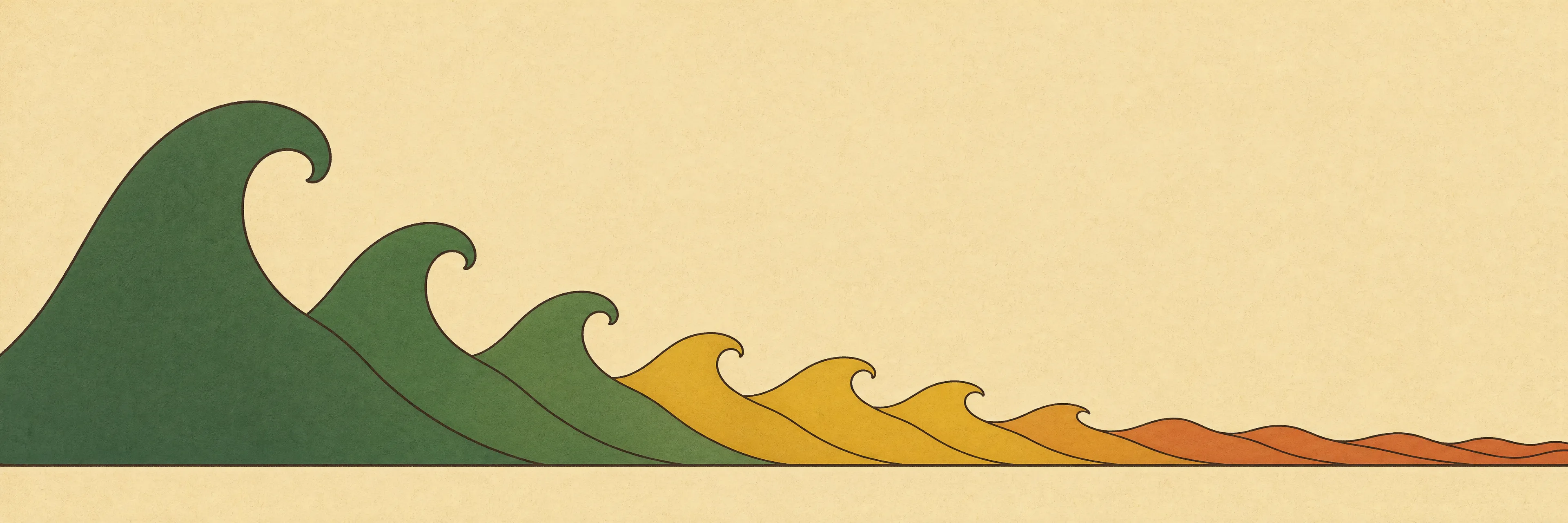
What does the eight-week arc actually look like?
Six movements, not a fixed calendar. Someone who's processing this quickly can be a stretch ahead; someone who's struggling stays in an earlier stretch longer. The weeks are a map, not a timetable.
- 1Before Day 0
Find the words
Before anything else, get clear and get it said — once, cleanly, without leaving the door open to a renegotiation. An over-apologetic, vague message feels kinder in the moment but drags the pain out for both of you; naming the real reason to yourself first, in your own language, makes the actual conversation shorter and cleaner.
- 2Weeks 1–2
Ride the crash
The relief fades and the crash arrives — guilt, numbness, second-guessing, sometimes grief that surprises you with its size. This is a reaction, not evidence you were wrong. The only job right now is to feel it without rushing past it, and to keep the basics — food, water, some sleep — from slipping too.
- 3Week 3
Hold the line
Nostalgia peaks right here, and the urge to reach out — “just to check in,” “just to apologize properly” — feels wise and kind in the moment. It rarely is either. This is the week to have your own concrete list of why it ended somewhere you can actually reach it.
- 4Weeks 4–5
Rebuild the self
The acute chaos usually eases, and a flatness shows up instead — a “who even am I without this.” The way through is action, not analysis: picking back up something that quietly got sidelined, trying something new, one low-stakes plan with another person instead of full isolation.
- 5Weeks 6–7
Make sense of it
Enough distance now to look back without getting swept under. The story can shift from “something that happened to me” to “something I came through” — not by forcing positivity, but by actually naming what got clearer, and what part of the ending was yours to learn from.
- 6Week 8 and on
Let it be finished
Acceptance doesn't mean happy about it — it means no longer fighting that it happened. Thinking of them without a spike of pain, a routine that's fully yours again, a general sense of moving forward: those are the real milestones, and the fact that check-ins can thin out here is success, not neglect.
Why is week three harder than week one?
Because your memory, starved of an attachment it just lost, starts doing something sneaky: quietly editing the relationship's highlight reel while conveniently misplacing the reasons you left. That's not a character flaw — it's memory doing what memory does under loss — and it lands hardest right around the three-week mark, after the acute shock has faded but before any real distance has built up.
Holding no contact through this stretch is doing real work, not just being stubborn. It typically takes somewhere between three weeks and three months of silence for the ache of a broken attachment to genuinely settle; every message — even a caring one — tends to reset that clock for both people, not just you.
- Three concrete, specific reasons it ended, written down somewhere you'll actually reread
- Muting or archiving the chat, rather than white-knuckling not looking
- Letting a wave of missing them pass through without acting on it — it's a wave, not a verdict
- Telling one real person your boundary, so you're not holding it alone
- A “just checking in” text, however kind it feels typing it
- One quick look at their socials, “just this once”
- Answering fast if they reach out first
- Rehearsing what you'd say if they asked to try again
Notice which column is harder to actually stick to — that's the tell for how much this needs backup, not willpower. Have Pallie help you ride out this week
What if I already broke no contact?
Treat it as a predictable slip, not proof you're failing. Almost everyone whose brain just lost an attachment gets pulled to reach back out at least once — a message sent, a late-night call, a string of texts you regret by morning. Shame about the slip does more damage than the slip itself; it's the thing most likely to spiral into a second one.
The move that actually helps is boring on purpose: name what triggered it — a lonely night, a shared photo resurfacing, a bad day at work — and, if the contact needs a boundary reinstated, send one short note instead of either silence or another emotional message. Something close to:
“I'm sorry for reaching out last night — that wasn't fair to either of us. I need space, and I won't be reaching out again.”
Brief. No pet names. No reopening the conversation. Then go straight back to whatever was helping before the slip — the point isn't a perfect no-contact streak, it's a general direction.
When is this more than the ordinary pain of ending it?
Guilt and grief after a breakup are heavy, but they move — they let other feelings back in within days or weeks, even on a bad stretch. A few things are outside what this guide, or a companion, should hold alone: the relationship involved abuse or trauma you're only now recognizing the weight of; the sadness is total and unmoving (“nothing will ever change”) rather than waves that pass; you genuinely can't function day to day; or the way you're coping — drinking more, checking their accounts obsessively, anything reckless — is getting bigger, not smaller. None of that means anything is wrong with you. It means the right kind of help here is a licensed professional, not a self-guided arc.
Walk it yourself, or heal it alongside Pallie
You have the whole map now: let relief and grief coexist instead of arguing with each other, hold no contact through the week it matters most, rebuild an “I” instead of just missing the “we,” and let the story turn into something you came through. You can absolutely walk all of this on your own.
Or let Pallie hold the arc with you — a warm check-in during the crash, a steady hand through the week-three urge, a blame-free reset if you slip, and a genuine sense of when to fade the check-ins out. Not a coach with a clipboard tracking your “progress” — a companion who understands that ending something you chose to end is still a loss, and sits beside you through it anyway.