

Coping With Grief After a Death
Not a checklist to finish, and not a straight line — a map of how grief actually moves, and how a life ends up holding both the loss and the living.
- Grief moves in waves, not stages.It oscillates between the pain of the loss and the pull of ordinary life — both at once, not one after the other.
- The goal isn't closure.It's a life that has room for the loss and the future together, with the person carried forward, not left behind.
- Most grief eases on its own timeline.A smaller share gets frozen rather than oscillating — knowing the difference is the point of this page.
This is for grief after the death of someone close — not a clinical protocol, and not a countdown to “being over it.” Here's the shape the journey tends to take over roughly sixteen weeks, whether you walk it alone or let Pallie walk it with you.
Is grief really a series of stages?
The five-stage model — denial, anger, bargaining, depression, acceptance — is the version most people have heard, and it has shaped a lot of unhelpful expectations. Contemporary bereavement research doesn't back it up as a universal sequence; only a minority of grieving people move through anything resembling those stages in that order, and expecting to often just adds a second layer of distress on top of the grief itself — the sense of failing at something that was never a real checklist.
The model with better evidence behind it is Stroebe and Schut's Dual-Process Model: healthy grieving oscillates between loss-oriented moments — crying, yearning, sitting with the absence — and restoration-oriented ones — going to work, laughing at something, picking up a routine again. Both are part of grieving well. Neither one proves the other is wrong.
Grief isn't linear, and it was never supposed to end in “moving on” — it ends, if it ends well, in carrying the person forward differently.
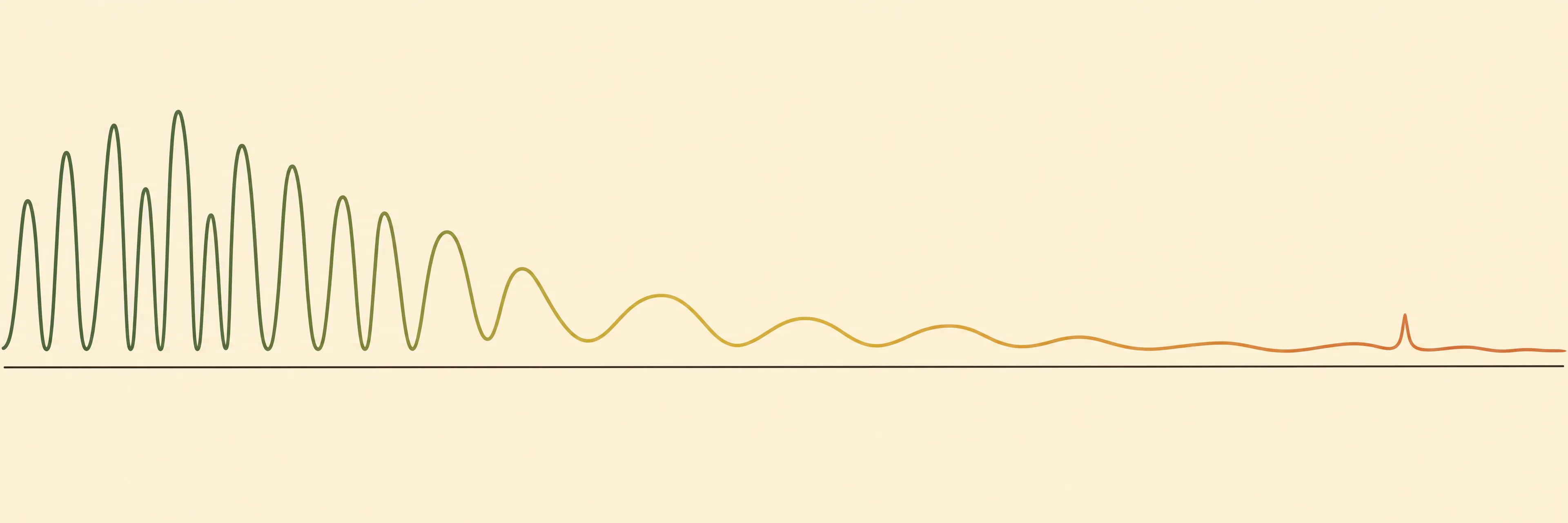
What does the ~16-week arc actually look like?
Three broad movements, not a strict calendar — grief bends the plan, not the other way around. A rough anniversary or trigger can pull someone back toward an earlier movement at any point; that's expected, not a failure of the plan.
One tiny daily anchor. The plain fact of the death said without euphemism, the person's name used often.
The long middle. Naming specific feelings, building small rituals, gently questioning the guilt of moving forward.
Not closure — a life with room for both the grief and a future, built through small, concrete forward steps.
What actually helps in the first few weeks?
Right after a death, the nervous system is often too overwhelmed to do anything but survive the day. Big gestures — a total lifestyle overhaul, an ambitious new routine — reliably fail here, because they demand executive capacity the grieving brain doesn't have, and trying just adds shame on top of grief. What works instead is absurdly small: one ten-minute anchor a day. A cup of something warm outside. A short stretch. Brushing teeth at the same time every morning. The point isn't the activity — it's the predictability, one steady thing an overwhelmed nervous system can hold onto.
At the same time, the reality of the loss needs to stay real rather than get softened into euphemism. Using “died,” not “passed” or “lost,” and using the person's actual name, often, confirms that they existed and that the absence is real — which fights the numbness and disbelief of early grief instead of feeding it. Naming specific emotions instead of one vague wave of despair does something similar for the nervous system: putting a precise word on a feeling measurably calms the brain's alarm response, where staying vague keeps it activated.
Does moving forward mean I'm betraying them?
This is the guilt loop that surfaces almost every time, usually once the initial shock eases and the long middle sets in: the belief that finding a moment of joy, or moving forward at all, is a betrayal of the person who died. It doesn't resolve by arguing someone out of it in one conversation — it softens with repetition, gently, every time it comes up again.
- “Loving them and having a good day aren't actually in competition”
- Naming a specific ritual — a song, a letter, a candle at a set time — instead of a vague “find ways to remember them”
- Noticing out loud when a memory comes up warm instead of only painful
- Concrete, specific offers of support — “I'll check in at 4 about the appointment”
- “They'd want you to be happy”
- “You need to move on”
- Open-ended “let me know if you need anything”
- Arguing the guilt away in one go instead of gently, every time it resurfaces
Small, intentional rituals help more than they sound like they should — a specific song at a specific time, a letter written to the person, a candle lit on a particular evening. A ritual gives grief a bounded time and place to land instead of leaking into everything, all the time. Build one with Pallie
How do I know if this is a wave, or something more?
Watch these signals more closely than the week map — they override the schedule every time.
| Signal | What it looks like | What it means |
|---|---|---|
| It's landing | “We” language returns, future-tense talk, a bittersweet memory without spiraling | Let it move forward |
| The anniversary effect | Disrupted sleep or heaviness in the weeks before a significant date, sometimes before it's consciously connected | Plan the date ahead |
| A wave, not a relapse | A day or several of not getting out of bed, routines dropped, acute despair | Normal — no shame |
| Stuck, not waving | Rigid “always / never / impossible” language, guilt that doesn't budge over months, no future-oriented talk at all | Beyond this guide |
Based on clinical markers for prolonged and complicated grief. A wave passes. Being stuck, frozen rather than oscillating for many months, is a different thing and deserves a different kind of help.
A companion walking this arc does no diagnosis and no clinical screening, ever — it notices when a pattern looks beyond normal grief and says so honestly. Three things push past what a self-guided arc or companion should hold alone: prolonged, complicated grief that stays frozen rather than easing over many months; a pervasive low mood untethered from reminders of the person, with global worthlessness or a total inability to feel pleasure, which reads as depression rather than situational grief; and any sudden, violent, or traumatic death — including the death of a child — which carries meaningfully higher risk and often needs trauma-informed professional support from early on. None of these mean someone is grieving wrong. They mean the right kind of support has changed.
What does the far end of this actually look like?
The graduation point isn't forgetting, and it isn't the absence of pain — it's what researchers call integrated grief: the loss is fully acknowledged, the raw intensity of early grief has resolved, and the person's place in your life has settled into something carried rather than something that overwhelms. Waves still come. They get smaller, further apart, and less frightening — not gone.
A real marker of this is what researchers call continuing bonds: most people who adapt well to a profound loss keep an ongoing, transformed connection with the person who died — through internal conversation, honored traditions, or simply carrying forward something of who they were. That's not a failure to let go. It's what letting a life rebuild around a loss actually looks like.
Walk it yourself, or let Pallie walk it with you
The map: stabilize with one small daily anchor and let the loss be real, ride the long middle of waves without treating any single day as proof of anything, then rebuild a life that has room for both the grief and what comes next. You can walk this alone, at your own pace.
Or let Pallie hold the arc with you — checking in often and asking nothing back in the early weeks, settling into steadier rhythm through the middle, and tapering deliberately as your own footing returns. Never a clinician, never diagnosing — a companion who happens to know how grief actually moves, and stays present for as long as this chapter takes.