
How to Handle Hard Phone Calls Without Freezing
The toolkit around the script — breath, tone, timing, what to do when the agent pushes back, and when to hand the call to someone (or something) else.
- Scripts handle the words. Breath handles the body.A minute of 4-4-4 breathing before you dial drops your heart rate enough for your voice to come out steady.
- Pushback has three answers.Broken-record, ask for a supervisor, graceful-exit. One of those three covers nearly every call that goes sideways.
- Some calls aren’t worth making yourself.Retention, refund chases, claim escalations — hand them to a partner, a VA, or a voice agent that places the call for you.
If you’ve already got a script for the call and you still can’t bring yourself to dial, the problem isn’t the words. It’s everything around them — the physiological spike, the retention rep who won’t let you off the line, the panic that hits mid-sentence. This guide is the toolkit for that layer.
When the call goes sideways: three techniques
Most “hard” calls aren’t hard because of the opener. They’re hard because the other side pushes back, stonewalls, or escalates. Three techniques cover nearly every version.
The broken-record technique
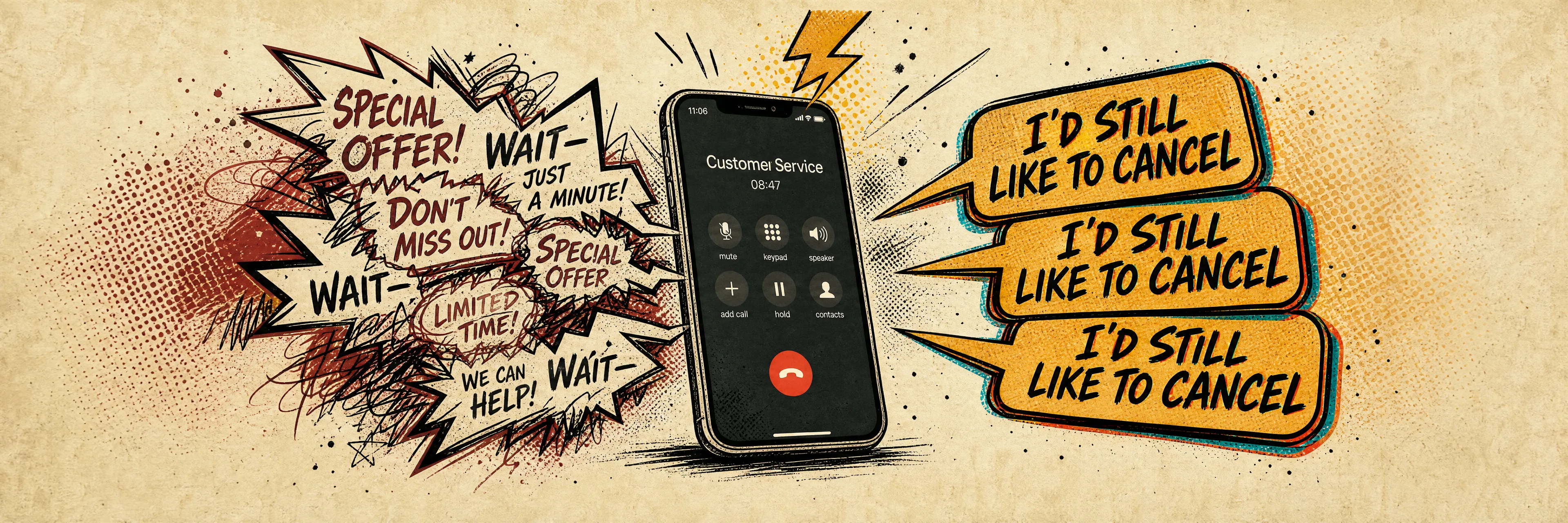
From assertiveness training: repeat your ask in the same calm words regardless of what the other person offers. “I understand, and I’d still like to cancel today.” “I hear you, and I’d still like to dispute this charge.” You’re not arguing — you’re refusing to get pulled off the line. Retention scripts are specifically engineered to get you explaining; explanation invites negotiation. A flat, polite repetition doesn’t.
Asking for a supervisor
If the first agent genuinely can’t help, don’t argue with them — escalate. “I understand you can’t change this at your level. Can you transfer me to a supervisor who can?” Said calmly, without accusation, this is a normal request that agents handle every hour. The supervisor almost always has wider discretion on pricing, waivers, and goodwill credits.
The graceful exit
If you feel yourself tipping into panic, end the call cleanly. “I’m going to need a moment — can I call you back in fifteen minutes?” That’s a normal, professional request. Hang up. Breathe. Check your bullet points. Call back. It’s not a failed call, it’s a paused one, and the next attempt is usually twice as calm.
The tactical layer: breath, tone, timing
Scripts handle the cognitive side. Anxiety is also physiological — a ringing phone triggers a real fight-or-flight response, complete with elevated heart rate, shallow breath and a constricted voice. Four small tools regulate that.
4-4-4 tactical breathing
Inhale for four seconds, hold for four, exhale for four. Repeated for a minute before dialling, it activates the parasympathetic nervous system, drops heart rate, and steadies the voice. It’s the single most accessible tool for the acute spike right before the first ring.
The “smile” trick
Smile while you’re on the phone. The physical shape of a smile changes your vocal cords — the voice comes out warmer and the agent mirrors it back. It also tricks your own brain into a marginally more relaxed state, which is useful even when no one can see your face.
Most phone panic isn’t about what you’ll say — it’s about operating without the feedback loop you normally rely on. The toolkit is how you build the loop out of breath, posture, and timing.
Voicemail-first as default
For incoming calls, turn on “Silence Unknown Callers”. Every unscheduled call goes to voicemail, which eliminates most of the anticipatory dread of the surprise ring. You transcribe the voicemail, figure out who it was, and call back on your terms — with a script, at a time you’ve chosen.
Time-of-day choices
Tuesday through Thursday, mid-morning (about 10am local to the callee) or mid-afternoon (2–3pm) are the lowest-friction windows for most business lines. Avoid Monday mornings, Friday afternoons, and the first and last hour of the business day. You’ll hit shorter holds and fresher agents — both things that reduce anxiety for an already anxious caller.
When to hand the call off instead
Not every call is worth rebuilding tolerance for. A decent heuristic: delegate when the call is bureaucratic, high-friction, and low personal stakes — a retention argument, a refund chase, a claim escalation. Take the call yourself when the outcome is personal and irreducible— a therapy intake, a family boundary, a job interview. Those are the reps that actually build the skill.
Delegation layers, in roughly increasing formality:
- Partner, parent, or friend for everyday admin. Free, fast, but reinforces avoidance if overused.
- Colleague or virtual assistant for work calls. Common in knowledge-work teams; often just a Slack message away.
- Patient advocate or gestoría for medical and bureaucratic calls. Requires a signed authorisation (HIPAA release, power of attorney, or local equivalent) but absorbs the friction entirely.
- A voice concierge like Pallie Callsfor the calls you genuinely never want to make — cable retention, subscription cancels, refund chases. You describe the job in text; an LLM voice agent dials the number, handles the conversation, and sends you a transcript and outcome summary.
The toolkit vs. handing it to Pallie
The honest comparison. The left column is what you do when you pick up the phone yourself. The right column is what happens when you give the job to Pallie Calls — a voice concierge that places the actual call for you.
Rule of thumb: if the call is bureaucratic and the outcome is the only thing you care about, hand it to Pallie. If the outcome is a human on the other end remembering you well, take it yourself with a script and the toolkit above.
When the toolkit isn’t enough
If you’ve run scripts, breathing, and time-of-day tweaks for a month and calls still feel impossible, that isn’t a willpower problem. The pillar on phone-call anxiety covers the clinical picture — Cognitive Behavioural Therapy sits at a 50–70% efficacy rate for anxiety disorders, and graduated exposure protocols reach 75–85% for phobia-level avoidance. Scripts close the symptom gap; therapy closes the underlying one.