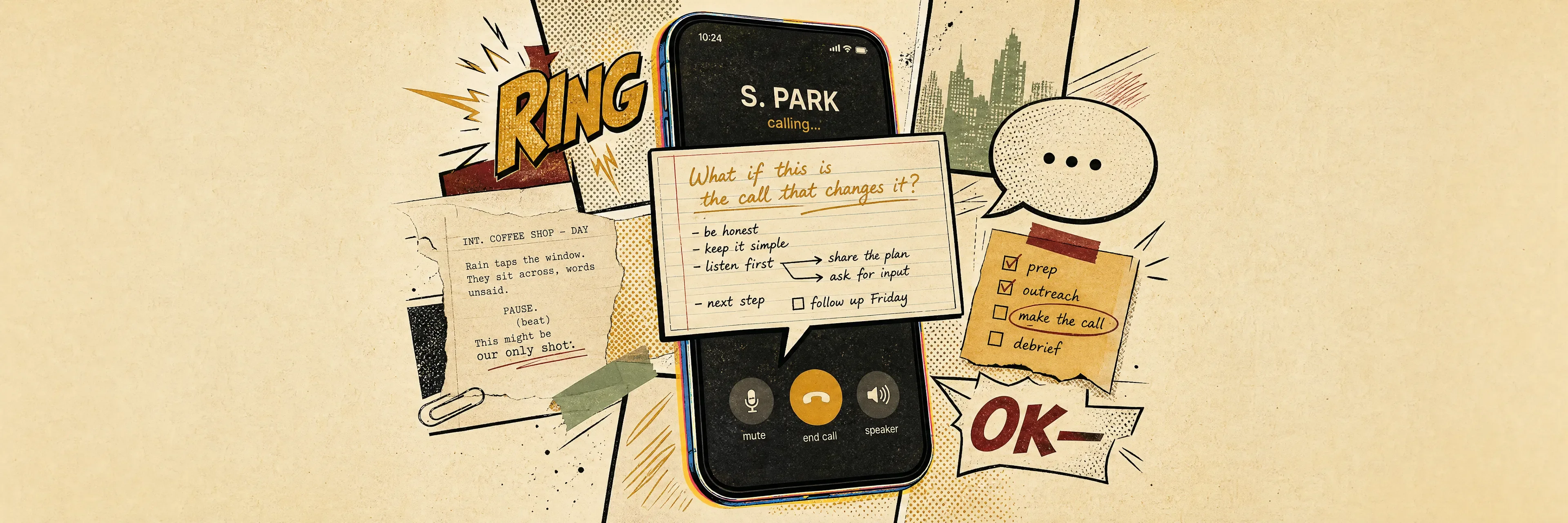
A flat editorial illustration of a printed phone-call cheat sheet clipped to a warm parchment desk beside a rotary phone, with sticky-note branches and an amber-underlined opening line. Sepia and amber palette, minimalist magazine composition.

Phone Call Script Generator

Pick the scenario, fill in a few details, get a ready-to-read script — opening line, pushback branches, graceful close.

Scenario
About the call
Tone
Length
Your scriptCancel a subscription or membership
Opening line · read verbatim

Hello, my name is [your name]. I'm calling to cancel my membership with the provider.

Identifier

Account email or membership number; month you joined.

Your ask

I'd like to cancel my membership effective today, please.

If they say…
  • If they offer a discount or pause"I understand, and I'd still like to cancel today, please." Repeat verbatim as needed. Don't explain — explanations invite negotiation.
  • If they say you need to cancel in writing or in person"I'd like to cancel by phone today. Please process it now, or transfer me to a supervisor who can."
  • If they keep transferring you"Before you transfer me, can I have your name and a reference number for this call so I don't lose the thread?"
Graceful close

"Please email me written confirmation with the effective date and a cancellation reference number. Thank you."

Before you dial
  • Calendar open (your day + the next two weeks).
  • Pen and paper for reference numbers and names.
  • Glass of water within arm's reach.
  • Sixty seconds of 4-4-4 breathing before you dial.
  • Account email / number and the last charge amount.
  • A one-line answer ready if they ask why ("I'm simplifying my bills").

4-4-4 breathing: inhale four, hold four, exhale four. Sixty seconds. Then smile, then dial — the physical smile warms your voice.

How this tool builds your script

Every scenario here is a handcrafted template — not an LLM, not a rephrased prompt. The templates follow the same four-part anatomy used in cognitive behavioural therapy’s pre-call scripting protocols: an opening you can read verbatim, an identifier line, a direct ask, and a graceful close.

1Pick the scenarioTen of the calls adults avoid most — plus a custom option for anything not on the list.
2Fill in the detailsYour name, who you’re calling, the outcome you want, plus one or two scenario-specific fields.
3Copy, print, dialScript updates live. Copy the full version, or just the opening line — the highest-anxiety moment of the call.

Why writing it down actually works

Phone-call anxiety is driven by the synchronous nature of the medium: a ringing phone hijacks attention and forces real-time response without preparation. Cognitive-gap research shows that anxious callers fill the silence after “hello” with negative assumptions — judgement, rejection, disapproval — which spike a real physiological fight-or-flight response. A written script closes the gap artificially. You don’t need to believe the call will go well; you just need the first sentence on paper.

90%Blank-mind preventionMost call collapses happen in the first five seconds after pickup. A verbatim opener removes that failure mode entirely.
60s4-4-4 to steady the voiceSixty seconds of box breathing before you dial activates the parasympathetic nervous system — dropping heart rate and constricted-voice symptoms.
50–70%CBT efficacy for anxietyScripting is the single highest-leverage CBT technique for phone anxiety, which is why it leads almost every therapist’s protocol.

The universal anatomy — why every script needs an objective, identifier, ask and graceful close, and how to pick a tone for a specific call — is covered in the full script playbook.

Tone, length and when to use which

The three tone options change the verb pattern and the pushback behaviour.

  • Polite & firm— default for medical, administrative and professional calls. Uses “I’d like to…” phrasing, which is direct without being confrontational.
  • Warm & casual— use for personal calls, small-business calls, or anywhere tone-matching the callee matters more than precision.
  • Assertive (broken-record)— turns on the assertiveness-training technique of repeating your ask in the same calm words regardless of pushback. Use for cancellations, charge disputes, bill negotiations — anywhere the other side has a retention or deflection script.

The three length settings control how many pushback branches render. Short keeps one (for low-friction calls), standard keeps three, and detailedincludes every branch in the template — including edge cases like “they keep transferring you” or “they won’t identify themselves”. When in doubt, start with detailed: reading extra contingencies is steadying even when you don’t use them.

Prefer not to make the call at all?

Scripts help. They don’t always help enough, and some calls simply aren’t worth rebuilding tolerance for — cable retention chases, insurance claim status loops, bureaucratic bill disputes. The generator is designed so you can either run the call yourself, or hand the script off.

Pallie is a voice concierge. Describe the job in chat, and Pallie will place the call on your behalf — navigate the phone tree, hold, speak to the representative, and send you a transcript plus the outcome. You stay in text.

Script Generator FAQ

How does the script generator decide what I should say?

It doesn't use an LLM. Each scenario is a handcrafted template — built from the pre-call scripting literature and the script patterns in our sister article on phone scripts — that takes your name, who you're calling, your goal and a couple of scenario-specific details, then composes a structured output: opening line, identifier, ask, pushback branches, graceful close and a pre-call checklist. Everything runs in your browser.

Is any of this sent to a server?

No. All scenarios and templates are bundled into the page. Your inputs are saved in your browser's localStorage under `pallie.call-script.v1` and never leave your device. You can clear them at any time with the Reset button or by clearing site data.

Why does it ask for my name and account details?

Because blank-mind panic hits the moment the other person picks up, and the most effective mitigation is a written opening line that includes your name, DOB and any reference numbers. Pre-call scripting research consistently finds that having the identifier line verbatim is the single highest-leverage intervention for acute anxiety. You're not obliged to fill any field — placeholders stand in for anything you leave blank.

What do the three tones actually change?

Polite & firm uses "I'd like to…" phrasing — the default for most admin and medical calls. Warm & casual softens to "I was hoping we could…" — useful for personal calls or small businesses. Assertive turns on the broken-record technique: every pushback branch loops back to the same calm repeated ask, no explanation. Use it for cancellations, disputes, and retention calls where explanations invite negotiation.

What's the difference between short, standard and detailed?

Short hides all but the most likely pushback — suitable for under-30-second calls with no real friction (rescheduling, simple follow-ups). Standard shows the three most common pushbacks. Detailed shows every branch in the template, including edge cases like "they won't identify themselves" or "they keep transferring you". If you're anxious, start with detailed — having more contingencies written down is steadying even if you don't read them all.

Can I use this on the phone while I'm on the call?

Yes — that's exactly what it's built for. Copy the full script, paste it into a note app, or hit Print for a paper version to have in front of you. The opening line is the key one: many people read it verbatim and improvise from the bullets underneath.

What if my call isn't in the list of scenarios?

Pick "Something else (custom)" at the bottom of the scenario dropdown and fill in your own goal. The generator will produce the same four-part structure (opening / identifier / ask / close) with generic branches — escalation, missing information, stalling. It's also fine to pick the nearest scenario and edit the output after copying it.

Won't reading a script sound robotic?

Only if you read every word like a teleprompter. The design here is deliberate: the opener is verbatim (because that's where blank-mind hits), but the rest is scaffold — branches and ask are short bullets you improvise from. If you stumble, you stop and restart. "Sorry, let me say that again" is a normal thing humans do on calls.