

When to Replace Running Shoes (and Why Rotation Works)
The midsole dies before the outsole does. Here's the foam science, the mileage evidence, and the rotation that pays back in injuries you never get.
- Standard trainers: 300–500 miles. Super-shoes: 150–200.Midsole foam quietly dies long before the outsole looks worn — visual wear is a lagging indicator, not a first cue.
- Rotate at least two pairs.A 264-runner prospective study (Malisoux et al. 2015) found alternating ≥2 pairs cut running-related injury risk by 39% versus single-shoe training.
- Let foam rest 24–48 hours.That's the unloaded window the midsole needs to decompress. Skip it and recovery drops from ~80% to 12–20% — you run on dead foam and each pair lasts less.
Running shoes are consumables. The glue and rubber last a long time — but the foam underneath, which is doing the actual work of absorbing impact, has a finite lifetime measured in miles and compression cycles. Run past it and the shoe quietly stops protecting you, without looking any different on the outside. This is the deep-dive sibling to our running shoes pillar — what actually wears out, how to spot it, and why two mediocre pairs beat one good pair.
What actually wears out first?
It's the midsole foam, not the outsole rubber. Every footstrike during running delivers a ground reaction force up to five times your body weight. The foam compresses, deforms, and slowly loses its ability to spring back. Meanwhile the rubber tread on the bottom is engineered to outlast it — by the time the outsole looks meaningfully worn, the foam has usually been structurally dead for weeks.
That's the uncomfortable part of shoe retirement: visual wear is a lagging indicator. Your quadriceps, shins, and iliotibial band notice before your eyes do. The cleanest signal that a pair is done is a cluster of new unexplained aches in the middle miles of your week — not a hole in the heel.
The foam goes dead before the shoe looks dead. Your body feels it two weeks before the outsole tells you.
The foam story — what's under your foot
Modern midsoles are polymer chemistry. Every foam family trades off four things: density (how heavy), energy return (how much of your impact comes back as propulsion), durability (how many compression cycles before permanent set), and cost.
| Foam | Density (g/cm³) | Energy return | Typical lifespan | Where you find it |
|---|---|---|---|---|
| EVA (traditional) | 0.20 – 0.25 | 50 – 65% | 300–500 mi | Budget and standard daily trainers. |
| TPU / ETPU | 0.15 – 0.25 | 70 – 75% | 500+ mi | High-durability trainers (e.g., adidas Boost). |
| Supercritical EVA / TPU | 0.14 – 0.16 | 65 – 75% | 400–500 mi | Premium daily and performance trainers. |
| PEBA (super-foam) | 0.10 – 0.12 | > 85% | 150–200 mi | Carbon-plated racers and super-trainers. |
The pattern: lighter and bouncier generally means shorter lifespan. PEBA hits the highest energy-return figures ever measured in a running shoe, but its microcellular structure is so sparse and so elastic that it deforms permanently in a fraction of the cycles a dense EVA will tolerate. That's why a $250 Vaporfly dies at 150 miles while a $140 Ghost keeps going past 500.
Compression set and the 24–48 hour rule
Foam under load doesn't just compress — some of that compression sticks. The microcellular walls deform, and if they don't get unloaded time to recover, the deformation becomes permanent. Materials scientists call this compression set.
Laboratory testing on EVA shows a simple threshold: give foam 24–48 hours of complete rest and the cells reclaim 75–85% of their compression; run the same shoe on consecutive days and only 12–20%recovers between sessions. The rest becomes permanent. So a runner who uses one pair for six runs a week isn't wearing one shoe for its full lifespan — they're running on increasingly dead foam for months.
This is the mechanical argument for rotation that has nothing to do with injury biomechanics. Two pairs, alternated, individually last 30–40% longer than a single pair used daily — because each one finally gets to decompress.
What the 300–500 mile threshold actually looks like
In the lab, worn midsoles behave predictably. Durometer readings (foam hardness) go up. Stack height shortens. Peak ground reaction forces measured through the sole go up — roughly a 4.9% increase in peak force transfer over 500 km of use, per an EVA-foam study by Wang et al.. The shoe stops attenuating shock.
The weird part is what happens on the runner. In-vivo studies that measured tibial axial acceleration (shock travelling up the shin) found that impact acceleration often doesn't rise with worn shoes — and sometimes drops slightly. The body is compensating. Runners subconsciously increase knee flexion at foot strike to absorb the shock the dead foam is no longer absorbing.
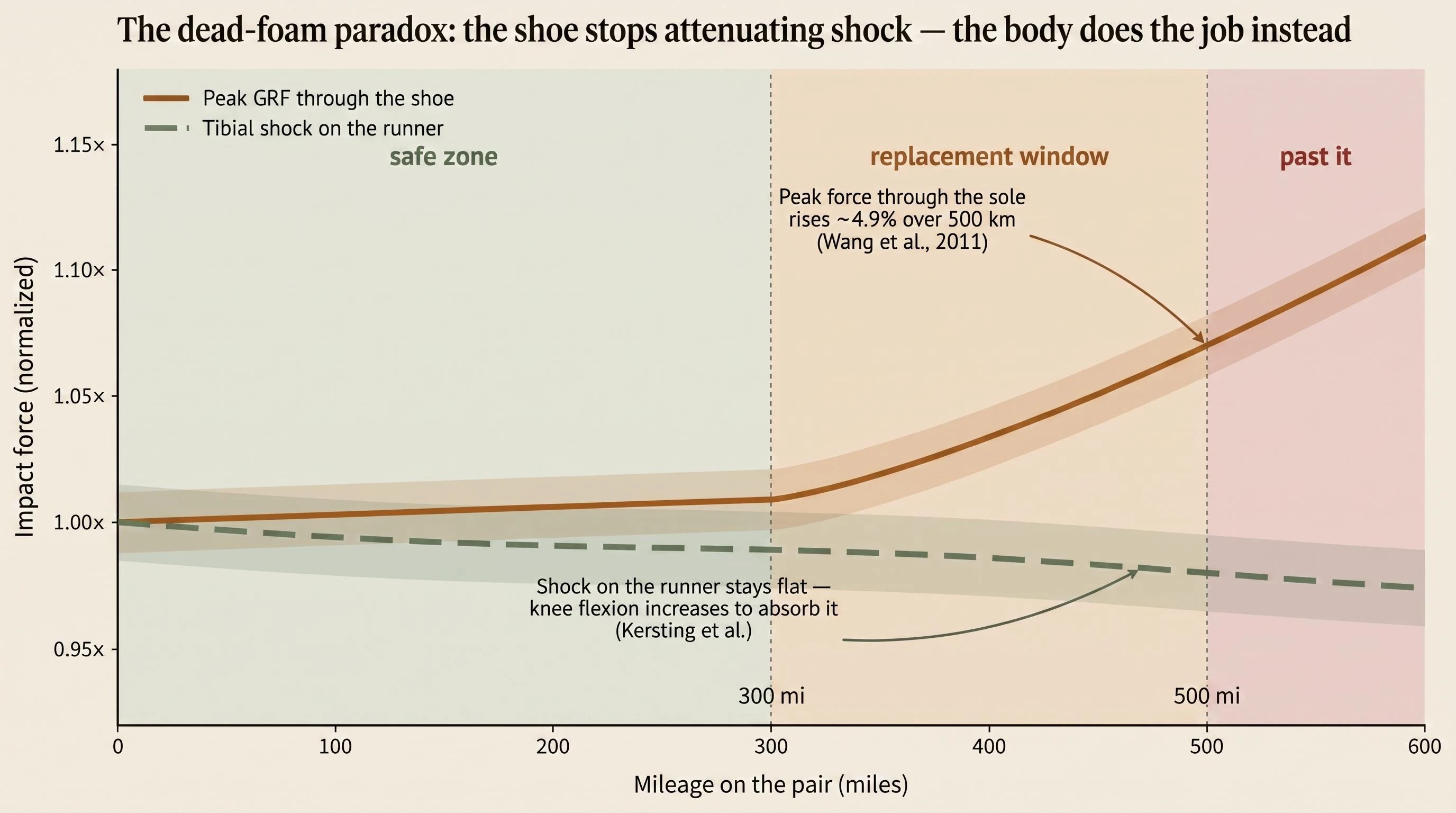
That masking effect is why runners don't feelthe shoe failing — and why injuries in dead shoes are often blamed on training load, ramp rate, or age. The impact didn't disappear. It just moved from the midsole into tendons and joints.
Rotation as injury prevention
The strongest evidence for running-shoe rotation comes from a 22-week prospective study by Malisoux et al. (2015). They followed 264 recreational runners and found that the parallel use of more than one pair of shoes was associated with a 39% reduction in running-related injury risk compared to single-shoe runners.
The proposed mechanism is tissue load-sharing. Different shoes have different geometries — heel-toe drops, stack heights, foam densities, arch heights, even outsole geometry. Those differences route ground reaction force through slightly different combinations of muscle, tendon, and bone on each footstrike.
Run the identical shoe every day and the identical kinetic chain absorbs the same vectors for weeks, which is exactly the load pattern that builds overuse injuries. Rotate two shoes with different drops, and the same total training volume spreads across slightly wider set of tissues — each one gets a break. Tendinopathies and stress fractures lose the fuel they need to accumulate.
The purpose-matched rotation
A mature rotation isn't just two copies of the same shoe. It matches shoe geometry to session physiology. A 3- or 4-shoe rotation maps onto the four workout shapes most runners end up doing.
| Role | Geometry | Foam | Lifespan | Exemplar |
|---|---|---|---|---|
| Daily trainer | 10–12mm drop · 34mm stack | Supercritical EVA | 400–500 mi | Brooks Ghost 16 |
| Tempo / intervals | 6–8mm drop · 28–36mm stack | PEBA + nylon plate | 300–400 mi | Saucony Endorphin Speed 4 |
| Long / recovery | 8mm drop · 41mm+ stack | Supercritical EVA + gel | 400–500 mi | ASICS Gel-Nimbus 26 |
| Race day | 8mm drop · 40mm stack (legal cap) | PEBA + carbon plate | 150–200 mi | Nike Vaporfly 3 |
Models are representative of category, not endorsements. Any model with similar stack, drop, and foam profile fits the same rotation slot.
Most runners don't need all four shoes. A smart minimum is two daily trainers in different geometries — that alone gets you most of the Malisoux injury benefit plus the foam-recovery extension. Add a tempo shoe when your training includes regular speed work. Add a race shoe only when you have actual races to target.
The super-shoe exception
Advanced Footwear Technology — the PEBA-plus-carbon-plate category — rewrites the lifespan math. Work by Hoogkamer, Kram and colleagues showed the original Nike Vaporfly 4% cut metabolic cost by roughly 4% in elite runners versus traditional racing flats. The plate stiffens the big-toe joint and stores energy; the foam compresses deeply and returns >85% of it on toe-off.
The problem: the physics that produce that energy return are the physics that produce rapid mechanical fatigue. PEBA foam deforms quickly under repeated load, and it doesn't fully recover even with rest. The industry-standard performance window is 150 to 200 miles— about a third of a standard daily trainer's life, at close to double the cost per mile.
The rational use case: race day and race-pace simulations only. A $250 super-shoe used for a spring marathon cycle (two tune-up races, one or two race-pace long runs, and race day) works out to roughly 80–120 miles — well inside its performance window and reasonable per-mile economics. That same shoe used for daily training burns its life in six weeks and costs 3x a normal trainer to replace.
The secondary benefit non-elites get from super-shoes isn't speed — it's muscle-damage protection over long efforts. Runners in PEBA finish marathons with lower eccentric muscle damage and recover faster, even when their pace is identical to a traditional trainer.
Practical rollout — how to actually do this
Starting fresh is easier than catching up. Three rules make the rollout painless:
- Stagger purchases by 4–6 weeks.Don't buy two pairs the same day — you'll retire them the same day and face a jarring double-replacement. Buy the second pair after the first has about 100 miles on it. That way you're never transitioning straight from a completely dead shoe to a brand-new stiff one.
- Alternate every other run. Simplest scheme that exists. Monday shoe A, Tuesday shoe B, Wednesday A, etc. Each pair gets at least 48 hours to decompress.
- Track mileage, not vibes.The failure mode of “I'll just feel when it's done” is that the body's knee-flexion compensation hides the moment. A simple per-pair mile counter beats intuition every time. Log it with our Shoe Mileage Tracker.
A note on break-in: modern shoes mostly don't need it. If a shoe needs 50 miles to start feeling right, it probably isn't the shoe for you. Save the race-day pair for race pace. Run 2–3 tune-up sessions in it before raceday so it's familiar, but don't burn marathon-pace miles on a 150-mile shoe.
Replace vs. don't replace — the real cues
Retire the pair
- Logged 400+ mi on a daily trainer / 150+ mi on a super-shoe
- New unexplained shin, knee, or hip aches with no training-load change
- Midsole feels flat or “bottomed out” underfoot
- Visible midsole creasing / wrinkles along the sidewall
- Foam still compressed visibly the morning after a long run
Keep running
- Outsole shows wear but mileage is under 300
- Upper is scuffed, mesh is dirty, laces are frayed
- Shoe feels the same as it did at mile 50
- A single odd run felt off (fatigue, heat, dehydration)
- Foam rebounds fully between runs (pair still rotating)
Resist the two biggest sunk-cost traps: the badge-of-honor 1,000-mile shoe (brag-worthy, quietly building an injury) and the pristine race-day pair kept for 18 months waiting for the right event (foam degrades in storage too — less than under load, but it still counts).
Common mistakes
- Judging shoes by outsole wearOutsole outlives midsole. If you wait for visible rubber wear, you've been running in a dead shoe for 100+ mi.
- Single-pair daily useThe foam never fully decompresses, so each shoe lasts shorter and the same tissues absorb every stride.
- Using the race shoe for daily milesPEBA in the carbon racer dies in 6 weeks at that usage. Reserve it for race-pace work only.
- Buying two identical pairs same-dayRotation works, but retirement clusters. Stagger by 4–6 weeks so one always has life left in it.
- Two different-drop trainers, staggeredCheapest way to capture both the injury reduction and the foam-recovery lifespan extension.
Bottom line
Standard trainer: retire at 300–500 miles. Super-shoe: 150–200 miles, race day only. Rotate at least two pairs, stagger purchases by a month, track the miles rather than trust the feel. Done that way, each pair lasts 30–40% longer and injury risk drops by roughly a third.
The alternative — one shoe, every day, until it visibly falls apart — is the pattern that quietly produces most of the overuse injuries runners blame on training volume. The foam just stopped doing its job somewhere around mile 350.