

Fasted Running and Fat Oxidation: When Training on Empty Helps (and When It Hurts)
Fasted Zone 2 builds fat oxidation. Fasted intervals just break you. Three rules separate useful fasted work from damage.
Fasted training is a surgical tool, not a lifestyle. Applied correctly it drives mitochondrial biogenesis and improves fat oxidation at aerobic intensities. Applied past its limits — or to the wrong sessions — it's just self-inflicted damage with no training benefit.
The mechanism, briefly
Low muscle glycogen activates AMPK, a cellular energy sensor that triggers mitochondrial biogenesis and upregulates fat-oxidation enzymes. Substrate use shifts from glycolytic toward lipolytic. This is a signalling benefit — the body builds better aerobic machinery.
Recent meta-analyses confirm fasted training raises the intensity at which you burn fat, but doesn't on its own improve VO2max or race times. The payoff is glycogen sparing: you can go harder before you run out. That matters late in a marathon. It doesn't matter on a 5K.
The crossover curve
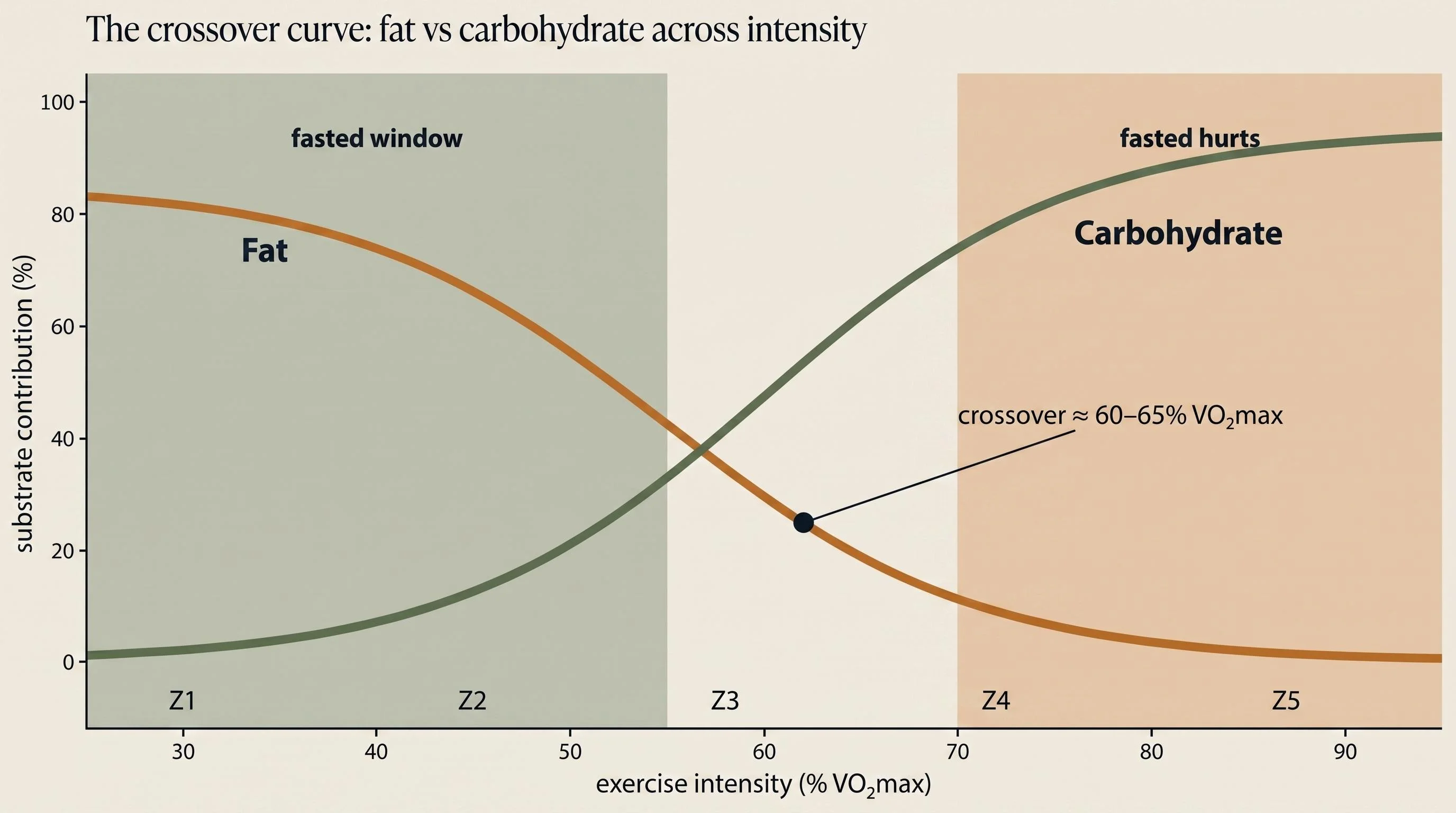
At rest you burn mostly fat. As intensity rises, carbohydrate takes over — around 60–65% VO2max, the curves cross. Fasted work is useful belowthe crossover. Above it you're asking the body to run on carbs you haven't given it.
Session-by-fueling matrix
Match fuelling to the session goal. Not the other way around.
| Session | Duration · intensity | Fueling |
|---|---|---|
| Recovery / easy | < 60 min · Z1 | Fasted or fed |
| Fat-oxidation focus | 60–90 min · Z1 / low Z2 | Fasted / sleep-low |
| Endurance base | 90+ min · Z2 | Fed, 60–90 g carb/hr |
| Threshold / VO2 / sprints | Any · Z4–Z5 | Fully fed |
The rule is simple: if the goal is speed or mechanical output, eat. If the goal is metabolic efficiency, you can skip the carbs — but you're also skipping the speed. Not sure which session is which this week? Ask Pallie to map your plan.
Sleep-low, train-low
The elite version of fasted training. A hard, fully-fueled evening session depletes glycogen. You eat a zero-carb recovery meal (protein + fat), sleep glycogen-depleted, do an easy fasted run the next morning, then refuel. AMPK stays elevated across ~14 hours.
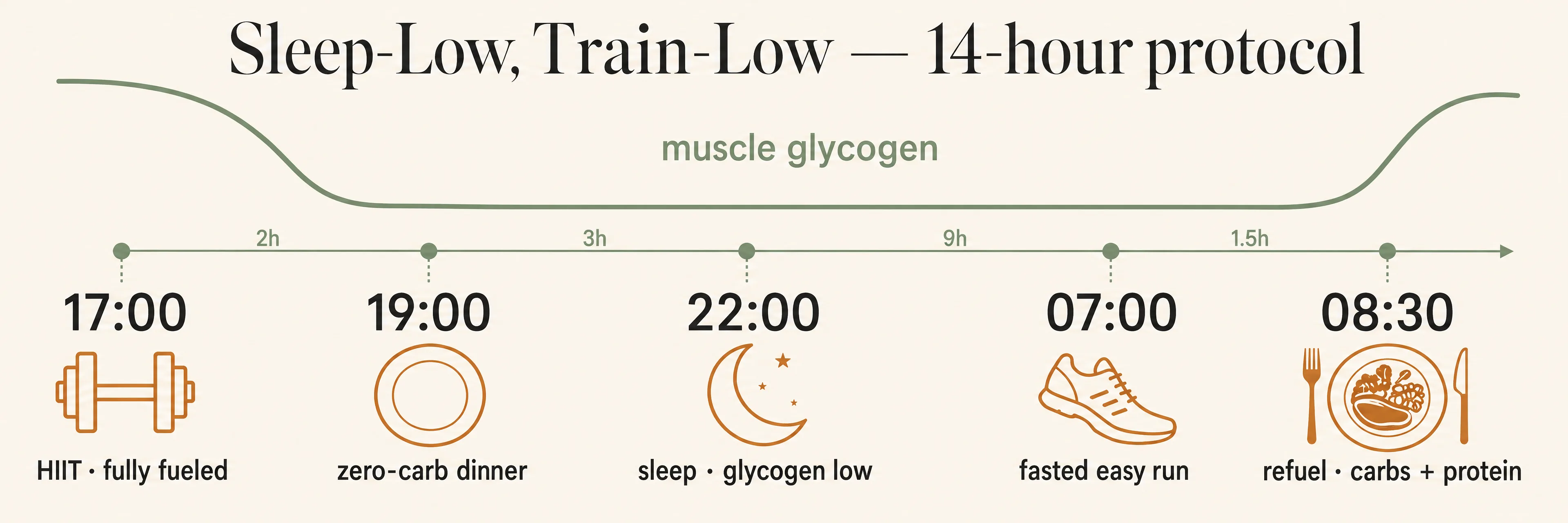
Controlled 3–4 week sleep-low blocks have shown ~3% 10K improvements and 12.5% gains in supramaximal time-to-exhaustion. One or two blocks a season, base phase only. Run it chronically and you get the opposite: flat HRV, sick days, overreach.
What you can drink — and what actually breaks a fast
Doesn't break it
- Black coffee
- Plain water
- Electrolytes (sodium, magnesium)
- BCAAs, ~5 g (technically trigger mTOR, negligible kcal)
Counts as fed
- Milk or cream in coffee
- Sugar, honey, sports drink
- A gel, a banana, anything with calories
- Protein shake
Your first fasted Zone 2 run
- Wake 06:30. Water + pinch of salt. Optional black coffee.
- Run 07:00.60–75 min strictly Zone 2. If you can't hold a sentence, slow down.
- Refuel 08:30. 20–40 g protein + 40–60 g carbs, within 30–60 min of finishing. Eggs + oats + fruit, or a loaded smoothie.
Skip the refuel and you pay for it on the next two days' quality sessions.
Women and fasted training
Female physiology handles fasted work differently — and worse. Roughly twice the density of kisspeptin neurons in the hypothalamus read glycogen drops as starvation signals and suppress the reproductive endocrine axis.
- Early follicular only (days 2–10). Low estrogen, the body tolerates mild fuel restriction.
- Avoid in luteal phase (days 15–28). Stacking stress on elevated cortisol.
- Stop at any REDs warning sign — missed periods, stress reactions, HRV drops, iron-deficiency symptoms.
Full picture: Intermittent Fasting for Runners: Does It Actually Work?
Bottom line
Zone 1 to low Zone 2. Under 90 minutes. One or two times a week, base phase only. Refuel within the hour. Done that way, fasted training measurably improves fat-oxidation machinery and aerobic efficiency.
Run it daily, run it fasted-intervals style, or run it through a build block, and you get blunted adaptation, flat HRV, and — for women — real endocrine hazard. Fuel for the work required. Train low with intent.