A low-volume cycling plan cannot simply shrink a 20-hour professional schedule. Pro athletes build aerobic engines through sheer volume and calcium signaling pathways. Time-crunched amateurs (4–8 hours/week) must rely on intense metabolic stress (AMPK enzyme activation) to trigger mitochondrial biogenesis in minimal time.
What does the "3+2" 6-Hour weekly framework look like?
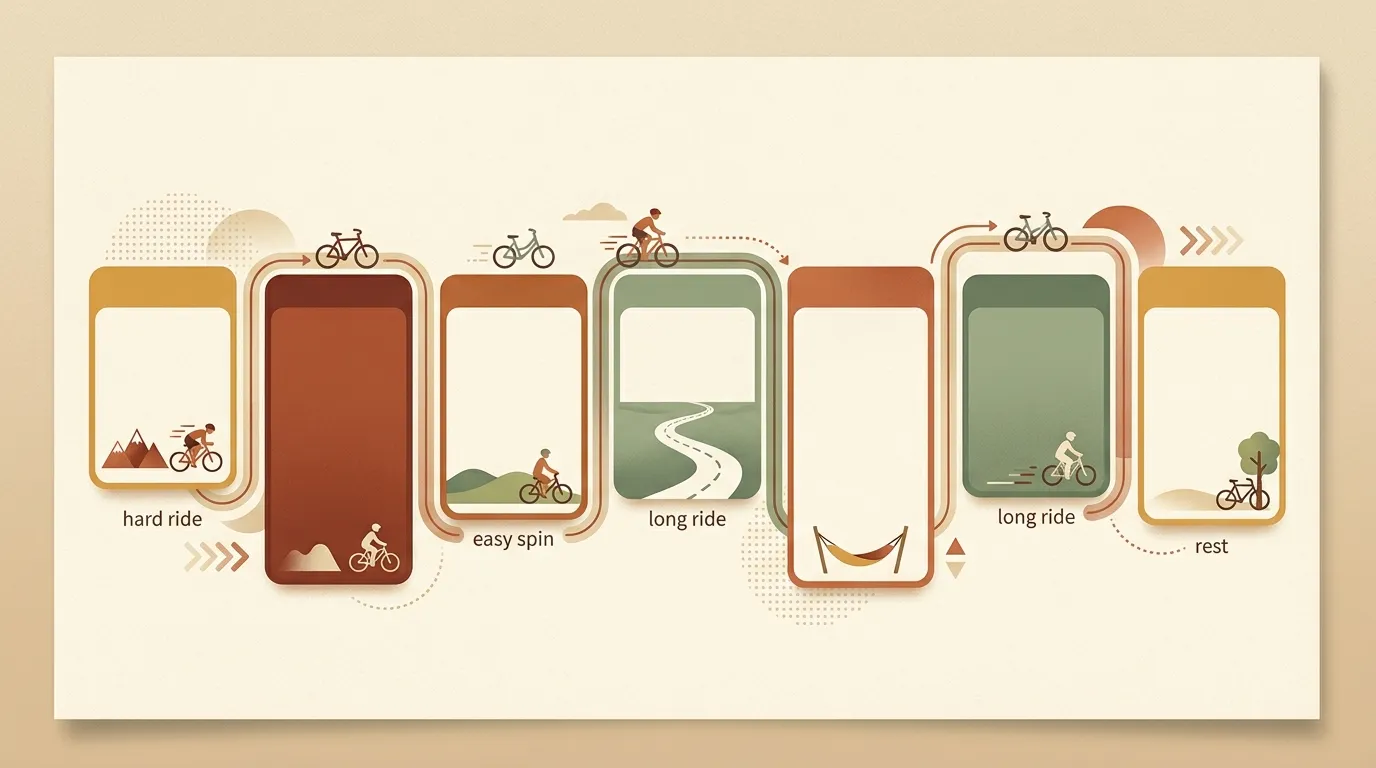
Coaching consensus highlights the 3+2 Framework as the optimal layout for a 6-hour week: 3 quality blocks (2 interval sessions + 1 long ride) combined with 2 easy recovery spins.
| Day | Workout Type | Target Intensity | Primary Purpose |
|---|---|---|---|
| Monday | Complete Rest | — | Autonomic CNS reset |
| Tuesday | 60m VO₂max Intervals | 4×8m @ 105% FTP (or 4×4m @ 110%) | Raise maximal aerobic ceiling |
| Wednesday | 45m Recovery Spin | Zone 1/2 (<55% FTP) | Circulation & active recovery |
| Thursday | 60m Sweet Spot / Threshold | 2×20m @ 90% FTP (or 3×10m @ 98%) | Build sub-threshold muscular stamina |
| Friday | Complete Rest | — | Protect weekend long ride freshness |
| Saturday | 2.5h Long Endurance | Zone 2 (56–75% FTP) | Aerobic durability, outdoor skills & fueling |
| Sunday | 45m Recovery Spin | Zone 1/2 (<55% FTP) | Flush fatigue before Monday reset |
Customize this layout for 4, 6, or 8-hour schedules with our Cycling Week Builder.
Why cap high-intensity sessions at two per week?
High-intensity intervals (Zones 4–5) generate central nervous system (CNS) autonomic fatigue and rapid muscle glycogen depletion. While legs may feel rested after 24 hours, central autonomic recovery requires 48 to 72 hours.
Attempting 3 or 4 hard sessions on 6 hours a week causes chronic fatigue, lowers the power you can sustain on hard days, and leads to performance plateaus. When extra time becomes available, extend the weekend Zone 2 ride rather than adding another interval day.
Weekend Warrior Evidence: A 2025 study by Tripp et al. confirmed that concentrating volume into a 2-day weekend block produces non-inferior VO₂max gains (~10% increase) compared to spreading volume across 4 days, provided total duration and intensity are matched.
How do you optimize indoor vs outdoor sessions?
Indoor smart trainers are essential tools for time-crunched cyclists, but demand specific thermoregulatory management:
- Time Density: 60 minutes indoors equals roughly 90 minutes outdoors because pedal stroke is continuous (zero coasting or descending).
- Cooling & Cardiovascular Drift: Riding indoors lacks convective wind cooling. Without industrial blower fans moving 1,500 to 2,000+ CFM focused on the torso and head, core temperature rises rapidly, causing heart rate to drift upward and power output to fade.
- ERG vs Slope Mode:Use ERG mode on smart trainers for steady threshold and Sweet Spot sets to guarantee time-in-zone. Use Slope/SIM mode for short anaerobic micro-bursts (<30 seconds) and pacing practice.
Learn more in our Cycling Training Plan Guide, compare intensity distributions in Polarized vs. Sweet Spot Training, and review volume benchmarks in our Zone 2 Base Training Guide.