
How to Study Effectively With Active Recall
Not by rereading harder — by testing yourself on purpose, on a schedule, until the struggle stops feeling like failure.
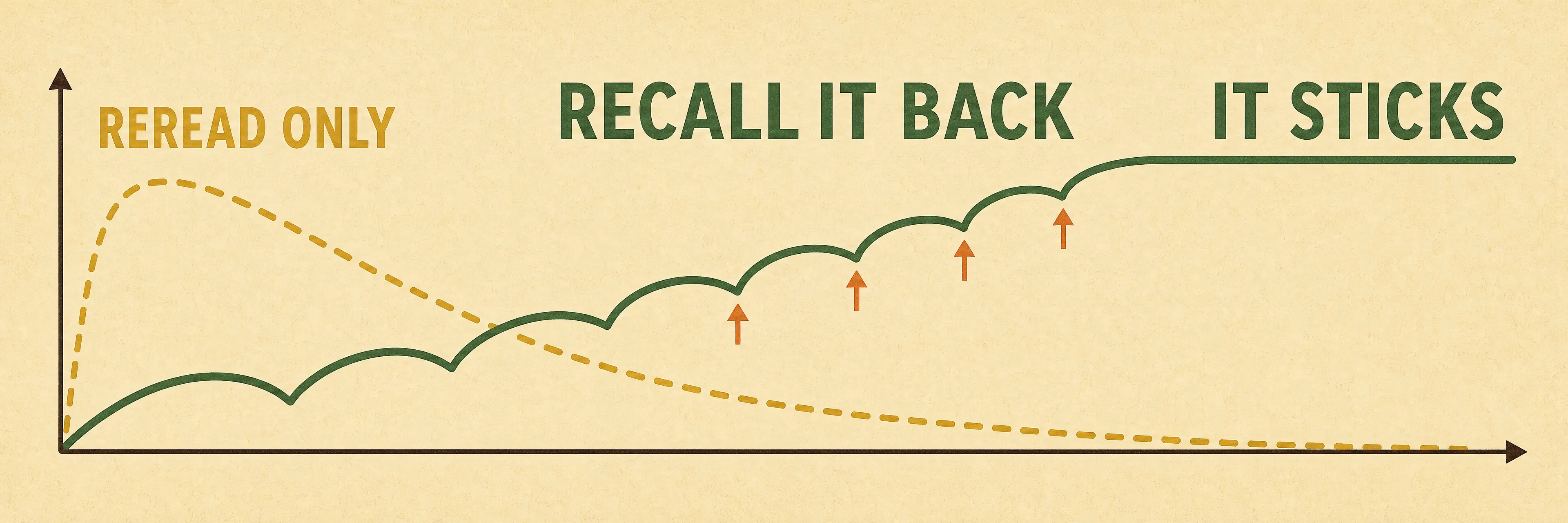
- Stop rereading, start recalling.Close the book and produce the answer from memory before you check it. The fluency of rereading is an illusion; the struggle of recall is the actual mechanism.
- Space it out, not all at once.Quiz yourself on new material a day later, a few days later, about a week later — expanding gaps, never a fixed daily grind.
- Push into why and how.Once recall stops being a fight, ask why it makes sense and how it connects to what you already know. That's what makes it durable, not just retrievable.
Most study advice is a listicle of tips you try once and drop. This is a six-week arc instead — a way of studying that gets easier precisely because it started out feeling harder. Walk it yourself with your own material, or have Pallie hold the schedule and quiz you along the way.
Why doesn't rereading work?
Because it optimizes for the wrong thing. When you reread a chapter or rewatch a lecture, the material starts to feel familiar — and that familiarity gets misread as knowledge. Psychologists call this the illusion of competence: fluency of processing, mistaken for depth of learning.
Rereading feels like filling a cup; recall feels like draining one — but only the draining actually builds the muscle.
Cognitive scientists Robert and Elizabeth Bjork explain this with two separate numbers your memory tracks for every fact: how easy it is to pull up right now(retrieval strength) and how deeply it's actually embedded for the long run (storage strength). Rereading right before a test spikes the first number and does almost nothing for the second — the Bjorks' research on “desirable difficulties” is the clearest evidence we have on why that gap matters.
| What it feels like | What it actually means | |
|---|---|---|
| “I've got this,” right before the test | High retrieval, low storage — fluent now, gone in days | Cramming illusion |
| Recall still feels easy, weeks later | High retrieval, high storage — the actual goal | Deep mastery |
| “I used to know this” | Low retrieval, high storage — one recall pass brings it back fast | Needs a refresher |
| Blank, no matter how hard you try | Low both — it never really landed the first time | Never landed |
The point isn't to diagnose yourself precisely — it's to notice that feeling fluent and actually retaining are two different things, and only recall tells you which one you have.
The six-week arc
Four movements, not a rigid calendar. Someone who takes to this quickly can move into deeper questions sooner; someone white-knuckling recall stays in the early weeks longer. The weeks are a map, not a timetable.
- 1Week 1
Break the illusion
Bring the material you're actually working through. After a normal reading session, close it and write what you remember from memory, no peeking. The thin, stumbling answer that comes back isn't a failure — it's a diagnostic everyone's rereading habit produces, and it's the moment the plan changes from rereading to testing.
- 2Weeks 2–3
Build the recall reflex
New material gets tested again in a day or so, again in a few days, again in about a week — expanding gaps, not a fixed drill. It will feel bad before it feels good; that discomfort is the mechanism, not a warning sign. This is also where a cramming relapse is most likely — the plan for that is below.
- 3Weeks 4–5
Deepen the schema
Once cold recall stops being a fight, the ceiling isn't retention anymore — it's whether facts connect to anything. Every clean recall gets a follow-up: why does that happen, not just that it happens? How is this different from what you covered two weeks ago? That pulls a fact into real understanding.
- 4Week 6
Let go
The goal was never a quiz partner you need forever — it was a habit that runs on its own. Prompts thin out on purpose this week. If you catch yourself testing without being asked, that's the win condition, not a lucky accident.
How do I actually schedule the recall?
You don't need an app or a spreadsheet. Three numbers carry almost the whole method.
The average time a new habit takes to stop needing willpower, per Lally et al. (2010). Six weeks gets the habit running; it isn't fully automatic yet, and that's expected.
A simple expanding schedule: test yourself a day after first learning something, again in a few days, again about a week out — before the memory has fully faded, not after.
Always attempt the answer cold before checking notes. Even a failed attempt to recall primes your brain to encode the real answer more deeply once you see it.
Sound like too much to track by hand? That's exactly the administrative part a companion can carry. Have Pallie hold the schedule
What happens when I fall back into cramming?
Almost everyone hits a “cramming relapse” — an exam feels close, recall feels slow, and rereading feels like the safer bet. It isn't a character flaw; it's a predictable response to acute stress, and active recall is cognitively taxing exactly when you have the least spare capacity for it.
Two things actually help, and both work better set up in advance, on a calm day, not mid-panic:
- Pre-write the fallback.“If I want to panic-reread the night before a test, then I'll do a 10-minute brain-dump of everything I remember first.” Deciding this ahead of time, per research on effective study strategies, makes it far more likely you'll actually do it under pressure.
- Use a fresh start, don't chase a backlog. Missed several days? Don't try to catch up all at once. Land near a natural reset point — a new week, a Monday — and pick something small. A five-minute recall beats a guilt-driven marathon session every time.
When is this more than normal study friction?
Occasional frustration with a hard concept is the method working, not a problem. But if studying has tipped into flat, hopeless language — “I don't care anymore,” “I'll never catch up” — or a real withdrawal from classes and people alongside failing grades, that's burnout, not a study-method gap. This is a method coach, not a clinician: the right move there is dropping all recall load to zero and talking to a campus counselor, advisor, or mentor — someone equipped for exhaustion, not a schedule.
Walk it yourself, or study it with Pallie
The whole map: test yourself instead of rereading, space the tests out, push into why and how once recall gets easy, then fade the scaffolding out. You can run this entirely on your own with a notebook and a calendar reminder.
Or let Pallie carry the administrative part — tracking what you covered and when, showing up with the right question at the right gap, reframing the friction on the day it feels pointless. Not a tutor who teaches your material (Pallie doesn't know your syllabus and shouldn't pretend to) — a companion who understands how memory works and quizzes you on your own material, over real weeks.