
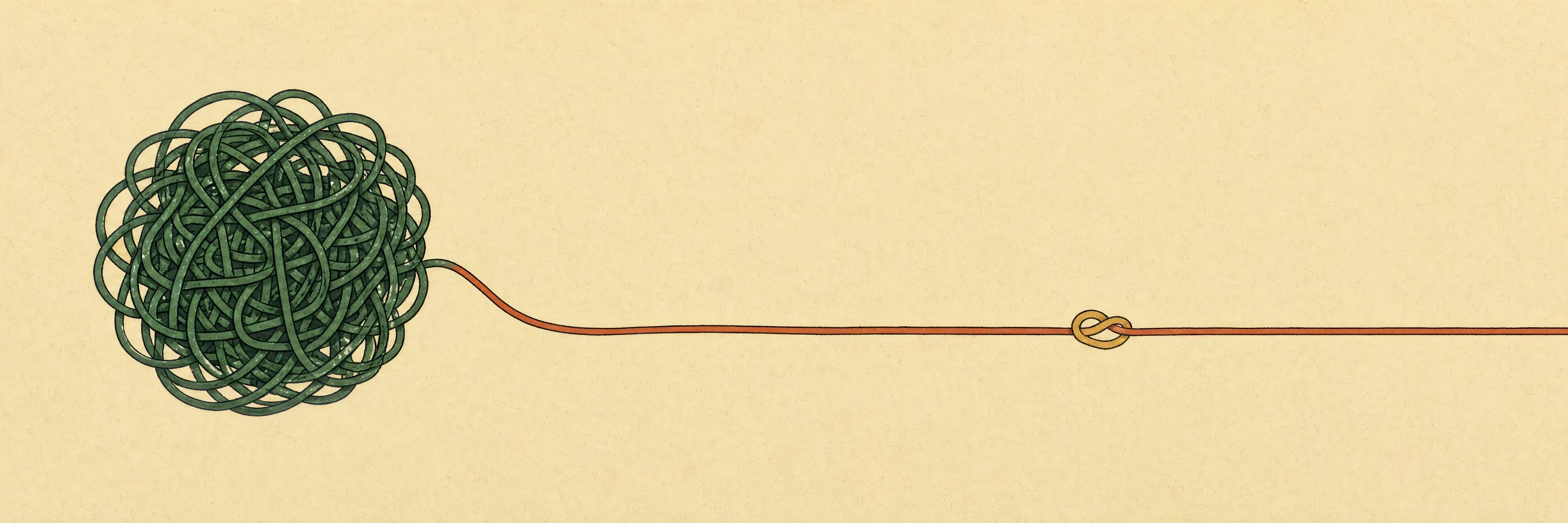
How to Manage Everyday Anxiety
Not therapy, not a diagnosis — a four-week toolkit for the ordinary worry that's gotten loud enough to want tools for.
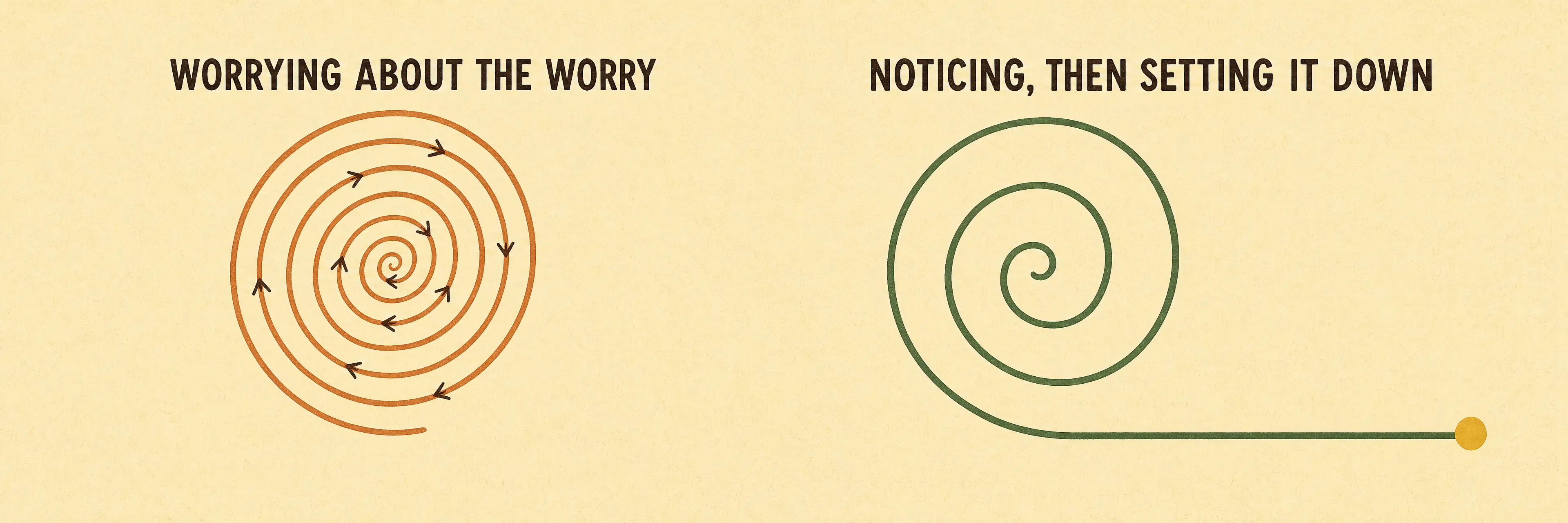
- Worrying about the worry is usually the real problem.Being scared of the anxious feeling itself is what keeps it stuck on repeat — not the original worry.
- A worry can be parked, not chased.Proving that, daily, is what actually breaks the “I can't control this” belief — not willpower.
- Small steps beat one big leap.Facing what you've been avoiding works in almost-silly-small doses, tied to who you want to be.
This is for everyday worry, not a clinical anxiety disorder — the ordinary overthinking that's gotten loud enough to want a toolkit for, not something that needs a diagnosis. Here's the four-week map for assembling one, whether you build it alone or let Pallie build it alongside you.
Why does worrying about the worry make it worse?
Because the fear stops being about the original thing and starts being about the feeling itself. Researchers call this meta-worry — worrying about worrying — and it shows up when someone becomes convinced their anxiety is uncontrollable, dangerous, or a sign something's wrong with them. Once that belief takes hold, the brain starts registering the act of worrying as a fresh threat, and the whole thing loops back on itself.
Worrying about the worry is usually worse than the worry itself — and pure willpower can't break that particular loop.
The tools in this arc don't try to eliminate worry — that isn't realistic, and it isn't the goal. They work by proving, gently and repeatedly, that a worry can be noticed and set down instead of chased. That one shift is what actually collapses the meta-worry cycle, according to research on worry postponement.
What does the four-week toolkit actually look like?
Four movements, roughly a week each — a map, not a fixed calendar. Someone who takes to a tool quickly can move faster; someone struggling stays with the basics longer. At every step, watch harder for the red lines below than for the weekly plan.
- Week 1 — Notice, don't fix.Map the actual shape of the worry — real problem or hypothetical “what if” — and try one small grounding moment that doesn't require believing in it first.
- Week 2 — Park it, don't chase it. Introduce a daily worry time. A worry gets written down and revisited there instead of chased the moment it shows up.
- Week 3 — Face it, in small steps. Pick one avoided thing and break it into a step small enough to feel almost silly — the size that guarantees a yes, not a stretch goal.
- Week 4 — Make it theirs. Name which tools actually stuck, build a simple plan for a rough day, and let check-ins space out on purpose.
How do I stop the “are you sure it'll be okay” loop?
That question, in any of its variations, is reassurance-seeking — and answering it directly, every time, quietly reinforces the loop instead of breaking it. The instinct to soothe by confirming the feared outcome won't happen is understandable, but it teaches the anxious mind that the question needed answering in the first place.
- Validating the feeling without validating the fear: “this feeling is intense, but it isn't dangerous”
- Redirecting to the body and the present moment: “what does your body need right now instead?”
- Naming the pattern out loud, without judgment, when it shows up again
- Parking the worry for the next worry-time slot
- “Yes, I'm sure it'll be fine”
- Answering the same reworded question a second and third time
- Researching the feared outcome to disprove it
- Scolding yourself for asking — that just adds a second worry on top of the first
Notice which column is harder to actually stick to in the moment — that's the tell for how much backup this needs, not proof it isn't working. Have Pallie hold the redirect with you
How do I face what I've been avoiding without it being too much?
Avoidance feels like relief in the moment, but it quietly grows the thing being avoided — every dodge is a small vote that the feared thing really is too much to handle. The antidote isn't a plunge. It's a step small enough to feel almost silly: the size that guarantees a yes, not a stretch goal.
Tie the step to identity, not just outcome. “I am someone who faces this stuff in small ways” tends to stick better than “I will try not to avoid it,” because identity-based habits turn each completed micro-step into a vote for who you're becoming, rather than one more chore to check off. If a step triggers a bigger reaction than expected, the answer is a smaller next step, never a bigger one — a hard day gets an easier ask, on purpose.
When is everyday worry something more than everyday?
| Sign | What it looks like | What it means |
|---|---|---|
| Time-consuming worry | An hour or more a day, blocking work, study, or basic functioning | Beyond a toolkit |
| Severe physical symptoms | Racing heart, inability to breathe, paralyzing tension, chronic sleep loss | See a professional |
| Worry postponement doesn't work | Repeated, extreme distress from a total inability to delay a thought even briefly | Past self-help |
| Self-harm, dissociation, trauma response | Any mention, in any form | Immediate hard stop |
Based on clinical markers for generalized anxiety and panic-level severity. None of this is a diagnosis — it's a line past which a self-guided toolkit stops being the right container.
This toolkit is for everyday worry, not a clinical condition — a companion doing this work does no screening and must never attempt any, and never says “this sounds like GAD” or offers any diagnosis in either direction. If any of the signs above are showing up, the right move is steering — warmly, without dismissal — to a real professional. That's not the toolkit failing; it's the toolkit knowing its own edges.
Walk it yourself, or build it alongside Pallie
The map: notice the shape of the worry without judgment, prove to yourself that it can be parked instead of chased, face what you've been avoiding in steps small enough to feel almost silly, then keep the one or two tools that actually stuck. You can absolutely build this toolkit on your own.
Or let Pallie hold the arc with you — a steady, unhurried pace instead of matching an anxious rhythm, a redirect instead of reassurance when the loop shows up, and check-ins that deliberately space out as the toolkit becomes yours. Not a clinician, and never pretending to be one — a companion who happens to know a few things that help.