
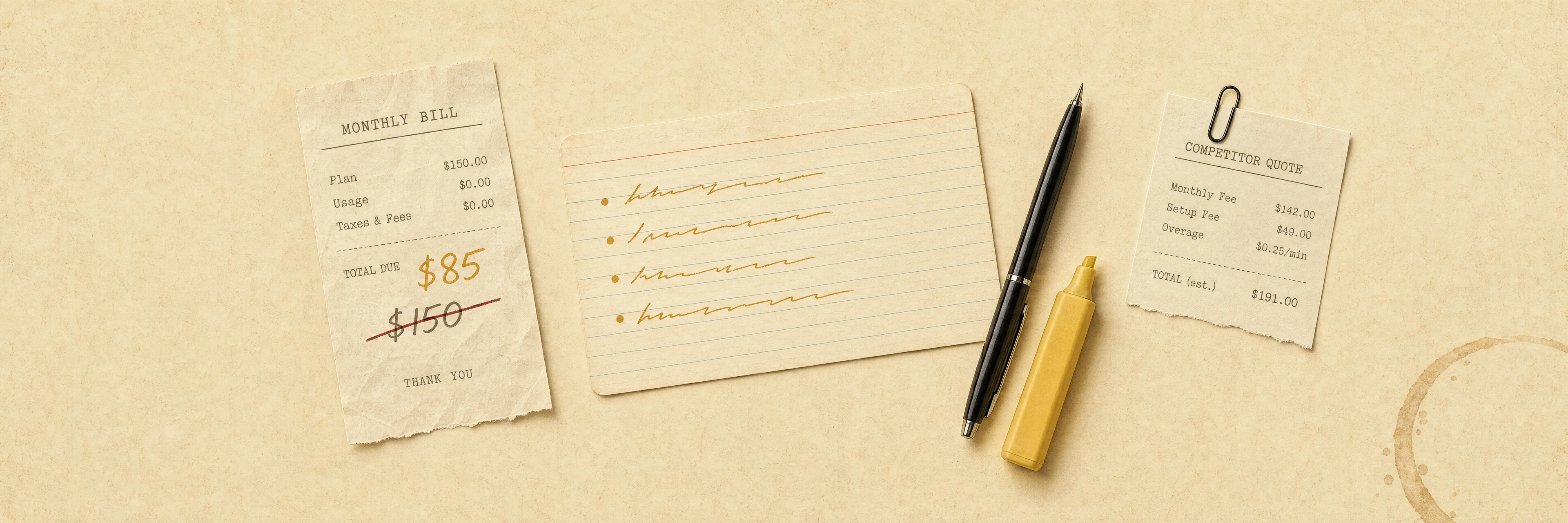
Retention Department Scripts That Actually Work
Paste-ready wording for eight of the most-negotiated bills — cable, internet, mobile, insurance, gym, APR, streaming — with pushback rebuttals for the moments the script runs out.
- Pick your scenario, then follow the shape.Every script below uses the same seven-beat anatomy — open with warmth, anchor with a competitor quote, make the ask, then shut up.
- The “golden silence” is the whole game.After you state your number, stop talking. The agent fills the pause within eight seconds — usually with their first concession.
- Escalate politely when the script runs out.The pushback table at the bottom handles the six answers retention uses to stall. None of them are the end of the call.
New to the playbook? The pillar on negotiating lower bills by phone covers why retention departments exist, how much you can realistically save, and the three-way choice between doing it yourself, paying a contingency-fee service, or handing it off. This page is the script sheet: eight self-contained scenario cards, each one a paste-ready call you can run in 20 minutes.
How to reach a retention agent (30 seconds)
Front-line customer-service reps can’t change your base rate — their software literally forbids it. Retention (a.k.a. loyalty, customer saves) is a separate department with its own promo matrix and compensation tied to the “save rate”. Reach it by calling the main number, telling the IVR or the first human you’d like to cancel your service, and waiting for the transfer.
Don’t negotiate with the front-line CSR — their job is triage. If they offer you a discount before transferring, politely decline (“thanks, I’d still like to speak with retention”) and hold out for the real desk. The word that reliably triggers routing is cancel, not “discount” and not “my bill is too high”.
The anatomy every script shares
Each of the eight cards below follows the same seven-beat structure. Learn it once and you can riff any scenario the catalog doesn’t cover.
- Opening — forced empathy.Thank them. Compliment the service. Acknowledge you’re about to ask for something. This is FBI negotiator Chris Voss’s forced-empathy opener — unexpected warmth breaks the defensive script.
- Identifier.Name, account number, tenure. One sentence. This is where most calls stall; written verbatim, it takes eight seconds.
- Competitor anchor.A real, current competitor price you can screenshot or read back. “[Competitor] is at $X for the same tier.”
- The ask.One sentence. Specific number, specific term. “Please match $X for 12 months.” No qualifiers.
- The silence.Stop talking. Five to ten seconds feels unbearable; let them fill it.
- Branches.Pre-written replies for the three or four most likely pushbacks. Each card below supplies them.
- Graceful close + written confirmation.Restate the agreed number, the term, and ask for an email confirmation with a reference number before hanging up.
Hold this shape in your head while you read the cards. Every scenario is just different wording around the same seven beats.
Eight scenario scripts
Copy the opener verbatim, swap the bracketed placeholders for your own details before you dial, and keep the branches visible while you’re on the line. If you’d rather not run the call yourself, the hand-off link under each card seeds Pallie with the scenario-specific brief.
Cable retention — promo has expired
Cable / Pay-TVYour introductory rate just rolled off and the monthly bill jumped 30–80%. Success rate ~70%, typical save $10–$30/month.
OpeningHi — before anything, the service itself has been solid and I'm not calling to complain about that. I'm calling because my bill's gone from $X to $Y and I need to decide between staying and switching.
Anchor & ask[Competitor] has the equivalent tier at $Z right now. I'd like retention to match that for the next 12 months — otherwise please schedule my cancellation for the end of this billing cycle, [date].
If they push back- If they say that's the best price available'Understood. Can you transfer me to retention or loyalty? I'd rather stay if the numbers work, but I'm ready to port to [Competitor] by [date] if not.'
- If they offer a small loyalty credit'I appreciate that. To be direct — $Z is my number. If that's out of reach, I'd rather use this call to confirm the cancellation.' Then the silence.
- If they say the promo is for new customers only'I understand the policy. I'm a four-year customer about to become a new customer somewhere else. Is there a retention-specific promo you can apply?'
'Great — so I'm on the [plan] at $Z for 12 months, confirmed by email today, reference number [X]. Thank you for the help.'
Or brief Pallie to make this callHome internet retention — bill-shock jump
Internet / Broadband12-month promo ended, rate jumped. Success rate ~66–70%. US save $10–$30/mo; UK ~£20/mo or £237/year by switching (Which?).
OpeningHi — first, the connection's been reliable and the installer was great. I'm calling because my monthly went from $X to $Y and I'm about to switch to [Competitor].
Anchor & ask[Competitor] is quoting me $Z for [speed] with a 12-month price-lock. Can retention match that and lock the rate in writing? If not I need to book my cancellation for [date].
If they push back- If they offer a speed upgrade instead of a price cut'I appreciate it, but more speed doesn't change the monthly — can you hold me at $Z at my current tier instead?'
- If they quote a CPI-linked rise (UK only)'This contract is under the Ofcom January 2025 rules — any mid-contract rise has to be quoted in pounds and pence up front. Can you confirm my locked monthly in writing?'
- If they claim they can't waive the early-termination fee'OK — I'll wait out the contract end [date] rather than pay the ETF. Can you put a note on my account to call me with the best offer two weeks before that date?'
'So my new rate is $Z for 12 months, no ETF, emailed to me today, reference [X]. Thank you.'
Or brief Pallie to make this callMobile carrier retention (US & UK)
MobileYour plan's drifted above market and competitors are advertising clean SIM-only or unlimited tiers. US save typically $10–$20/line; UK haggling success 63% with ~£258/yr switch savings.
OpeningHi — I've been with you since [year] and the coverage where I live is genuinely good. I'm calling because [Competitor] is offering the same data allowance at $X and I'm about to port my number.
Anchor & askI'd like retention to put me on a $Y plan matching that allowance, 12-month price-lock. If you can't, please start the port-out/PAC code process for [date].
If they push back- If they offer extra data instead of a price cut'Extra data doesn't fix the monthly. What can you do on the price at my current allowance?'
- If they push a trade-in or handset deal'I'm SIM-only — I don't need a handset. What's your best retention offer on the plan alone?'
- UK: if they quote a CPI-linked annual rise'For anything signed after 17 January 2025, Ofcom requires a pounds-and-pence rise quoted at signup. Can you confirm my exact monthly for the full term in writing?'
'So I'm on the $Y SIM-only plan, locked for 12 months, emailed confirmation with reference [X]. Thanks for the help.'
Or brief Pallie to make this callAuto insurance renewal
InsuranceRenewal premium jumped despite no claims. Success rate ~65%, typical save $15–$50/month. Agents often re-rate via new discounts rather than slashing price.
OpeningHi — I've been a policyholder since [year], clean record. I'm calling because my renewal came in at $X and I've pulled a quote from [Competitor] at $Y for the same coverage and deductible.
Anchor & askBefore I switch, can retention re-rate the policy and apply any discounts I'm eligible for — safe-driver, telematics, multi-policy — to get me to $Y or as close as you can?
If they push back- If they try to raise your deductible to cut premium'Let's keep the deductible at $D for now — I want to see what the premium does under my current terms first.'
- If they offer multi-policy bundling'What's the bundled price with home/renters, and what's the auto-only price with every discount applied? I want to compare both clean.'
- If they won't move'Understood. Please note my renewal is [date] and I'll be cancelling on that date unless retention can revisit. Can you schedule a call-back two weeks before?'
'So my new premium is $Y, same coverage and deductible, effective [date], written confirmation to my email. Thank you.'
Or brief Pallie to make this callHome insurance renewal
InsuranceRenewal letter arrives, premium jumped 15–40% with no claims. Success rate ~60%, typical save $10–$40/month. Deductible and bundle tweaks do most of the work.
OpeningHi — I'm calling about my home policy renewal, number [X]. No claims in the last [N] years. The renewal came in at $A and I've just quoted [Competitor] at $B for equivalent coverage.
Anchor & askBefore I switch providers, can retention match $B while keeping my current coverage limits and a deductible no higher than $D?
If they push back- If they flag an increase tied to "market conditions"'I understand the market. My question is what you can do on my specific policy, given my claims history and tenure, to match the $B quote.'
- If they push you up on the deductible'I'm open to a small bump on the deductible if the premium savings justify it. What's the premium at $D vs $D+500 vs $D+1000?'
- If they propose reducing coverage'I'd rather not cut coverage. Can we get to the number through discounts, bundling or loyalty credit first, and only look at coverage as a last resort?'
'So renewal is $B, same coverage, deductible $D, renewed [date], confirmed in writing to my email. Thank you.'
Or brief Pallie to make this callGym retention — freeze vs cancel
Gym membershipYou want out, or at least a pause. Agents have wide discretion; success rate ~70% and freezes are often cheaper than retention discounts. Works on chain gyms and boutique studios.
OpeningHi — I'd like to cancel my membership, account [X]. I've not been using the gym enough to justify the monthly and I've decided to step away.
Anchor & askPlease process the cancellation effective today — or, if you can offer a 3-month freeze at a nominal admin fee, I'd consider that instead.
If they push back- If they offer a discounted monthlyBroken record: 'I appreciate that, but the issue isn't the price — it's that I'm not using it. Please process the cancellation today.' Repeat verbatim.
- If they mention a notice period'Understood. Please register today as the notice start, and email me a written confirmation with the final billing date.'
- If a freeze is offered'What's the freeze fee, for how long, and does it auto-resume? If it's under [your threshold] for 3 months with no auto-charge, I'll take it.'
'So I'm [cancelled effective X / frozen until Y] with cancellation reference [Z], confirmed to my email. Thank you.'
Or brief Pallie to make this callCredit-card APR reduction
Credit cardHighest-success category on the list. 83% of APR-reduction requests succeed (LendingTree 2025), average cut 6.7 percentage points. One call on a $7k balance can save $1,600+ in interest.
OpeningHi — I'm calling about the APR on my card ending [last 4]. I've been a cardholder since [year], I pay on time, and I've been receiving balance-transfer offers from [Competitor Card] at [introductory APR].
Anchor & askGiven my history, I'd like my purchase APR reduced from [current]% to something closer to [target]%. If you can't, I'll move the balance to the competitor offer.
If they push back- If the first agent says no'I understand. Can you transfer me to a supervisor or the account-retention team? They typically have more room on APR.'
- If they offer a smaller cut (say, 2 points)Silence for five seconds, then: 'That's a start. Can you get closer to a 5- to 6-point cut for at least 12 months?'
- If they offer a temporary promotional APR'What's the rate, for how many months, and what does it revert to? I'd also like to ask about a permanent cut on top, even if smaller.'
'So my purchase APR is [new]% effective [date], confirmed in my next statement. Thank you for the help.'
Or brief Pallie to make this callStreaming retention — Netflix, Max, Disney+, etc.
StreamingPrices keep creeping. Retention varies by service (~50% success); some offer a downgraded ad tier as an alternative to cancellation, others a temporary discount.
OpeningHi — I'd like to cancel my subscription, account [email]. The monthly's gone up too much for how often I watch and I've decided to step away.
Anchor & askBefore you process it, is there a retention offer — a discounted month, a reduced tier, or an ad-supported plan at a lower price — that you can apply to keep me for another 3–6 months?
If they push back- If they offer the ad tier only'That works if it's genuinely cheaper with no feature cuts I'd miss. What's the price, and can I switch back to premium without penalty if I change my mind?'
- If they offer one discounted month'One month doesn't move me — can you extend that across 3 to 6 months? Otherwise I'd rather just cancel today.'
- If they refuse any concession'Understood. Please process the cancellation now and email confirmation with the last billing date.'
'So I'm [on the reduced plan at $X until Y / cancelled effective [date]], confirmation reference [Z]. Thank you.'
Or brief Pallie to make this callWant a script for a provider or bill type not on this list? Build your script (auto-filled).
Five tactics that unlock bigger discounts
Scripts are the skeleton. These five tactics are the muscle — they’re what separates a retention call that saves you $8 from one that saves you $30.
Forced empathy
Open by thanking the agent and acknowledging the product is good. Retention takes angry calls all day; warmth is so unusual it disarms their defensive script.
“I’m a little embarrassed to be calling — the service has been great.”
Competitor anchor
A named competitor with a specific current price. Agents need documented justification to override the base rate; vague “I saw a better deal somewhere” doesn’t clear their system.
“[Competitor] is offering $X/month for the same tier — I can share the URL.”
Golden silence
After the ask, stop talking for five to ten seconds. The pause feels unbearable. The agent almost always fills it — usually with their first concession.
State the number. Breathe in. Breathe out. Do not speak until they do.
Willingness to walk
A specific cancellation date at the end of your current billing cycle converts a bluff into a credible threat. It triggers the internal churn process and forces the agent to deploy real save offers.
“Please book my cancellation for [last day of cycle] unless we can land on $X today.”
Escalate early
Line agents have a ceiling; supervisors have deeper override authority. Ask politely, once, when the first agent caps out. You’re not being rude — you’re giving them a clean exit.
“I understand that’s your limit. Could you transfer me to a supervisor or retention specialist?”
The phrasing that moves the number
Small wording differences produce large outcome differences. Same request, two framings — one reads as a complaint, the other reads as a decision.
- “I’ve got a quote for £22 from [X] — match it or schedule my cancellation for the 28th.”
- “I’d like retention to put me on $Z for 12 months.” (five-second silence)
- “Before you transfer me, please note on the account that I’m asking for [rate].”
- “Could you escalate to a supervisor? I’d rather stay if we can get to the number.”
- “I’d like a better deal if that’s possible.”
- “Could you lower my bill to $60? …or I mean, maybe $70, whatever you can do.”
- “You’ve been ripping me off — I want this fixed right now.”
- Long justifications about why you deserve it (agents empathise without conceding).
Pushback rebuttal table
Retention has a short list of standard stalls. None of them are the end of the call. Match their line to yours — calmly, verbatim if it helps.
| What they say | What you say back |
|---|---|
| "That's the best price available for your plan." | "I understand that's the CSR rate. Can you transfer me to retention or loyalty? I'm about to switch to [Competitor] by [date]." |
| "We don't price-match competitors." | "That's fine — I'm not asking you to match a competitor's price, I'm asking what your own retention promo is for a [tenure]-year customer who's about to cancel." |
| "That promo ended." | "I assumed so. What's currently active for retention? I'll take whatever you're allowed to offer a canceling customer today." |
| "Let me transfer you to cancellations." | "Before you transfer, can you note on the account that I asked retention to match [rate]? I'd prefer not to repeat the story to a new agent." |
| "You're already on a discount." | "Even so, my bill is $X and the market rate is $Y. If the retention budget has nothing further, please schedule my cancellation for [date]." |
| "We can offer a small credit instead." | "A one-off credit doesn't fix the monthly. What's the best you can do on the recurring rate for the next 12 months?" |
| "That offer is for new customers only." | "I'm about to become a new customer somewhere else. Is there a retention-specific promo for an existing customer considering churn?" |
| "I don't have that authority." | "Understood — could you escalate to someone who does? A supervisor or account-retention specialist is fine." |
Silence is the most powerful negotiator in the room. After the ask, the first person to speak loses the anchor.
When DIY isn’t the right tool
The scripts work. They’re also unpaid labour. A realistic retention call runs 45 to 90 minutes, most of which is on hold. Three situations where handing the call off — or walking away entirely — beats DIY:
- Your time is worth more than the save.A $20/mo broadband cut is $240/year. If the call costs you 90 minutes of focused time, that’s ~$160/hour in saved spend — less if you earn more than that doing something else. Briefing Pallie takes two minutes.
- You’ve tried and it didn’t land.If you already made the call and retention stonewalled, a second attempt by someone else sometimes lands at a different agent with a different promo matrix. US services like Billshark and Rocket Money do this for a 33–60% contingency fee on first-year savings; Pallie keeps 100% of the savings with you and charges a flat call fee.
- The provider is genuinely uncompetitive.If the competitor quote is materially better and retention won’t match even after escalation, switching is the rational move. UK Which? data puts average switching savings at £237/year on broadband and £258/year on mobile.
Still want the script on paper first — with a hand-off brief ready in case you bail halfway through? Build your script or brief Pallie.