Why Planets Move Backward: Retrograde Motion & Orbits
Backward loops, phases, oppositions, and changing brightness all follow from viewing moving worlds from a moving Earth.
- Retrograde motion is an optical illusion. A planet continues orbiting forward while Earth's changing line of sight draws a temporary backward loop.
- Synodic periods measure orbital alignments. Mars returns to opposition every 780 days, whereas Jupiter repeats every 399 days.
- Phase geometry changes apparent brightness. Venus peaks in brightness as a thin 22% crescent, while Mars varies tenfold between perihelic and aphelic oppositions.
- Tidal forces govern lunar evolution. Tidal locking keeps one face toward Earth while lunar laser ranging records the Moon receding at 3.8 cm per year.
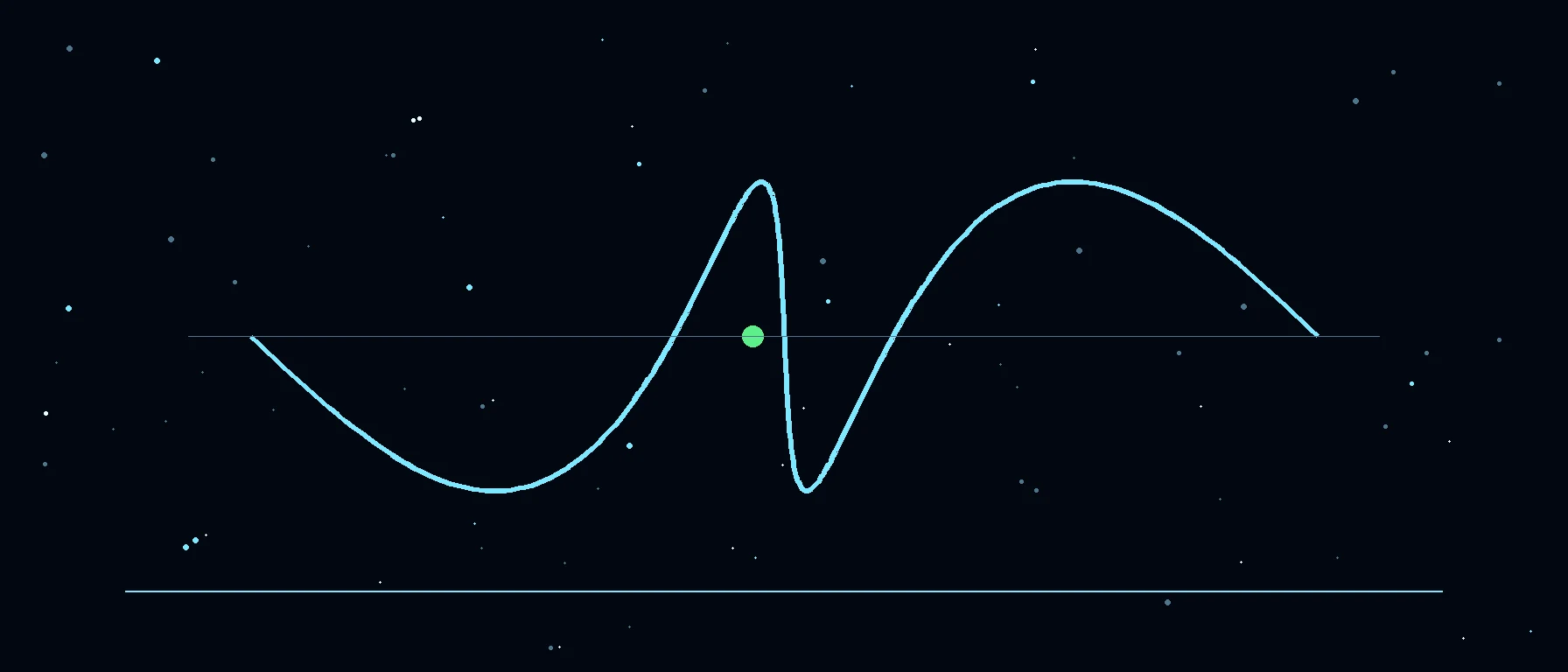
Apparent retrograde motion occurs when Earth, traveling on its faster inner orbit, overtakes another planet. As the line of sight shifts against the background stars, the planet appears to slow down, pause at a stationary point, move westward in a loop, and then resume its normal eastward drift.
Why do planets appear to move backward?
Earth completes a full orbit around the Sun in 365.26 days, whereas Mars requires 686.98 days. As Earth passes between Mars and the Sun, the relative line of sight projects Mars backward against the distant background stars. Mars appears to slow its prograde drift, pause at a stationary point, move westward for 74 to 80 days across an arc of roughly 15 degrees, stop at a second stationary point, and then resume its normal eastward motion.
Ancient geocentric models attempted to explain this geometry by constructing complex epicycles—small circles rolling along larger planetary orbits centered on Earth. The heliocentric revolution championed by Copernicus and mathematically refined by Kepler revealed that retrograde loops are line-of-sight illusions. When a faster inner world passes a slower outer world, or when an inner planet passes Earth, the shifting perspective naturally traces a backward loop across the sky.
What governs planetary retrograde cycles?
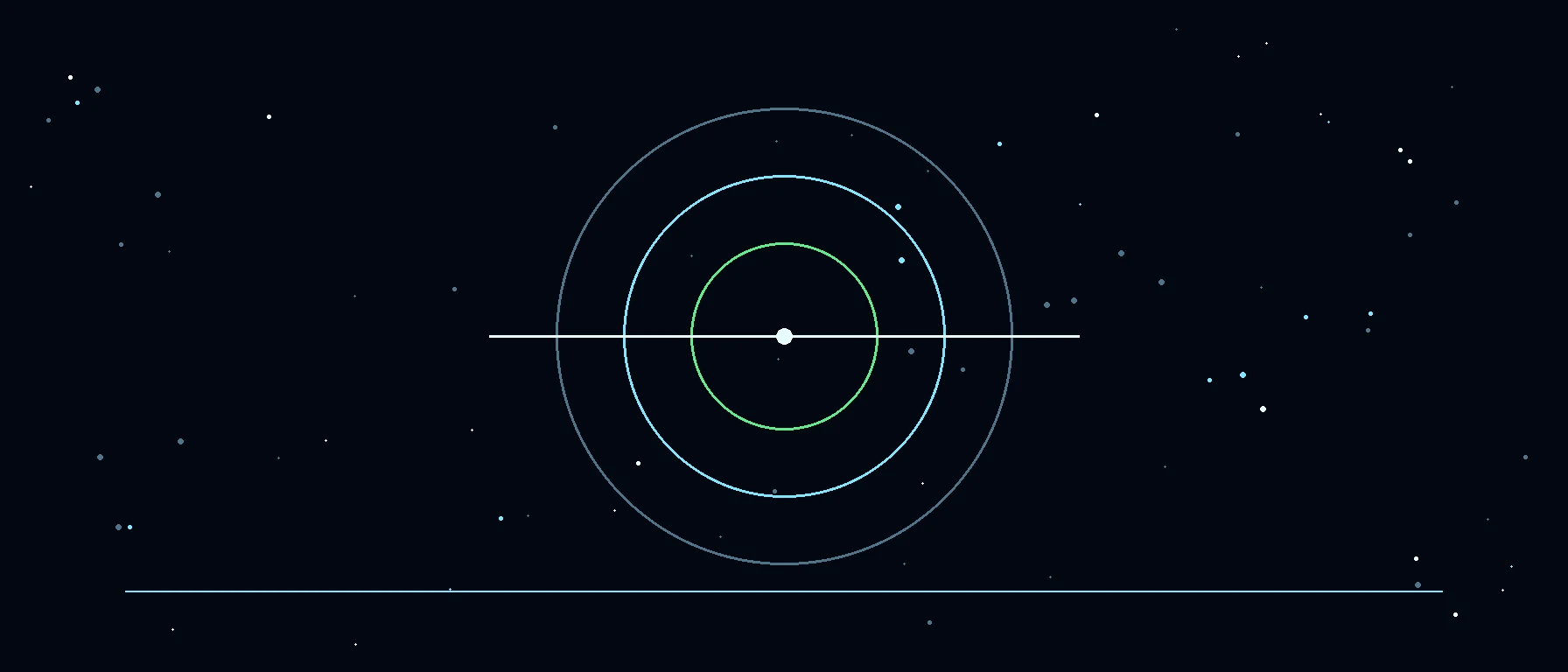
A sidereal period (P) measures a planet's true orbital period relative to distant background stars. A synodic period (S) measures the time required for a planet to return to the exact same alignment relative to the Earth and Sun (such as from one opposition to the next). They are linked by the fundamental relation 1/S = |1/E − 1/P|, where E is Earth's orbital period.
| Planet | Semi-Major Axis (AU) | Orbital Period (Sidereal) | Synodic Period | Retrograde Loop Span | Retrograde Duration |
|---|---|---|---|---|---|
| Mercury | 0.387 AU | 87.97 days | 115.88 days | 11°–15° | ~24 days |
| Venus | 0.723 AU | 224.70 days | 583.92 days | 15°–16° | ~42 days |
| Mars | 1.524 AU | 686.98 days | 779.94 days | ~15° | 74–80 days |
| Jupiter | 5.203 AU | 11.86 years | 398.88 days | ~10° | ~120 days |
| Saturn | 9.537 AU | 29.46 years | 378.09 days | ~7° | ~140 days |
| Uranus | 19.191 AU | 84.01 years | 369.66 days | ~4° | ~150 days |
| Neptune | 30.069 AU | 164.79 years | 367.49 days | ~3° | ~150 days |
Why do planetary brightness and apparent size fluctuate?
A planet's visual appearance from Earth is governed by its varying distance, phase angle, and physical ring or atmosphere structure. Venus exhibits a unique geometry known as greatest brilliancy. As Venus moves closer to Earth, its apparent disk grows from 9.7 to over 66 arcseconds while its illuminated fraction shrinks to a thin crescent. It reaches maximum brightness (magnitude -4.6 to -5.0) when it is roughly 22% illuminated, perfectly balancing disk size against illuminated area.
Mars demonstrates extreme variations due to its elliptical orbit. At a perihelic opposition (closest approach to the Sun), Mars approaches within 56 million kilometers of Earth, soaring to magnitude -2.9 with an apparent diameter of 25.1 arcseconds. At an aphelic opposition, Mars lies over 100 million kilometers away, appearing as a comparatively dim magnitude -1.2 dot spanning just 3.5 arcseconds. Saturn's brightness fluctuates with its 26.7-degree ring tilt over its 29.46-year orbit, causing the rings to appear edge-on every 13 to 15 years (most recently on March 23, 2025). As of 2026, confirmed satellite counts stand at: Saturn 285, Jupiter 115, Uranus 27, Neptune 14, Mars 2, and Earth 1.
How do lunar phases and tidal locking work?
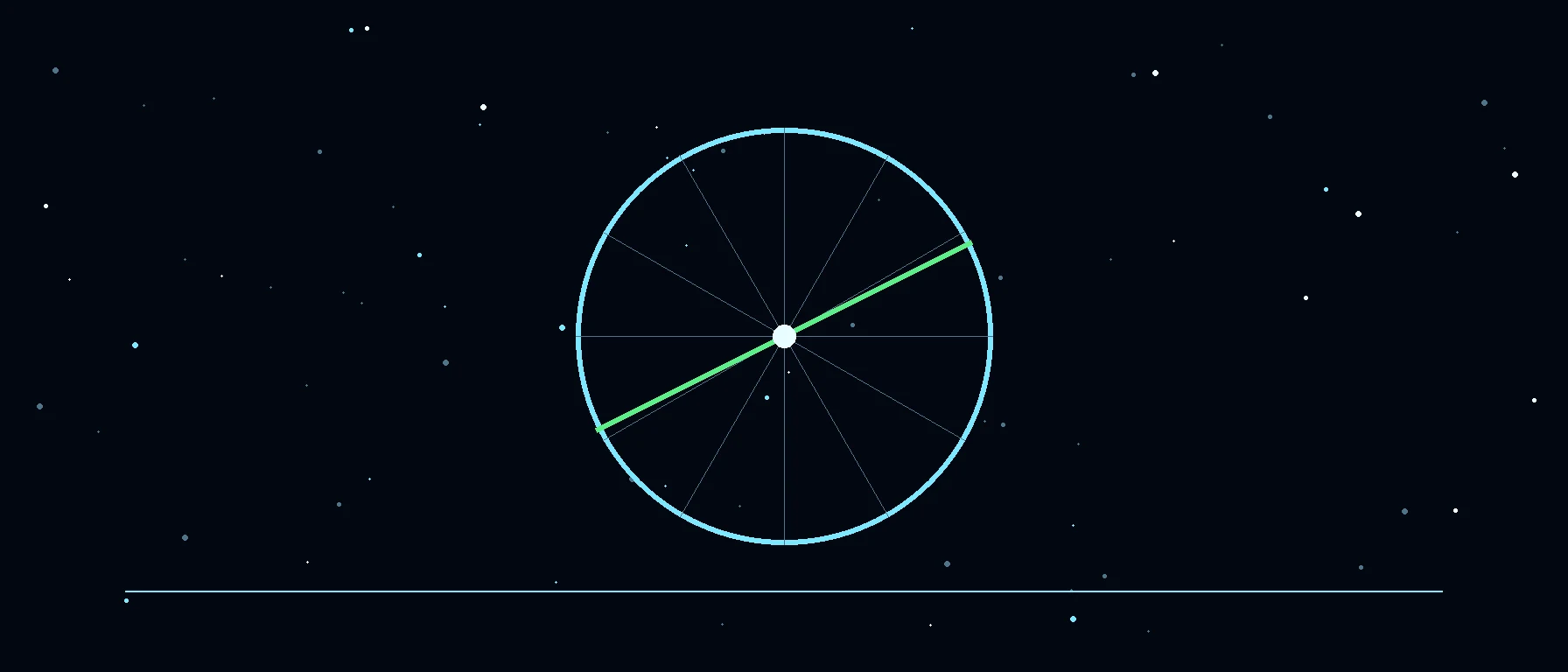
The Moon completes a 360-degree orbit relative to background stars every 27.32 days—its sidereal month. However, because Earth advances along its orbit around the Sun during that time, the Moon must travel an additional distance to realign with the Sun, creating a 29.53-day synodic month between matching lunar phases.
Gravitational tidal friction between Earth and the Moon slowed the Moon's rotation early in its history until its spin matched its orbital period, locking one hemisphere permanently toward Earth. Lunar laser ranging experiments measuring reflections off Apollo retroreflectors prove the Moon is receding from Earth at 3.8 centimeters per year. Because the Moon's orbit is elliptical, its distance varies from perigee (~363,396 km) to apogee (~405,504 km), altering its apparent size by 14%. Orbital speed variations caused by this eccentricity allow Earth observers to see slightly around the Moon's edges—a phenomenon called libration that reveals 59% of the total lunar surface over time.
What defines a planet, and how empty is space?
Planet Criteria (2006 IAU)
- 1) Orbits the Sun.
- 2) Hydrostatic equilibrium (round shape).
- 3) Cleared the neighborhood around its orbit.
- Clearing Ratio: Earth is 1.7 million times more massive than its orbital debris zone.
Dwarf Planets & Small Bodies
- Meets criteria 1 and 2, but fails criterion 3.
- Official dwarf planets: Ceres, Pluto, Haumea, Makemake, Eris.
- Pluto Ratio: Possesses only 0.07 times the mass of its Kuiper Belt neighborhood.
The Astronomical Unit (AU) was fixed in 2012 at exactly 149,597,870,700 meters. Light travel times from the Sun are: Earth (8.32 min), Mars (12.67 min), Jupiter (43.27 min), Saturn (79.32 min), and Neptune (250.08 min / ~4.17 hours). Voyager 1 crossed the heliopause on August 25, 2012, and is currently over 170 AU (~25.8 billion km) away. Explore the main guide Understanding the Night Sky.
Data sources include NASA Planetary Fact Sheet, IAU 2006 Resolution 5A, and JPL Horizons Ephemeris System.
Watch a planet against the same nearby stars over several nights and the geometry of the solar system becomes visible.
Open the live sky